Colorado bill to limit license plate reader data access passes Senate commitee

A Colorado bill that passed its first state Senate committee Monday would limit law enforcement access to data captured by automatic license plate readers.
Senate Bill 26-70 is a bipartisan policy that would require law enforcement to get a warrant in order to search a license plate reader database if more than three days have passed since the crime being investigated occurred. These readers, such as those made by the company Flock Safety, take photos of passing cars and send the date, time and location of the vehicle into a database. Law enforcement can use the information to find stolen cars and gather other relevant information for criminal investigations.
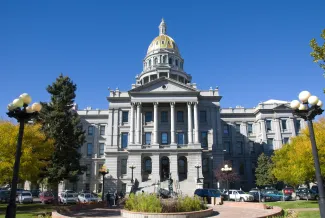
Colorado Capitol Building Denver © iStock - kuosumo
But bill sponsors and supporters argue that guardrails are necessary to protect personal privacy amid a growth of mass surveillance.
“I have constituents who are concerned about the proliferation of such technology and the impacts to their privacy,” said bill sponsor Senator Lynda Zamora Wilson, an El Paso County Republican, said during the Senate Judiciary Committee hearing Monday. “We know that 10 to 15 years ago there were hardly any license plate readers in our streets. Now there are hundreds, if not thousands across the state, with increasing surveillance platforms on the horizon.”
The bill, she said, attempts a balance between letting law enforcement use such tools in their work and protecting the privacy of ordinary citizens, whose movements can be tracked and recorded by license plate readers.
“We should not build centralized repositories of our citizens’ movements without strong guardrails and security controls. This bill provides those safeguards, ensuring the data is handled with the care it demands and that access requires judicial oversight,” she said.
Senator Judy Amabile, a Boulder Democrat, is also on the bill, as well as Representative Yara Zokaie, a Fort Collins Democrat, and Representative Kenny Nguyen, a Broomfield Democrat.
© iStock - Alex_Schmidt
Flock Safety is one of the largest automatic license plate reader companies, and it has dozens of contracts in Colorado cities — including Denver, until the city decided this week to switch to the competing company Axon. Flock has been under scrutiny for months after reports that U.S. Immigration and Customs Enforcement uses the company’s database for its mass detention and deportation campaigns.
“Agencies that are contracting for these systems — not all, but some —have been sloppy, and so information has been shared with ICE and with other states, and it is hurting people in Colorado,” Amabile said.
In addition to requiring a warrant for data searches after 72 hours, the bill would prevent most data sharing with out-of-state agencies, ban the sale of historical data, mandate audits of who accesses the data, and limit how long historical data can be retained to 30 days, unless there is an active investigation that requires it.
Supporters say the bill would also bring state law into line with the Fourth Amendment, which protects people against unreasonable government search and seizures.
“Requiring a warrant ensures that surveillance is targeted rather than generalized,” said Alasdair Whitney, legislative counsel for the Institute for Justice, a public-interest law firm. “It preserves the ability to investigate crime while preventing dragnet searches of law-abiding people.”
A federal judge, however, recently ruled that the use of Flock cameras does not violate the Fourth Amendment. The Virginia plaintiffs in that case, represented by Institute for Justice lawyers, plan to appeal the decision.
Cases solved
Opponents argued that anything in plain public view, like a license plate, is not subject to the Fourth Amendment.
The opposition Monday was nearly all from law enforcement agencies across the state. Their representatives detailed investigations they say were solved only because of access to Flock data. They said Flock allows them to use breadcrumbs of information to figure out details about a suspect and build a case.
Sgt. Dominic Marziano, a member of the Aurora Police Department’s Gun Violence Suppression Team, said the department used Flock to narrow in on the white SUV a person drove when they shot at four men at a gas station. Witnesses did not have the make, model or license plate of the car, but users can search Flock for general descriptions at a certain time and place.
“That effort, which took us longer than the four days, allowed us to build probable cause, obtain warrants, and ultimately hold the suspect accountable,” Marziano said. The bill, as introduced, had a shorter data retention period, and an amendment lengthened it to 30 days.
“We would never have had enough specificity to obtain a warrant, and the data would have been destroyed before the suspect was ever identified,” he said.
In an emailed statement, Flock spokesperson Paris Lewbel wrote that the company, which is seeking to have the bill amended, wants the legislation to “ensure law enforcement can continue using this critical technology in a responsible and transparent way to keep communities safe.”
“Flock Safety strongly supports legislation that creates guardrails for how license plate recognition data is used and shared, enhances transparency, and helps build public trust — while preserving the efficacy of this important public safety tool,” she wrote.
The bill passed on a 5-2 vote out of committee. Senator John Carson, a Highlands Ranch Republican, and Senator Dylan Roberts, a Frisco Democrat, voted against it. It now heads to the Senate Appropriations Committee.