Colorado wildlife officials say no wolf releases planned this winter

Colorado Parks and Wildlife officials said Wednesday that they have “no plans” relocate additional gray wolves into the state this winter, confirming a major setback for the agency’s voter-mandated reintroduction program following federal interference on behalf of livestock industry groups.
CPW “continues to explore options for translocations in winter 2026/2027,” it said in a press release.
The halt to wolf reintroductions after the release of just 25 individual animals — nearly half of which have already died — represents the biggest victory to date for livestock groups that have waged a five-year battle to subvert Colorado voters’ narrow approval in 2020 of Proposition 114, which mandated gray wolf reintroduction in the name of restoring ecological balance.

Colorado Parks and Wildlife
Colorado’s restoration plan, approved by CPW commissioners in 2022, called for an initial target population of 50 wolves, to be achieved by annual releases of 10 to 15 relocated wolves for the program’s first three to five years. The first release occurred in December 2023. The state was authorized by the U.S. Fish and Wildlife Service to manage an “experimental” wolf population under section 10(j) of the Endangered Species Act.
Since Proposition 114’s passage, repeated attempts by livestock groups to delay or pause the restoration plan were rejected by CPW commissioners, state lawmakers and the courts. But in September 2025, opponents — including far-right former U.S. Representative Greg Lopez, now running as an independent candidate for governor — appealed to the Trump administration to step in, asking the USFWS to issue a “cease-and-desist order halting further translocation of wolves into Colorado for a period of 12 months.”
A month later, USFWS Director Brian Nesvik moved to block Colorado’s plan to import wolves from Canada this winter, ordering CPW to halt any efforts to source wolves from outside a specified area in the northern Rockies, including Idaho, Montana, Wyoming and eastern portions of Washington and Oregon. Nesvik wrote in a letter that importing Canadian wolves was “violative” of Colorado’s 10(j) permit.
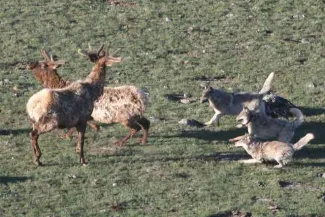
Wolves hunting elk in the Rocky Mountains. Courtesy National Park Service.
In fact, the permit, issued in 2023, identifies northern Rockies wolves only as a “preferred” donor population, and does not contain any requirement or limitation on relocation operations. Although environmental groups called the position taken by the USFWS “baseless,” and Governor Jared Polis wrote that state officials “disagree with the legal basis for that analysis,” the state has opted to comply with the Trump administration’s order, and no legal challenges have been filed against it.
The administration further escalated its threats against the state’s wolf reintroduction program last month, when Nesvik warned CPW that the USFWS could revoke the state’s 10(j) permit altogether, returning control of the population to the federal government.
Earlier this week, CPW confirmed that another gray wolf, known as wolf 2504, had died in northwest Colorado, bringing the total number of reintroduced wolves that have been killed in the state to 11. The mortality rate for Colorado’s wolvesis significantly higher than in previous reintroduction efforts in the northern Rockies.
The state’s remaining wolves have formed four breeding packs, and an unknown number of wolf pups were born in 2025. In a statement, Eric Odell, the agency’s wolf program manager, said that it was “not possible to predict the impact” of halting reintroductions this winter.
“When populations are small, the contributions of each individual is especially significant,” Odell said. “If mortality remains high, as observed in 2025, the risk of failing to achieve a self-sustaining wolf population in Colorado increases, potentially requiring additional resources to address.”