Exceptional drought holds in Colorado high country as conditions ease slightly

© KiowaCountyPress.net
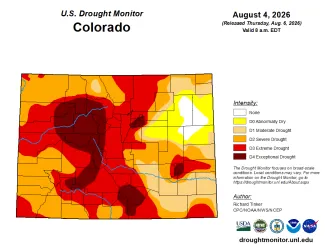
Drought conditions eased slightly across Colorado over the past week, though exceptional drought — the most severe category — continues to grip a broad swath of the state’s central and northern mountains, according to data released Thursday by the National Drought Mitigation Center. The latest U.S. Drought Monitor map, which reflects conditions as of Tuesday, August 4, shows extreme and exceptional drought combined covering 47 percent of the state, down from 51 percent the previous week.
©
Snowpack
With Colorado’s mountain snowpack long since melted out for the season, high country moisture now depends almost entirely on summer rainfall — and that rain has been slow to arrive. Precipitation was sparse from the Rockies westward over the past week, according to the U.S. Drought Monitor, with most locations recording only light amounts. Scattered areas across the Rockies picked up several tenths of an inch to slightly over an inch.
Southeast Colorado and some of the state’s higher elevations fared better, receiving moderate to heavy precipitation that helped hold conditions steady or bring modest improvement. The Southwest monsoon has delivered moderate rainfall to portions of New Mexico and Arizona, but its reach into Colorado has been limited.
The contrast with a year ago is stark. At the start of the current water year, October 1, nearly half the state — 46 percent — was free of drought or abnormal dryness, and no exceptional drought existed anywhere in Colorado. The poor snow season that followed, combined with a hot, dry summer, has left the state’s reservoirs and rivers drawing down under some of the most severe conditions on record for the region.
Drought Conditions
Exceptional drought covers 13 percent of Colorado, centered on the central mountains. Eagle County and Pitkin County are both entirely — 100 percent — in exceptional drought, according to the U.S. Drought Monitor. Summit County is close behind at 88 percent exceptional drought, with the remaining 12 percent in extreme drought.
Farther north, Grand County is 54 percent exceptional and 41 percent extreme drought, while Routt County stands at 33 percent exceptional and 13 percent extreme drought, with the remainder in severe drought.
The week brought modest improvement overall. Extreme drought contracted from 37 to 34 percent of the state, and exceptional drought edged down from 14 to 13 percent. Severe drought held steady at 31 percent. Just three percent of Colorado — a sliver of the far southeast corner — remains entirely free of drought or abnormal dryness.
Statistics
Compared with the prior week, drought-free area increased slightly from two to three percent, while abnormally dry conditions held at six percent. Moderate drought expanded from 10 to 13 percent as areas formerly in severe drought improved. Severe drought was unchanged at 31 percent. Extreme drought fell from 37 to 34 percent, and exceptional drought declined from 14 to 13 percent.
One year ago, conditions were far less dire. Some 45 percent of the state was free of drought or abnormal dryness, with 10 percent abnormally dry, 11 percent in moderate drought, 14 percent in severe drought and 20 percent in extreme drought. No exceptional drought existed in Colorado at that time.
| Week | Date | None | D0 | D1 | D2 | D3 | D4 |
|---|---|---|---|---|---|---|---|
| Current | 8/4/26 | 3 | 6 | 13 | 31 | 34 | 13 |
| Last Week to Current | 7/28/26 | 2 | 6 | 10 | 31 | 37 | 14 |
| 3 Months Ago to Current | 5/5/26 | 0 | 4 | 9 | 29 | 40 | 18 |
| Start of Calendar Year to Current | 12/30/25 | 29 | 33 | 22 | 13 | 2 | 1 |
| Start of Water Year to Current | 9/30/25 | 46 | 9 | 9 | 22 | 14 | 0 |
| One Year Ago to Current | 8/5/25 | 45 | 10 | 11 | 14 | 20 | 0 |
Just over 4,657,000 Colorado residents live in a drought-impacted area. Colorado’s 2023 population was estimated at 5,877,610.
Drought categories include (ranked from least to most severe) abnormally dry (D0), moderate (D1), severe (D2), extreme (D3), and exceptional (D4) drought.
Colorado drought conditions as of August 4, 2026. Map courtesy National Drought Mitigation Center.