Ag secretary: Decision to import ground beef highlights need to boost domestic food production

© Smederevac - iStock-1470677566
Secretary of Agriculture Brooke Rollins said Tuesday that a U.S. decision to lower certain tariffs on ground beef imports has highlighted the importance of working to bring more U.S. food production on-shore.
While at the Farm Progress Show in Iowa, Rollins announced a U.S. Department of Agriculture data modernization program and spoke about the Trump administration’s commitment to growing the nation’s beef herd and advancing biofuels.
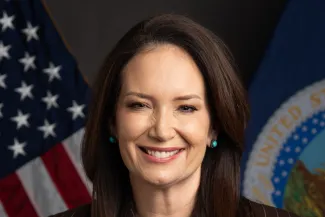
Brooke Rollins - public domain
On August 21, President Donald Trump announced he was suspending quota tariffs on ground beef for 90 days, or long enough for 300,000 metric tons of ground beef to enter the U.S. market, in an effort to lower grocery store prices.
The move was opposed by American cattle producers who have had declining herd sizes over the past several years.
While answering questions from the media after a press conference Tuesday, Rollins said she understands the president’s decision to put the “American consumer at the front of the decision matrix” felt like a “gut punch” to ranchers. But, she said, the decision opens up a discussion around the nation’s food system.
“If we don’t have beef, we don’t have freedom,” Rollins said. “If we continue to offshore our American food production, we lose the American experiment — full stop. I think we’re teetering on the edge of that in some ways with some of the offshoring that’s happening, some of the big ag consolidation that’s happening.”
Earlier in the day, in a public address at the Farm Progress Show, Rollins said the “big four” meatpackers — referring to JBS, Tyson, Cargill and National Beef which Rollins said control more than 80% of meat packing in the nation — have “not been conducive to rebuilding the herd” and supporting independent ranchers.

“With the Make America Healthy Again movement, with the announcements that I made yesterday in Nebraska, we’re putting protein, we’re putting beef, right back at the center of policymaking in Washington D.C.” Rollins said.
On Monday, the secretary was in Nebraska where she announced a suite of actions to help rebuild the nation’s beef herd. The “Ranchers First Initiative” included a tool to help ranchers keep their heifers, an expansion in grassland programs to help restore pasture, efforts to boost local processing and assistance to beginning farmers.
The initiative also called for the prioritization of American raised and processed beef in federal food procurement programs.
“All of these big federal agencies have hundreds of millions of dollars that we spend every day on food procurement,” Rollins said while speaking about the initiative Tuesday. “By just recalibrating a little bit of that, the signal to our beef producers, to our farmers, would be so tremendous that we will continue to build that out to buy locally to get more healthy, nutritious food on the plates of our kiddos, of our veterans, of our soldiers.”
Ranchers were also hit in August by the announced closures of two larger beef packing plants. Rollins said the “silver lining” to those closures is that it opens up an area of meat processing “that we can return back to regional and mid-sized processing, while ensuring we’re rebuilding the herd.”
Rollins said she had a verbal conversation with leadership at Tyson, one of the companies that recently announced a plant closure, to “make sure” the company’s closed plant would only be sold to a American company.
The ag secretary said she will be making another announcement related to meat processing later this week with the president. She said that announcement will touch on “labeling” and “cross-state sales.”
Small refinery exemptions
The U.S. Environmental Protection Agency announced Monday it would grant exemptions to renewable fuel mixing requirements for certain small refineries.
Farm and biofuel leaders were disgruntled by the decision, arguing it hurts farmers and the biofuels industry by allowing these facilities to skimp on the requirements to mix fuel with bio-made fuels.
Rollins defended the action Tuesday by noting EPA also proposed to reallocate 100% of the awarded exemptions into the 2026 and 2027 renewable volume obligations. Rollins said Trump has been the “most pro-biofuels president in American history.”
Earlier in the day, she highlighted the administration’s work in issuing “historic” renewable fuel standards and finalizing a rule around regeneratively grown biofuel feedstocks.
Rollins was in Iowa in August to attend the Iowa State Fair and said Tuesday she will be “back in Iowa very soon.”