Commentary - As data center debate heats up this Kansas town, answers — and trust — become harder to find

One thousand seven hundred and forty dollars.
That’s the amount Jay Vehige paid the city of Emporia for an open records request in early July.
Like many Emporia residents, Vehige wanted answers about how long the city had known about a proposed hyperscale data center before the project was announced June 2. The city voted the next day to annex 1,000 acres of predominantly rural land just west of town for the project, setting off a political chain reaction that is still rending this community of 25,000 on the edge of the Flint Hills in east-central Kansas.
Nearly two months later, Vehige is still waiting for his answers.
“I wanted to see the story behind this,” Vehige told me.
Join the club, friend.
© PeterHermesFurian - iStock-1352430281
He had requested, under the Kansas Open Records Act, any city communications that mentioned the proposed data center or the entity behind it, Kanza Park Place LLC.
City attorney Christina Montgomery estimated the cost of the search at $1,740, Vehige said, which city policy required to be paid in advance. She also expected the search to be completed within eight weeks, with documents released in “reasonable installments” as they became available. Under Kansas law, entities may charge actual costs for searches and should deliver the records within three days. If they can’t, they must provide a written explanation as to why. Vehige paid the amount from contributions to Emporia Neighbors United, a group formed to fight the data center. Last week, the city said it needed more time to fulfill the request.
“Due to the staff availability, scope of your request, and unanticipated work load,” city clerk Kerry Sull wrote in a message that Vehige summarized on social media, “additional time is needed to continue to process your request.”
The city anticipated providing a “follow-up response” on or before September 25.
That’s not even the date Vehige can expect the records, only when he could expect the next “response.”
The city’s slow-walking of open records requests is a symptom of a municipal government that has become distrustful of its citizens. No doubt city staff is experiencing an “unanticipated work load” because of the data center controversy, but delaying requests also shields information for as long as possible. It tracks with the city’s temporary move to virtual meetings, citing unspecified “threats,” and consideration of eliminating or severely reducing time for public comment at regular commission meetings.

© iStock - arcoss
Since the data center was announced, Emporia has become the city of secrets. Vehige, a 36-year-old activist and lifelong Emporia resident, would like to shed light on just what is being hidden.
Vehige has been at the center of just about every protest here — and elsewhere — in the last few years, including No Kings events. He attended Emporia State University, where he majored in political science, and he joined the Dakota Access Pipeline protests at Standing Rock in 2017.
Vehige has filed open records requests with the city before, including once when he wanted to know what kind of weed control was being used on public playgrounds because he was concerned for the safety of his children. He always found the city clerk helpful, he said, and was never charged for a request.
That tone has changed as the city has faced data center backlash.
When the data center project was announced, Vehige used his organizing skills to focus community resistance to the project. He found a grassroots coalition of pi**ed-off people ready to buy a sign, make a donation or sign a petition.
Emporia’s distaste for data centers is in keeping with national trends. A March 2026 Gallup poll found 71% of Americans were opposed to data centers in their communities. The fight over new projects has emerged as the “epicenter” of the midterm elections and is reshaping the political landscape, according to recent reporting from the New York Times.
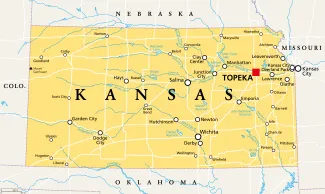
In Kansas, data center projects have roiled communities from Gardner, in the northeastern corner of the state, to Dodge City in the west. In Gardner, Beale Infrastructure withdrew its application this May after a fierce backlash from residents. A 1,280-acre site in Dodge City is being considered by Google for a data center there, although no deal has yet been struck.
Making a comprehensive list of towns being eyed for data centers is difficult because during this artificial intelligence gold rush, projects are popping up faster than you name them. A partial roster includes De Soto, Edgerton, El Dorado, Garden City, Leavenworth, Osawatomie, Ottawa, Topeka, Tonganoxie and Wyandotte County, as well as Emporia. What developers see in these and other rural towns are infrastructure, including power and water, and job-starved communities that until recently were presumably receptive to large-scale projects. In addition, last year the state passed a 20-year sales tax exemption on construction and materials for data centers.
At Emporia, as in other cities across the country, secrecy surrounding the project has bred mistrust.
At public hearings on zoning issues and at city commission meetings where the project has steadily crept forward, residents turned out in the hundreds to protest. Dozens have offered public comments questioning the speed of the project, the environmental impact and whether a data center is the right fit for the community.
During a public comment session at a July 22 Emporia City Commission meeting, high school physics teacher Lux Claridge was arrested for clapping in support of data center opponents. Claridge, who had been warned not to clap, was hauled out of the meeting and booked into the county jail. They were charged with disorderly conduct and interfering with law enforcement.
On August 3, the city announced that the next two city commission meetings would be held virtually, “in the interest of public safety.” Although the public could watch the live stream of the meetings, no public comment period would be held. Credible threats had been made against city officials and staff, according to city manager Trey Cocking.
Curious about the nature of these threats, I filed an open records request on August 11 with the city for evidence of the threats. My request was denied the next day by the city clerk.
“Communications received from private individuals that are responsive to your request will be withheld pursuant to KSA 45-221(a)(14), which permits a public agency to withhold correspondence between the agency and a private individual,” Sull wrote me in an email.
Sensing that the city might be stretching the exemption, I asked First Amendment attorney Max Kautsch for his opinion. Kautsch practices in Lawrence and for years has been the legal hotline attorney for the Kansas Press Association.
“You’re right to question this,” Kautsch replied in an email. “At the very least, (the exemption) was not intended to shield threats. The legislative history shows the exception was to incentivize constituents to communicate freely with officials by shielding such communications from the public. The rationale would seemingly be inapplicable to communications from anonymous bad actors.”
Refusing to disclose, Kautsch wrote, did not engender public trust.
If evidence of any threats was off-limits and nothing rose to the level of having a police report taken, then why move the commission meetings to remote? I asked Cocking, the city manager, to explain.
“The absence of a formal incident report does not mean the city received no threatening or concerning communications,” Cocking replied in an August 19 email. “Beginning July 28 and continuing to the present, elected officials and city staff have received a large volume of profane, hostile, and threatening communications, including letters, emails, phone messages, and social media messages. Many have contained violent language or imagery, and others have made disturbing references to elected officials’ families. Many have been anonymous.”
The volume and nature of these messages when considered together raised concerns about the safety of city officials, staff and the public at meetings, according to Cocking. The move to virtual meetings was temporary, he wrote.
The city established an email address for comments, although those messages would not be read aloud at meetings, otherwise publicly shared, or disclosed through an open records request because of the exemption previously cited. For most of August, the city stifled public dissent by moving it out of the public eye.
At the remote meeting held August 19, commissioners mulled changes that would eliminate or severely reduce the amount of time the public would have to address them when in-person meetings resume in September. State law doesn’t require a public comment session during regular meetings, and the commissioners appeared to favor a plan that would reduce comment sessions to no more than 30 minutes, with each speaker given two minutes on a first-come, first-served basis.
But even then, warned Mayor Becky Smith, the public was on notice.
“I think I’m willing to give everybody another shot to be civil and to act like grown-ups,” Smith said, “and to learn how to use their grown-up words. So I’m willing to give the public another shot at public comment, but that would be two strikes if everybody can’t behave.”
I have a couple of grown-up words for Mayor Smith.
They are free speech.
Rather than chiding the public, the mayor should explore ways in which officials can engage with residents instead of treating them like children. What Claridge did may have broken the commission’s “decorum,” but it didn’t hurt anybody, and the city’s reaction should have never reached the level of criminal charges. Nothing was less decorous or disruptive than their arrest. Reducing the amount of time for public comment as a response — and it’s clear that this is Smith’s thinking because of the “two strikes” warning — is just retaliatory.
No rational person expects public officials to endure death threats. Such actions should be rightly and soundly condemned. But in the case of Emporia officials, it’s difficult for the public to condemn something that remains hidden. Frankly, it sounds like the kitchen got too warm for the commission.
And it’s likely to get much hotter.
Although the city attempted to block Emporia Neighbors United’s petition to put a data center question before voters by suing Vehige and seeking a declaratory judgment, a district court judge ruled August 20 that it would indeed appear on the November ballot. Whether the result has any legal weight depends on another question the court has yet to decide: Does the petition seek a legislative or administrative action? If the latter, the ballot question becomes just an opinion poll instead of law.
Either way, this will likely to be an uncomfortable fall in Emporia.
On August 26, the city held an eight-minute special meeting, in person but without public comment. The commission voted to put the data center ban on the ballot as well as another question, also driven by petition, that would prohibit large battery storage systems. It also voted unanimously to seek outside legal counsel with expertise in data centers and municipal government.
In an unrelated action, city Commissioner Erren Harter filed a lawsuit August 25 against Vehige and two Lyon County officials to stop a recall petition against him from going forward. The recall petition accuses Harter of misconduct in office, a claim he denies. The suit alleges county officials shouldn’t have certified the petition because the claims are untrue. Also named as defendants are Vehige’s partner, Haley Radford, and Kathleen Lamb, both of whom helped circulate the petition.
On August 24, the city dropped its case against Claridge.
The charges were dismissed in municipal court, Claridge told me, because of an unspecified “conflict.” The case was referred to the county attorney, who has the option of pursuing charges, but that seems unlikely. The municipal charges should have never been filed in the first place.
This is what happens when the public is seen as the enemy.
The narrowing of the curtains on municipal government is a disturbing symptom of a larger ailment. We are experiencing a kind of civic amnesia, in which we’ve forgotten what good local government looks like. We don’t recognize the sounds of a leader when we hear one or the cries of a public in distress. We don’t pay attention to local government until the bulldozers appear in the backyard and somebody in a hard hat shouts that our home is standing in the way of progress.
“We’ve really slipped into an authoritarian government type of situation,” Vehige said. “The city commission is debating on how to get rid of public comments. Our voices don’t matter to the people that have been elected to represent us.”
After our interview, Vehige was off to Dodge City and Garden City to help organize data center resistors there. Long after, I kept wondering why anybody would want to put a data center, a notorious guzzler of water, in a drought-prone area where the underlying aquifer has been all but exhausted. Even midsized data centers use as much water as a small town, according to the Lincoln Institute of Land Policy.
The answer, as always, is money.
But there’s one community resource that secretive data center projects are damaging hardest of all.
It’s public trust.
In her new book, “The Rise and Fall of the Artificial State,” historian Jill Lepore ponders how technology has changed American democracy. She compares Hannah Arendt’s prescient warnings about fascism to current fears about the emergence of a tech oligarchy that drives government.
Between 1958 and 2024, she writes, the percentage of Americans who trusted the federal government fell from more than 70% to about 20%. The reasons had to do with more than technology, but increasingly the driver is a kind of tech authoritarianism that culls the human from humanity.
“The rise of the Artificial State is inseparable from the fall of the natural world,” Lepore writes. “The Artificial State is the factory farming of humans, the sorting and segmenting, the isolation and alienation, as if humans were becoming to machines what animals had become to humans.”
The race to turn swaths of rural Kansas into a silicon prairie is consistent with Lepore’s chilling warning of what tech billionaires want for our future. It won’t be Richard Brautigan’s 1967 poem of a mystical and benevolent cybernetic meadow, but a Philip K. Dick dystopian nightmare. City governments shouldn’t aid that effort by burying the truth with exorbitant fees, sketchy denials and endless delays for open records requests.
The city should trust the public with the truth.
God knows Vehige and the public have paid for it.
Max McCoy is an award-winning author and journalist. Through its opinion section, the Kansas Reflector works to amplify the voices of people who are affected by public policies or excluded from public debate. Find information, including how to submit your own commentary, here.