Drought eases across Colorado after rain and mountain snow

© KiowaCountyPress.net
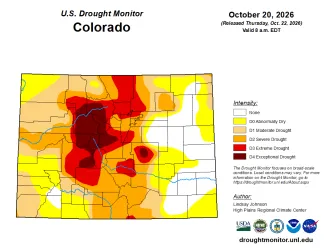
Drought retreated across much of Colorado this week as recent rain and mountain snow eased short-term moisture deficits, though extreme and exceptional drought remain entrenched in the central and northern mountains, according to the National Drought Mitigation Center. The U.S. Drought Monitor map, released Thursday, October 22, shows conditions as of 8 a.m. EDT (6 a.m. MDT) Tuesday, October 20. About 61 percent of Colorado is in drought (D1 to D4), down from about 71 percent a week earlier.
Snowpack
The U.S. Drought Monitor’s weekly summary said recent rain and mountain snow helped ease short-term moisture deficits in the Colorado Rockies, where some areas saw one-category improvements this week. Even so, the season’s snowpack is only beginning to build, and early-season readings are small and unreliable, so it is too soon to say how the winter is shaping up.
Daily SNOTEL reports from the Natural Resources Conservation Service show how much moisture the mountains have collected since the water year began October 1. In Routt County, the Elkhead Divide station has recorded 2.8 inches of precipitation, Dry Lake 2.5 inches and Elk River 2.2 inches. In Pitkin County, Castle Peak shows 2.8 inches. Totals are lower farther east along the Continental Divide in Grand County, where Berthoud Summit has recorded 0.9 inches and Lake Irene 0.6 inches. Those figures are start-of-day values that NRCS has not yet reviewed.
A year ago, at the same point, the U.S. Drought Monitor showed only about 29 percent of Colorado in drought, and about 53 percent of the state was free of any dryness.
Drought Conditions
The worst conditions are in the mountains, according to the U.S. Drought Monitor. Statewide, about 6 percent of Colorado is in exceptional drought (D4) and 12 percent in extreme drought (D3), down from 8 percent and 18 percent last week. In Eagle County, 91 percent of the county is in exceptional drought and 9 percent in extreme drought. In Summit County, 88 percent is in exceptional drought and 12 percent in extreme drought.
©
Farther along the Divide, Pitkin County is 65 percent exceptional and 16 percent extreme drought, with the remaining 19 percent in severe drought. In Grand County, 48 percent is in exceptional drought, 40 percent in extreme drought and 12 percent in severe drought. Routt County is 13 percent exceptional, 25 percent extreme, 21 percent severe and 41 percent moderate drought. Jackson County and Moffat County have no extreme or exceptional drought. Jackson is 57 percent moderate and 32 percent severe drought, while Moffat is 41 percent moderate drought and 6 percent severe drought, with the other 52 percent abnormally dry.
The picture is much better on the southeastern plains. The Drought Monitor summary noted that portions of eastern Colorado received more than 200 percent of normal precipitation this week. Kiowa County has no drought, with 65 percent free of any dryness and 35 percent abnormally dry (D0). Cheyenne County is 95 percent free of any dryness and 5 percent abnormally dry, Prowers County is 90 percent and 10 percent, and Bent County is entirely free of any dryness. Baca County has no drought, but 81 percent of the county is abnormally dry.
Statistics
Compared with last week, the share of Colorado free of any dryness rose from 16 percent to 17 percent, while abnormally dry (D0) conditions grew from 14 percent to 22 percent as some drought areas improved. Moderate drought (D1) increased from 17 percent to 20 percent. Severe drought (D2) fell from 28 percent to 23 percent, extreme drought (D3) from 18 percent to 12 percent and exceptional drought (D4) from 8 percent to 6 percent.
One year ago, 53 percent of Colorado was free of any dryness, 18 percent was abnormally dry, 16 percent was in moderate drought, 12 percent in severe drought and 1 percent in extreme drought. None of the state was in exceptional drought. At the start of the water year, the map showed 25 percent of the state in extreme drought and 10 percent in exceptional drought.
| Week | Date | None | D0 | D1 | D2 | D3 | D4 |
|---|---|---|---|---|---|---|---|
| Current | 10/20/26 | 17 | 22 | 20 | 23 | 12 | 6 |
| Last Week to Current | 10/13/26 | 16 | 14 | 17 | 28 | 18 | 8 |
| 3 Months Ago to Current | 7/21/26 | 3 | 7 | 9 | 32 | 37 | 12 |
| Start of Calendar Year to Current | 12/30/25 | 29 | 33 | 22 | 13 | 2 | 1 |
| Start of Water Year to Current | 9/29/26 | 9 | 9 | 24 | 23 | 25 | 10 |
| One Year Ago to Current | 10/21/25 | 53 | 18 | 16 | 12 | 1 | 0 |
About 81 percent of Coloradans live in areas in drought, according to the U.S. Drought Monitor.
The U.S. Drought Monitor ranks conditions from least to most severe: abnormally dry (D0), which is not yet drought, then moderate (D1), severe (D2), extreme (D3), and exceptional (D4) drought.