Extreme and exceptional drought grips western Colorado as eastern plains hold steady

© KiowaCountyPress.net
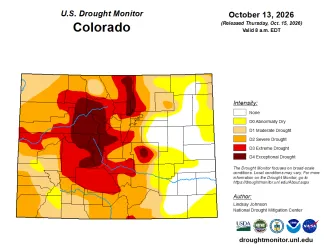
About 26 percent of Colorado is in extreme (D3) or exceptional (D4) drought, according to the U.S. Drought Monitor map released Thursday, Oct. 15, by the National Drought Mitigation Center. The map is based on data valid Tuesday, Oct. 13. The state’s overall footprint was unchanged from a week earlier, but the portion of Colorado in extreme drought fell from about 24 percent to 18 percent as a storm brought relief to parts of the Rockies.
©
Snowpack
The new snow season is only beginning, so there is little to measure yet. The U.S. Drought Monitor said a strong storm that combined with moisture from the remnants of Hurricane Rachel brought rain and mountain snow to parts of the Rockies Oct. 10–12, though the northern Rockies in Montana saw the heaviest snowfall. The Drought Monitor’s weekly summary said localized precipitation fell across portions of Wyoming and Colorado, but amounts were generally insufficient to produce widespread relief.
The backdrop is a poor snow year. Last winter, the Natural Resources Conservation Service reported record low snowpack across much of Colorado heading into 2026, and the effects are still showing up in the high-country drought numbers below. Drought Monitor forecasters said significant drought persists across the western High Plains, particularly in Wyoming and Colorado, where long-term precipitation deficits and soil moisture shortages continue to limit recovery.
A year ago, only about 1 percent of Colorado was in extreme or exceptional drought, and none was in exceptional drought, according to the Drought Monitor. Today about 26 percent is in one of those two categories.
Drought Conditions
The most severe conditions are concentrated in the northern and central mountains. According to the U.S. Drought Monitor, nearly all of Eagle County (100 percent) is in exceptional drought, as is 88 percent of Summit County, with the remainder in extreme drought. In Pitkin County, 80 percent is in exceptional drought and 20 percent in extreme drought.
In Grand County, 54 percent is in exceptional drought and 42 percent in extreme drought. Routt County is 26 percent exceptional and 33 percent extreme, according to the Drought Monitor. Smaller areas of extreme drought remain in Jackson County (11 percent) and Moffat County (6 percent); neither has exceptional drought.
Nationally, the Drought Monitor said drought conditions remained largely unchanged across the High Plains, with temperatures running 8 to 16 degrees above normal. Most of the Dakotas, Nebraska and Kansas received less than 25 percent of normal precipitation, and conditions across the eastern plains of Colorado remained unchanged. Localized improvements were noted in the Rocky Mountains of Colorado and Wyoming.
Statistics
Compared to last week, the share of Colorado free of both drought and dryness held at 16 percent. Moderate drought (D1) rose from 16 to 17 percent, severe drought (D2) increased from 22 to 28 percent, extreme drought (D3) fell from 24 to 18 percent, and exceptional drought (D4) held at 8 percent. Abnormally dry (D0) conditions moved from 13 to 14 percent.
One year ago, 49 percent of Colorado was free of drought and dryness. Abnormally dry conditions covered 15 percent, moderate drought 19 percent, severe drought 16 percent and extreme drought 1 percent. No part of the state was in exceptional drought.
| Week | Date | None | D0 | D1 | D2 | D3 | D4 |
|---|---|---|---|---|---|---|---|
| Current | 10/13/26 | 16% | 14% | 17% | 28% | 18% | 8% |
| Last Week to Current | 10/6/26 | 16% | 13% | 16% | 22% | 24% | 8% |
| 3 Months Ago to Current | 7/14/26 | 3% | 7% | 10% | 34% | 34% | 12% |
| Start of Calendar Year to Current | 12/30/25 | 29% | 33% | 22% | 13% | 2% | 1% |
| Start of Water Year to Current | 9/29/26 | 9% | 9% | 24% | 23% | 25% | 10% |
| One Year Ago to Current | 10/14/25 | 49% | 15% | 19% | 16% | 1% | 0% |
Just over 4,188,000 Colorado residents live in a drought-impacted area. Colorado’s 2023 population was estimated at 5,877,610.
Drought categories include (ranked from least to most severe) abnormally dry (D0), moderate (D1), severe (D2), extreme (D3), and exceptional (D4) drought.