EarthTalk – Can plants tune to pollinator sounds?

©
Dear EarthTalk:
Can plants actually “hear” pollinators nearby and open up accordingly and can we harness this knowledge to help pollinators and plants thrive?
Peter B., Bloomfield, CT
As pollinator populations face steep global declines due to habitat loss, pesticides and climate change, scientists are exploring surprising ways plants may be helping themselves, as well as their insect partners, thrive. Recent research suggests that some plants may actually be able to detect the sounds of nearby pollinators and respond by boosting nectar production. This discovery opens up new possibilities for agriculture, conservation, and our understanding of how plants interact with the world.
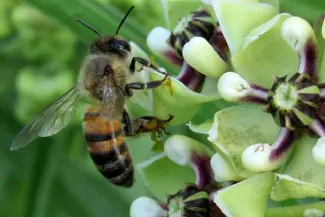
Although plants don’t have ears, they can sense vibrations in their environment, including sound waves in the air. In a 2024 study, researchers found that the evening primrose (Oenothera drummondii) increased the sugar concentration of its nectar within just three minutes of being exposed to sound frequencies mimicking bee wingbeats. Interestingly, when the flower petals were removed, the response disappeared, suggesting that petals themselves act as acoustic sensors. This form of “hearing” allows plants to dynamically adjust their offerings based on the likelihood of being visited, effectively making their nectar more appealing to pollinators. As National Geographic reported, it’s a fast and targeted response to a specific ecological cue, and it’s now considered one of the most direct examples of plant bioacoustics.
More recent studies suggest that plants can detect and respond to pollinator sounds in surprisingly specific ways. Francesca Barbero, a professor of zoology at the University of Turin, explains that “plants could improve their reproductive success if their responses drive modifications in pollinator behavior.”
Additional studies have shown that even some non-flowering plants may respond to mechanical vibrations in their surroundings. A 2025 report highlighted new evidence that even some non-flowering species respond to mechanical vibrations in their environment. One 2024 working paper proposed using pollinator sound simulations in greenhouses to trigger nectar production in crops like berries and tomatoes. This offers a potential tool for improving yields without chemicals.
If developed further, such applications could help support pollinators, reduce pesticide use, and optimize crop health naturally. Researchers are thinking about “sound gardens” where speakers mimic pollinator wingbeats to stimulate plants into a more receptive state. Scientists caution that we don’t yet fully understand the mechanisms behind these responses or how consistent they are in real-world environments. Others warn against overstating things, as these are unconscious biochemical responses.
CONTACTS
- Can Plants Detect the Sounds of Their Pollinators?, bioengineer.org/can-plants-detect-the-sounds-of-their-pollinators-asa188.
- Sonic Roots: The Hidden Power of Sound in Plant Growth, www.ssrn.com/abstract=5056305.
- Flowers respond to pollinator sound within minutes by increasing nectar sugar concentration, pmc.ncbi.nlm.nih.gov/articles/PMC6852653.
EarthTalk® is produced by Roddy Scheer & Doug Moss for the 501(c)3 nonprofit EarthTalk. See more at https://emagazine.com. To donate, visit https://earthtalk.org. Send questions to: question@earthtalk.org.