Exceptional drought grips Colorado's central mountains and Western Slope

© KiowaCountyPress.net
Chris Sorensen / (Kiowa County Press)
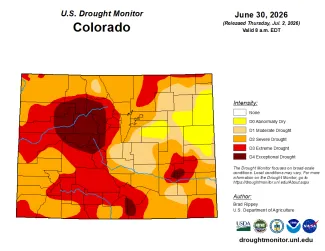
Exceptional drought — the most severe category tracked by the U.S. Drought Monitor — now blankets much of Colorado's central mountains and Western Slope, according to data released Thursday by the National Drought Mitigation Center. The weekly map, reflecting conditions through Tuesday, June 30, shows extreme (D3) and exceptional (D4) drought covering roughly 39 percent of the state, up from about 38 percent a week earlier, even as scattered showers eased milder dryness in parts of the eastern plains.
©
Colorado drought conditions as of June 30, 2026. Source: National Drought Mitigation Center.
Snowpack
Colorado's mountain snowpack has melted out for the season, as is typical for early July, ending the spring runoff that normally recharges reservoirs and high-country soils. With no snow left to feed streams, attention has turned to soil moisture and the summer monsoon, both of which remain well behind where water managers would like to see them.
The U.S. Department of Agriculture reported that 89 percent of Colorado's topsoil moisture was rated very short to short as of June 28, and 63 percent of the state's rangeland and pastures were rated very poor to poor, according to figures cited in the U.S. Drought Monitor's weekly summary. Among Western states, only Arizona, at 70 percent, reported worse rangeland conditions.
Conditions are markedly worse than a year ago. On July 1, 2025, just 8 percent of Colorado sat in extreme drought and none of the state had reached the exceptional category. Today, extreme or exceptional drought covers nearly 40 percent of Colorado — a measure of how quickly the past several months have dried out the high country.
Drought Conditions
The heart of the exceptional drought lies in the central Rockies and along the Western Slope. Eagle, Pitkin and Lake counties are now entirely in exceptional drought (D4), while Summit County is 88 percent covered and Grand County 54 percent, according to the U.S. Drought Monitor.
Farther west, Garfield County is split almost evenly between extreme and exceptional drought, at 49 percent and 48 percent respectively, and Rio Blanco County carries 51 percent extreme and 23 percent exceptional drought. Gunnison County is 65 percent extreme and 15 percent exceptional, Chaffee County 76 percent extreme and 23 percent exceptional, and Routt County, in the state's northwest, holds 33 percent exceptional drought.
Several southwestern and south-central counties are locked in extreme drought without yet reaching the exceptional category. Saguache and San Juan counties are entirely in extreme drought (D3), and Mineral, Hinsdale and Mesa counties are each more than 85 percent covered by extreme conditions, according to the U.S. Drought Monitor. Scattered rain over the past week trimmed the state's footprint of severe drought (D2) even as extreme drought expanded slightly.
Statistics
Statewide, exceptional drought (D4) held steady at about 9 percent of Colorado over the past week, while extreme drought (D3) edged up to 30 percent from 29 percent, according to the U.S. Drought Monitor. Severe drought (D2) eased to 40 percent from 47 percent, and abnormally dry conditions (D0) expanded to 7 percent from 3 percent as pockets of rain nudged some areas into lower categories. No part of the state is free of at least abnormal dryness.
A year ago, on July 1, 2025, Colorado looked far healthier: 42 percent of the state was free of drought entirely, severe drought covered 15 percent, extreme drought 8 percent, and no exceptional drought was present. In the twelve months since, drought has spread across the entire state and intensified sharply in the mountains and on the Western Slope.
| Week | Date | None | D0 | D1 | D2 | D3 | D4 |
|---|---|---|---|---|---|---|---|
| Current | 2026-06-30 | 0 | 7 | 13 | 40 | 30 | 9 |
| Last Week | 2026-06-23 | 0 | 3 | 12 | 47 | 29 | 9 |
| 3 Months Ago | 2026-03-31 | 0 | 11 | 24 | 16 | 27 | 22 |
| Start of Calendar Year | 2025-12-30 | 29 | 33 | 22 | 13 | 2 | 1 |
| Start of Water Year | 2025-09-30 | 46 | 9 | 9 | 22 | 14 | 0 |
| One Year Ago | 2025-07-01 | 42 | 13 | 21 | 15 | 8 | 0 |
Just over 4,755,000 Colorado residents live in a drought-impacted area. Colorado's 2023 population was estimated at 5,877,610.
Drought categories include (ranked from least to most severe) abnormally dry (D0), moderate (D1), severe (D2), extreme (D3), and exceptional (D4) drought.