Extreme drought expands across southeast Colorado as exceptional drought grips mountain headwaters

© KiowaCountyPress.net
Chris Sorensen
(Kiowa County Press)
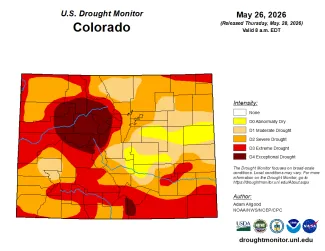
Extreme drought expanded across roughly a third of southeast Colorado and exceptional drought continued to grip the central mountains in the U.S. Drought Monitor report released Thursday by the National Drought Mitigation Center. The new map, based on data valid Tuesday, May 26, 2026, shows the entire state in at least abnormally dry conditions for a second straight week, with the worst categories deepening in the Arkansas Valley and the headwaters of the Colorado River.
©
Snowpack
Mountain snowpack across Colorado has effectively run out for the season. The U.S. Drought Monitor narrative noted that "the effects of the meager winter snow cover are beginning to be felt in falling streamflow values" across the West, and Colorado is feeling it as much as any state. Headwaters counties from Routt and Grand down through Summit, Eagle, Lake and Pitkin are sitting at the worst category on the map — exceptional drought (D4) — a designation typically reserved for once-in-50-year conditions.
A year ago, none of those counties carried a D4 designation on the U.S. Drought Monitor, and statewide exceptional drought stood at zero percent. As of this week, 10 percent of Colorado is in exceptional drought and another 31 percent is in extreme drought (D3). The early-season runoff and below-normal seasonal totals flagged by federal forecasters are now showing up in reservoir storage and streamflow numbers across the upper Colorado, Yampa and Arkansas basins.
Drought conditions
The most severe drought in the state is centered on two areas this week, according to the U.S. Drought Monitor. In the mountains, Eagle, Summit and Pitkin all show 100 percent of their area in exceptional drought (D4), and Lake is at 96 percent D4. Grand is split between exceptional (66 percent) and extreme drought (29 percent), and Routt is 33 percent D4 and another 42 percent D3.
On the eastern plains, the High Plains narrative noted that "drier conditions across southeastern Colorado and Kansas, coupled with hot temperatures, resulted in degradation." Baca is now nearly entirely in extreme drought (100 percent D3), and extreme drought also expanded in Prowers (40 percent D3), Otero (38 percent D3), Kiowa (31 percent D3) and Crowley (22 percent D3). Las Animas now shows the only pocket of exceptional drought outside the mountains, with 5 percent of the county in D4 and another 83 percent in D3.
Kiowa is one of the sharpest one-week changes on the map: extreme drought rose from zero to 31 percent of the county in a single week, while severe drought (D2) eased from 72 percent to 58 percent as the worst conditions hardened. Modest improvements were recorded across far northern and northeastern Colorado, where convective storms dropped up to two inches of rain.
Statistics
Compared to last week, severe and extreme drought tightened their grip on Colorado while abnormally dry (D0) and moderate drought (D1) eased only slightly. The new categorical breakdown is 6 percent in D0, 16 percent in D1, 37 percent in D2, 31 percent in D3 and 10 percent in D4, with no part of the state drought-free, according to the U.S. Drought Monitor. A week ago, D3 covered 33 percent and D2 covered 36 percent; the categories are essentially trading area as severe pushes into extreme.
A year ago, the picture was markedly different. The May 27, 2025 map showed 34 percent of Colorado free of any drought designation, with 17 percent in D0, 24 percent in D1, 19 percent in D2 and just 6 percent in D3. There was no exceptional drought anywhere in the state at this point in 2025. Conditions have deteriorated steadily through the cool season — the start-of-water-year benchmark (Sept. 30, 2025) showed 46 percent drought-free — and the past three months alone added 30 points of additional D3 coverage statewide.
| Week | Date | None | D0 | D1 | D2 | D3 | D4 |
|---|---|---|---|---|---|---|---|
| Current | 5/26/26 | 0 | 6 | 16 | 37 | 31 | 10 |
| Last Week to Current | 5/19/26 | 0 | 4 | 17 | 36 | 33 | 10 |
| 3 Months Ago to Current | 2/24/26 | 25 | 19 | 22 | 25 | 8 | 1 |
| Start of Calendar Year to Current | 12/30/25 | 29 | 33 | 22 | 13 | 2 | 1 |
| Start of Water Year to Current | 9/30/25 | 46 | 9 | 9 | 22 | 14 | 0 |
| One Year Ago to Current | 5/27/25 | 34 | 17 | 24 | 19 | 6 | 0 |
Just over 4,606,000 Colorado residents live in a drought-impacted area. Colorado’s 2023 population was estimated at 5,877,610.
Drought categories include (ranked from least to most severe) abnormally dry (D0), moderate (D1), severe (D2), extreme (D3), and exceptional (D4) drought.