Low snowpack, drought conditions continue across much of Colorado

© KiowaCountyPress.net
Drought conditions intensified across parts of Colorado during the past week as an unusually warm and dry winter continued across much of the state, according to the latest report from the National Drought Mitigation Center.
Snowpack
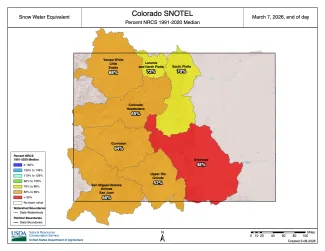
Low mountain snowpack remains a major concern heading toward the spring runoff season. Most of Colorado’s river basins remain below 70 percent of median snow water equivalent for early March.
As of Saturday, the Arkansas basin was faring the worst, at 48 percent of normal. The Laramie and North Platte basin has remained just above 70 percent for the past month, while a late week snowstorm brought the South Platte basin up to 70 percent.
©
Drought Conditions
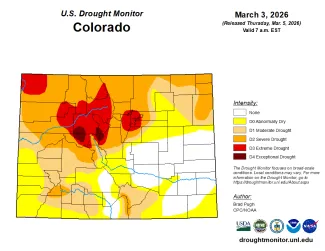
The east central and southeast plains remain largely drought-free. Elsewhere in the state - especially the northern mountains - drought has continued to be a factor. Extreme and exceptional drought dominates the north-central mountains, with Pitkin, Eagle, Lake, Grand, and Summit counties all having pockets of exceptional drought – the most intense category.
Extreme drought appeared across the Front Range this week, impacting Jefferson, Boulder, Broomfield, and neighboring counties. Extreme conditions continue in western Moffat County, as well as around the areas of exceptional drought, including all or portions of Rio Blanco, as well as counties surrounding Eagle County.
In western Colorado, Mesa and Delta counties saw an expansion of severe drought, as did Larimer and Phillips counties in the northeast. Severe drought now covers much of Yuma County to the south of Phillips.
Abnormally dry conditions increased on the eastern plains and across most of Fremont County.
Overall, the most severe drought conditions remain concentrated in the northern mountains and parts of western Colorado, while the eastern plains remain largely drought-free.
©
Statistics
Overall, 21 percent of Colorado is drought-free, down from 25 percent in the previous week, while an additional 22 percent is abnormally dry, up from 19 percent. Moderate drought decreased from 22 to 20 percent, while severe drought expanded from 25 to 26 percent. Extreme drought rose from eight to 20 percent, while exceptional drought remained steady at one percent.
One year ago, 55 percent of Colorado was drought-free, while 20 percent was abnormally dry. Seventeen percent of the state was experiencing moderate drought, with six percent of the state in severe conditions. Extreme drought represented one percent of the state. None of Colorado was in exceptional drought - the worst category.
Just over 3,444,000 Colorado residents live in a drought-impacted area. Colorado’s 2023 population was estimated at 5,877,610.
Drought categories include (ranked from least to most severe) abnormally dry (D0), moderate (D1), severe (D2), extreme (D3), and exceptional (D4) drought.
Colorado Drought Percentages for March 3, 2026 | |||||||
Week | Date | None | D0 | D1 | D2 | D3 | D4 |
| Current | 3/3/26 | 21 | 22 | 20 | 26 | 10 | 1 |
| Last Week to Current | 2/24/26 | 25 | 19 | 22 | 25 | 8 | 1 |
| 3 Months Ago to Current | 12/2/25 | 42 | 21 | 22 | 13 | 2 | 0 |
| Start of Calendar Year to Current | 12/30/25 | 29 | 33 | 22 | 13 | 2 | 1 |
| Start of Water Year to Current | 9/30/25 | 46 | 9 | 9 | 22 | 14 | 0 |
| One Year Ago to Current | 3/4/25 | 55 | 20 | 17 | 6 | 1 | 0 |