Movie Review - Godzilla Minus Zero

© StarLineArts - iStock-2153469659
Bob Garver
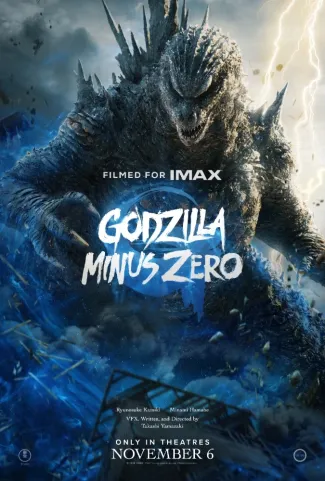
The confusingly-titled “Godzilla Minus Zero” is a follow-up to 2023’s “Godzilla Minus One.” That film took place in 1947, this one takes place in 1949, presumably they are counting up to the original “Godzilla” film from 1954. The setting for “Minus One” was a Japan recovering from World War II. The setting for this film is a Japan recovering from both World War II and the Godzilla attack of the first movie. The last thing the suffering nation needs is an attack by another 50-foot monster called Ghidora, but they get it in the opening scene.
©
We soon rejoin our heroes from “Minus One.” Pilot Kōichi (Ryunosuke Kamiki) has married his lover Noriko (Minami Hamabe) and together they are raising orphan Akiko (Sae Nagatani). Noriko suffered some near-fatal injuries in the first movie, but is seemingly back to mostly-full health, give or take some bandages and an eyepatch. Also returning is government official Noda (Hidetaka Yoshioka), who recruits Kōichi to serve as a consultant, but stresses to Noriko and Akiko that he won’t be put in harm’s way. Yeah, and Maverick was just brought back for “Top Gun: Maverick” to serve as an instructor.
New for this movie is Professor Murakami (Min Tanaka), a biochemist working with Noda capable of building weapons that can destroy Ghidora. He’s a survivor of both the Ghidora attack and the U.S. bombing of Hiroshima, losing his family in the latter. He’s willing to save Japanese lives, but what he really wants is revenge on the U.S. He’d wipe out an entire major city if he could get his hands on the right weapon.
Noda’s plan is to use pilots, coached by Kōichi, to both bomb Ghidora and, if necessary, shoot rods into the creature that can then be hit with a concentrated lightning strike. The plan is a spectacular failure, with the bombs proving ineffective, and the lightning serving only to mutate Ghidora into an even larger dragon with three heads, all capable of breathing fire. Speaking of breathing fire, the lightning has another effect on the ocean, in that it reignites a threat that was thought to be eradicated, but has merely been lying dormant for years. You didn’t think that a movie called “Godzilla Minus Zero” would have Ghidora as its only kaiju, did you?
The rest of the film sees our heroes wrestle with the problem of “two” giant reptiles capable of destroying what’s left of Japan. Human technology has already proven futile, but maybe if the two creatures were to fight each other, one could be killed and the other injured, leaving it vulnerable to being finished off. One creature might be able to be controlled thanks to some cellular imprinting from the first movie, but it will still be risky, and is it really in humanity’s best interest for anyone to have control over a weapon of such destructive power?
People come to Godzilla movies for monster action, and make no mistake, they’ll get it here. The creatures and action are as crisp here as they were in “Minus One,” and that film won an Oscar for Best Visual Effects, the first win (and nomination) in the franchise’s 70-year history. But the real story coming out of this film is the human drama, with Murakami’s obsession with revenge and the Kōichi/Noriko/Akiko family dynamic. The ending of the film is very weepy, some will say too much so, but I wasn’t annoyed by the emotion of one character as much as I was by the film teasing that it might go in a direction other than the one I knew it would go. Length and pacing drag “Godzilla Minus Zero” down a bit, but overall I’m still loving this wing of the franchise.
Grade: B-
“Godzilla Minus Zero” is rated R for some violent content/bloody images. Its running time is 135 minutes.
Contact Bob Garver at rrg251@nyu.edu.