
Movie Review - Mercy

© StarLineArts - iStock-2153469659
“Mercy” was the #1 movie at the box office on a weekend where the weather showed little in the way of mercy to much of the country. Hope you’re all safe out there.
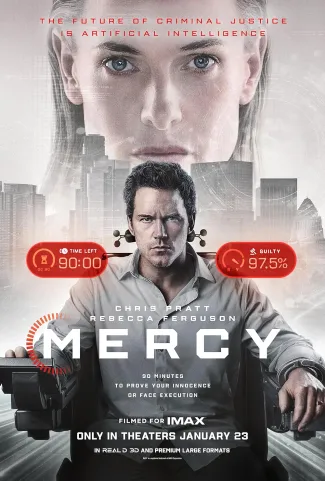
As if the weather weren’t enough of a disadvantage, “Mercy” is saddled with one of the stupidest cinematic premises I’ve ever seen. It takes place in a dystopian future where murder trials take the form of “Mercy trials,” suspects being strapped unsupervised to a chair in a tech-filled, but otherwise empty room and given 90 minutes to prove their innocence to an A.I. judge. If they can’t establish a reasonable doubt within the time limit, they’re executed on the spot.
©
To give the suspects a fighting chance, tech is at their disposal to examine the crime scene, check security cameras, call witnesses, look at evidence like strangers’ personal financial records, and so on, all in the name of making the system think that they are less than 92 percent guilty. But emotional pleas do no good, the way they might with a human jury. Also, there are no lawyers to navigate (some would say “manipulate”) the justice system. No suspect given this kind of trial has ever been found not guilty.
Detective Chris Raven (Chris Pratt), a major proponent of the Mercy system, awakens one day to finds himself strapped to a chair for a Mercy trial. On a screen, Judge Maddox (Rebecca Ferguson) informs him that he’s the prime suspect in the murder of his wife (Annabelle Wallis). His probability of guilt is deemed to be 96.7 percent. If he wants to avoid being… the movie never says, but I’m guessing electrocuted, he’d better get cracking on getting that number down below 92 percent. Oh, and he suffered a brain injury when he was arrested, so he doesn’t remember anything about the morning of the murder – including whether or not he did it.
Chris goes about uncovering the truth. He knows that he wasn’t always the best husband, struggling with anger and alcoholism, but he couldn’t have done it… in the emotional sense. In the literal sense, maybe. He doesn’t get much help from friends and family, like his less-angelic-than-he-thought daughter (Kylie Rogers), his sponsor (Chris Sullivan), or his partner (Kali Reis), who are seemingly of the attitude that they want to help him, but the evidence isn’t looking good.
He uncovers layers upon layers of secrets: his wife may have been having an affair with a chef (Jeff Pierre), she may have been involved with illegal drug manufacturing with her co-worker (Rafi Gavron), and there may be a conspiracy to unleash untold terror. And he may have to come to the conclusion that the Mercy system itself may not be as perfect as he previously thought. Who would have thought that putting a murder trial in the hands of a judge that can simply be unplugged might have flaws?
“Mercy” is one of those movies that wants to warn us about the dangers of A.I., that this is where society is headed if we entrust in it too much. Except no, we’re not. A.I. is indeed creeping its way into all facets of life, including the justice system, and there are dangers that come along with it, but we’re a million miles from this strapped-to-a-chair-with-no-humans-around nonsense. The whole thing is ridiculous. It’s so ridiculous, in fact, that it warrants being seen by people who like ridiculous movies. This movie gets my rare “B-minus-minus” rating, reserved for movies that I would never recommend in the traditional sense, but do make me shake my head and chucklingly say, “You gotta see this.”
Grade: B- -
“Mercy” is rated PG-13 for violence, bloody images, some strong language, drug content and teen smoking. Its running time is 100 minutes.
Contact Bob Garver at rrg251@nyu.edu.