New report scrutinizes New Mexico disaster spending, which continues for years without legislative approval

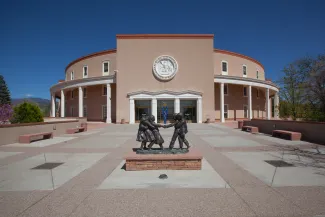
The New Mexico Legislative Finance Committee released a new report Tuesday on an issue that has caused tension between majority Democratic lawmakers and the Democratic governor in recent years: Governor Michelle Lujan Grisham’s increasing use of emergency orders.
Between 2023 and 2026, Lujan Grisham issued 811 executive orders that enabled the executive branch to spend nearly $554 million, all without the Legislature’s approval, on natural disasters like fires and floods, but also on emergency food assistance during a federal government shutdown and on controversial National Guard deployments to New Mexico cities.
© jdwfoto - iStock-1487999298
The LFC report notes that much of the spending associated with those disasters occurs a year or more after the “acute” phase of the disaster, which analysts say shows the Legislature has time to meet, deliberate and approve funding as needed following the immediate disaster response.
“Emergency orders could be smaller, with regular legislative sessions appropriating the remaining needs within the year following the emergency,” LFC program evaluator John Valdez told lawmakers at the interim LFC meeting Tuesday in Ruidoso. “It further shows that waiting on the Legislature to act in a normal session would not delay spending of most of those funds.”
Analysts also raised concerns about which contractors are receiving emergency funds, noting that two out-of-state debris removal contractors — DRC Emergency Services LLC in Texas and AshBritt Inc. in Florida — received more than half of all the state’s emergency funding for disaster response and recovery between 2022 and 2026.
The report authors recommended that the Legislature enact a strict definition of the word “emergency” in state statute to refer specifically to the early phases of a disaster, a period that is distinct from the “recovery” phase. The report defines that phase as beginning when immediate threats are stabilized to life and property.
In response to the report findings, officials with the state Department of Homeland Security and Emergency Management attributed the lag in state spending a year or more after disasters occur to the complex invoicing system required to secure reimbursement from the Federal Emergency Management Agency, which still owes the state more than $200 million from recent disasters. They also said they use competitive bidding in selecting contractors for a host of disaster services.
© zimmytws - iStock-511889079
State Department of Finance and Administration Secretary Wayne Probst moreover defended the executive branch in comments to lawmakers, taking the moment to reflect on Lujan Grisham’s quick responses to a host of disasters that marked her second and final term in office, which ends this year.
“As you look forward, and we look sort of nostalgically backwards, I think it’s also a good opportunity to again celebrate what we’ve done together,” Probst told lawmakers, “and to recognize some of those people who have made the most impact in these communities that have been affected by the fires and floods and other natural disasters.”
During the legislative session earlier this year, lawmakers unanimously enacted House Bill 180, which would have created more definitions and limits on the governor’s spending. Even though the bill would not have gone into effect until after Lujan Grisham left office, she vetoed it out of concern it would impose unnecessary delays.
The bill’s Republican sponsor, Representative Harlan Vincent (R-Ruidoso Downs) told Source New Mexico recently that he intends to reintroduce a version of the bill at the upcoming 60-day session in 2027.