Next-gen geothermal aims to greatly expand clean power

© StevanZZ - iStock-2243756830
Click play to listen to an abbreviated version of this article.
In 1904, the Italian town of Larderello saw the world’s first trickle of electrical power generated from the heat of the Earth. It was enough to make five lightbulbs glow. By 1913, Larderello had a full-scale plant producing up to 250 kilowatts of electricity, using steam from natural hydrothermal vents to drive a turbine connected to a generator. Yet, despite this pioneering success over 100 years ago, geothermal power has remained a niche endeavor, largely because it’s limited to volcanic areas where natural steam or hot water is readily available. Today, it amounts to only about 0.5 percent of global electricity generation.
Far more planet power might be harvested using a suite of emerging technologies, broadly known as next-generation (next-gen) geothermal. They generally aim to extract heat from deep rock formations by creating artificial hydrothermal systems. That enables power stations to run in areas that are not volcanic, vastly expanding the range of potential sites. Some forms of next-gen geothermal aim to operate at much higher temperatures than traditional plants, potentially making them more efficient and economically appealing.
© zhaojiankang - iStock-802436842
This power source could be an ideal partner for intermittent renewable sources such as wind and solar, as it offers a steady supply of power and may also be able to ramp up and down to cover any shortfalls. “Geothermal could be the backbone to providing a clean, affordable, reliable, low-cost grid,” says Katrina McLaughlin at the World Resources Institute, a nonprofit sustainability research organization based in Washington, DC.
In the past few years, next-gen geothermal has been spurred on by drilling methods developed in the oil and gas industry and by the increasingly urgent need for sustainable power. In 2024, an International Energy Agency report (1) forecast that it could meet 15 percent of global electricity demand by 2050, with costs falling to $50 per megawatt-hour by 2035, on par with the cheapest solar power. “In principle, geothermal is an amazing technology that can deliver on all your energy dreams,” says Lev Ring, president of geothermal startup Sage Geosystems, based in Houston, Texas.
But the industry needs expensive infrastructure, with high upfront costs and financial risks that may deter investors. And the rock-fracturing processes used by many next-gen geothermal systems can cause earthquakes, which may restrict its use to sparsely populated areas.
That puts pressure on the startup companies developing these technologies. Failure could stymie geothermal development for years to come; success could open a wave of fresh investment that reshapes the global energy mix.
Drill Skill
Next-gen geothermal traces its origins back to the early 1970s, with landmark experiments at the Fenton Hill test site in New Mexico. The idea was to drill deep into the Earth, reaching rocks at roughly 200 °C that were hot enough for a practical geothermal power system. At these depths, the rocks tend to be tight-knit and impermeable, with any cracks squeezed shut. But as the Fenton Hill researchers showed, forcing high-pressure fluid into such rock formations can make them permeable, opening pre-existing cracks or creating new ones. Water can then be passed through the cracks to draw heat to the surface—the basis of a technique now known as enhanced geothermal systems (EGS).
In Beaver County, Utah, Fervo Energy is building an EGS plant called Cape Station that it expects to produce up to 100 megawatts of electrical power in 2026 and 400 megawatts in 2028, with permits to go up to 2 gigawatts. The company is using techniques first developed in the oil and gas industry and adapted for geothermal with the help of the nearby Utah Frontier Observatory for Research in Geothermal Energy (FORGE), an underground laboratory sponsored by the US Department of Energy.
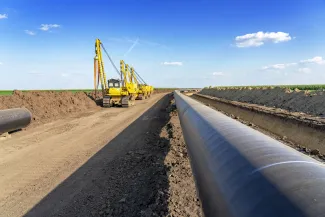
These techniques include drilling around corners. One approach involves putting a slight bend in the final section of drilling pipe, with hydraulic pressure from above driving the drill bit. This allows a rig to bore several wells that start just a few meters apart on the surface but then splay out toward different volumes of hot rock. That reduces the need for surface pipework and saves time because the rig doesn’t have to be moved far.
Drilling around the bend also means that boreholes can plunge to the needed depth and then turn horizontal. After drilling a pair of horizontal channels in the deep rock, Fervo pumps in high-pressure water to create cracks between the two. Then, once the plant is running, water sent into the lower channel will percolate through these cracks into the upper channel, gathering heat as it goes. Returning to the surface, the hot water will vaporize a volatile fluid, forming a high-pressure gas that drives a turbine. Cape Station is the world’s biggest EGS project. “Everyone is watching Fervo to see how they do,” says Roland Horne, a geophysicist at Stanford University in California, who taught Fervo’s founders and is on the company’s advisory board.
Meanwhile, Sage Geosystems is using similar drilling techniques in a different way. They also drill two boreholes, but then create fracture networks that branch out from each borehole and do not connect. Engineers pump water back and forth between the two wells, picking up heat each time in a process the company calls “huff-n-puff.”
Unlike Fervo’s EGS, this approach enables Sage to avoid using gritty additives called proppants. These are used to hold open the cracks, but they can also impede the flow of water, Ring explains. He believes this will prove to be a more efficient system, although the huff-n-puff approach also uses higher pressures than Fervo’s plant, requiring additional equipment to manage the water at the surface. Sage is now teaming up with Ormat Technologies to build a pilot generation project, which aims to generate 4 megawatts of electricity by 2027 and 150 megawatts by 2028.
Buried Treasure
Whichever EGS system is used, the potential power supply is enormous. A 2025 study by Ring and colleagues calculated that next-gen geothermal, deployed at depths down to 5 kilometers in the contiguous United States (2), could produce more than 5 terawatts—roughly four times total US generating capacity today.
How far and how fast this resource gets exploited will come down to economics. In 2024, Horne and his Stanford colleague Mohammad Aljubran estimated the price of electricity from EGS plants using Fervo-type technology (3). They found that almost 90 percent of the United States could have access to geothermal energy at a cost of less than $80 per megawatt-hour, comparable to some existing forms of firm (nonintermittent) generation such as nuclear power and biomass. “And it is actually cheaper than solar with batteries, which is what they need to provide firm power,” Horne says. The Department of Energy projects that average EGS costs will fall below $70 per megawatt-hour by 2030 and predicts that US next-gen geothermal capacity could reach 90 gigawatts or more by 2050 (4). That would supply more than 10 percent of the clean firm power required to complement intermittent renewables in a zero-emissions grid.
Not everyone is so optimistic. A 2025 report by certification body Det Norske Veritas anticipates that a shortage of investment could stall US geothermal at only about 15 gigawatt capacity (5). Ring agrees that getting projects financed remains one of the main barriers for next-gen geothermal. “Banks are not keen on providing capital,” he says, because it is unproven at commercial scale. “At the moment, there are zero power plants operating with this technology.”
Induced seismicity could be another barrier. Hydraulic fracturing can release built-up forces in Earth’s crust, and so trigger earthquakes. In 2009, an EGS project near Basel, Switzerland, was canceled after it caused quakes up to magnitude 3.4; and in 2017, a project in Pohang, South Korea, was responsible for a much bigger 5.5-magnitude quake. This may be a tolerable risk in some regions, and several other projects have not produced any noticeable seismicity, Horne says. “Nonetheless, to reduce the risk further, it is likely that in the near-term, EGS projects are likely to concentrate on areas with low population density,” he says.
Canadian company Eavor thinks that a different kind of geothermal technology could avoid earthquake risks. In Geretsried, Germany, it is drilling a system of boreholes to circulate water (along with some proprietary additives) to a depth of 5 kilometers, then horizontally through the rock and back up again. This closed-loop system does not require any rock fracturing, so there is negligible risk of induced seismicity.
However, each well only provides a small contact area with the unfractured rock, which means lower power per borehole. Eavor gets around this by drilling a lot of holes, but that takes a lot of cash. “The economics of closed loop are behind EGS and conventional geothermal by an order of magnitude,” Horne says.
Robert Winsloe, co-founder of Eavor, insists that the investment will pay off overall. The Geretsried plant is designed to generate 8 megawatts of electricity, which will cost much more than other conventional power sources. But in winter, it will instead supply about 64 megawatts of heat to a planned district heating system in the town, at a more affordable level. Many other towns in Germany have existing district heating that similar plants could feed. “The path to geothermal is paved with district heating in Europe,” Winsloe says.
Hotter Stuff
All these projects exploit strata no warmer than a home oven, around 200 °C. Tapping much hotter rocks, above 300 °C, would yield a lot more power from each well, potentially bringing down electricity costs and overcoming the investment barrier. “If superhot geothermal is achievable, it is going to provide commercial rates of return comparable to the oil and gas industry,” Ring says.
A startup called Mazama is testing superhot technology in Oregon, as is the Iceland Deep Drilling Project (IDDP) in the middle of the North Atlantic. In such volcanically active territory, engineers don’t need to go deep to reach high temperatures. The first IDDP well happened to hit a magma chamber only 2.1 kilometers down, releasing steam that would have been enough to generate 36 megawatts, which is 5 to 10 times the power from most conventional geothermal wells, says project scientist Sigurður Hafsteinn Markússon.
However, taming such high temperatures is difficult. As the IDDP has discovered, extreme thermal expansion can break conventional drill casings, which are based on steel pipe surrounded by cement. The project aims to counter that by using advanced cement formulas and flexible couplings between stretches of pipework. Fluids from these deep rocks also tend to be corrosive and laced with hydrochloric acid, so the project will investigate new alloys and protective titanium layers for its pipes. Markússon also expects that an initial dose of cold water down the wells should cause the rocks to crack without needing the high pressures of conventional hydrofracking. “We are hoping to look into developing power plants with this technology from around 2030,” he says.
While superhot rock may be less than 5 kilometers down in Iceland or Oregon, it lies much deeper in most other parts of the world. That puts it under very high pressure, as well as high temperatures, and one concern is that under these conditions rock may become too plastic for fracking to work properly. Recent research seems promising, however. Small samples of granite were subjected to pressures of 1,500 atmospheres and temperatures up to 800 °C and then deformed (6). Despite being somewhat plastic, the rock seemed to develop high permeability, with many microcracks instead of a few big ones. This suggests that permeability could be created in superhot, superdeep rock, although the lead author of the research, Gabriel Meyer at the Laboratory of Experimental Rock Mechanics in Lausanne, Switzerland, urges caution, saying it’s not clear how long the cracks would remain open.
And drilling will be challenging. Some entirely new methods are being explored. A company called Quaise Energy is developing a method to melt through rock using microwaves, for example. But less radical technology might be able to do the job.
Sage aims to reach depths of at least 10 kilometers and temperatures above 300 °C by using dense fracking fluids that send cracks downward through the rock. Eavor hopes to go down to 15 kilometers and 450 °C, using new cooling methods and other technologies that remain under wraps. Still, those superdeep, superhot systems may turn out to be impractical or remain many years in the future.
For now, the EGS plants being developed by Fervo and Sage benefit from a favorable political environment. The current US administration has streamlined permitting for geothermal and maintained tax credits for the industry, while removing those benefits for wind and solar. More policy nudges might be needed, says McLaughlin—for example, to cut delays in connecting to the grid, delays that are currently hindering all forms of generation.
What happens next could hinge on the results from these projects over the next few years. Horne hopes that more startups will follow Fervo’s lead to develop large EGS plants, not least because widespread investment might need more than one or two successes. McLaughlin says it is important to show that this technology works in geographically diverse sites, not only in the western US states where traditional geothermal thrives. Among the big questions yet to be answered, she says, “Can it go east of the Mississippi?”
How the oil and gas industry responds may be crucial. It has the money and muscle to turn this promising trickle of next-gen geothermal into a flood. “Oil companies are hanging around the door,” Horne says, “deciding whether or not to join in.”
Stephen Battersby wrote this article for the Proceedings of the National Academy of Sciences.