November is peak month for wildlife crashes in Colorado

November is the peak month for wildlife crashes in Colorado, according to the Colorado State Patrol. The patrol is urging drivers to use caution and watch the roads for animals during migration and rutting season.
October through December are the highest months for wildlife crashes in the state, according to Colorado State Patrol investigation data. In 2025, troopers investigated 608 wildlife-involved crashes.
Dawn and dusk remain the top times of day for these crashes. However, wildlife crashes can happen at any time.
© iStock - Alex_Schmidt
"Animals are active 24 hours a day, and all year round, but drivers may see a noted increase right before sunrise and then again at dusk," said Colonel Matthew C. Packard, chief of the Colorado State Patrol. "Wildlife like dawn and dusk due to the dim light for hiding and cooler temperatures while moving around. Unfortunately, reduced visibility leads to more crashes."
The patrol looked at its data from the past five years, 2021 through 2025. The top 10 counties for wildlife crashes investigated by the patrol, from highest to lowest, were La Plata, El Paso, Montezuma, Pueblo, Chaffee, Garfield, Archuleta, Park, Moffat and Douglas.
"Driving the posted limit and repeatedly scanning roadways is your best strategy to avoid wildlife," Packard said. "You need to give yourself time to brake if no one is immediately behind you. Speeding or driving distracted takes away any opportunity to avoid the crash."
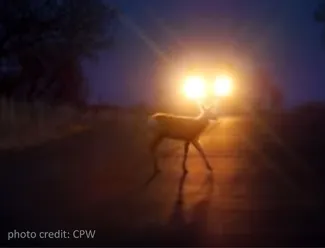
The patrol offers these tips to avoid a wildlife crash. Do not drive faster than the speed limit. Scan roads and shoulders for movement and eye shine. Use bright lights at night when it is safe. If you have time and space behind you, stop for wildlife on the road and use hazard lights. Watch for groups of animals. If you see one animal, there may be others nearby.
Sometimes a driver meets an animal and does not have time to brake safely in a straight line. In that case, the right choice is to drive through and stay in your lane. If you are in an outside lane with the white stripe to your right, or in a single lane, angle slightly to hit the back end of the animal. Never swerve or jerk your vehicle's wheel.
If you are in a crash with an animal, call 9-1-1 just as you would in any other emergency. If you see wildlife in distress near the road that may have been struck, call *CSP. The patrol will notify the proper resource and send it to the scene.