Colorado flu admissions resume their climb as COVID-19 hospitalizations double in two weeks

Flu hospitalizations in Colorado resumed their climb in the week before Thanksgiving, and COVID-19 admissions doubled in two weeks.
Hospitals admitted 211 people with influenza in the week ending November 21, according to the Colorado Department of Public Health and Environment. That was up 30 percent from 162 the week before, and more than three times the 63 admitted in the same week last season. It is the most for that week of the season in any of the five earlier seasons on the state's dashboard. The previous high was 174, in 2022.
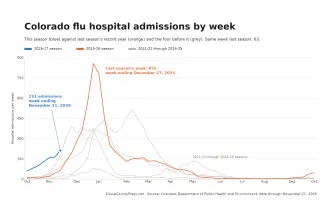
Weekly flu hospital admissions in Colorado this season compared with the five earlier seasons. Kiowa County Press chart; data from the Colorado Department of Public Health and Environment
The rise followed a week in which admissions barely moved, which the Press reported November 18. The state revises earlier weeks as reports come in, so some figures here differ from that article.
Other flu measures rose, too. Flu accounted for 2.3 percent of emergency department visits, up from 1.8 percent the week before. At the clinics that report test results to the state, 14.6 percent of flu tests came back positive, up from 11.2 percent. In the same week last season, 12.8 percent were positive.
Since the season began October 4, 896 Coloradans have been hospitalized with flu. At the same point last season, the total was 170. In the four seasons before that, it never topped 367. Last season was the worst on record, with a peak of 855 admissions in the week ending December 27.
Children and older adults
Children are showing up in emergency rooms with flu more than any other age group. It was diagnosed in about 6 percent of emergency visits by children under 5 and 5.2 percent of visits by children ages 5 to 17. For adults, the share was 1.6 percent or less.
Thirty children were hospitalized with flu in the week ending November 21, up from 18 the week before. One Colorado child has died of flu this season.
Older adults still make up most hospital stays. Of the 385 October flu admissions the state has sorted by age, 225 were people 65 or older. The state updates its age and regional tables monthly. In October, it counted no flu admissions in its southeast region.
Nearly all of the flu is influenza A. Of the hospitalized patients whose virus was subtyped this season, 234 had A(H1N1) and two had A(H3N2), the strain behind last winter's record season.
COVID-19 admissions double
Hospitals admitted 120 people with COVID-19 in the week ending November 21, up from 95 the week before and 58 two weeks earlier. That was more than twice the 48 in the same week last season, and close to last winter's peak of 140, in the week ending January 10. It is still far below earlier years. In the same week in 2022, Colorado hospitals admitted 485 COVID patients.
COVID accounted for 0.73 percent of emergency visits, up from 0.59 percent the week before and about twice the share in the same week last season. Among people 65 and older, the share nearly doubled in a week, to about 1.1 percent. At reporting clinics, 6.1 percent of COVID tests came back positive, up from 4.6 percent.
The Centers for Disease Control and Prevention rated Colorado's COVID wastewater level high for the week ending November 14, up from moderate the week before. Wastewater levels can show a virus spreading before people get sick enough to see a doctor.
The state counted 11 COVID deaths in October, up from four in September. Last winter, COVID deaths peaked at 43 in January. Since October 4, the state has logged 23 COVID outbreaks and 11 flu outbreaks at nursing homes and other residential care facilities. Over the same weeks last year, there were 34 COVID outbreaks and four flu outbreaks.
RSV stays low
RSV, which can be serious for infants and older adults, remains low. Hospitals admitted 11 RSV patients in the week ending November 21, down from 16 the week before. Eight of them were children. Last season, RSV admissions did not peak until the week ending February 28. The state has logged four RSV outbreaks at schools and child care centers since October 4.
Across the country
Flu activity continues to increase nationally, the CDC said in its weekly flu report for the week ending November 14. That week, 11.8 percent of flu tests at clinical labs were positive, and hospitals reported 11,734 flu admissions. The agency estimates at least 3.7 million illnesses, 50,000 hospitalizations and 2,800 deaths from flu so far this season. Seven children have died of flu nationally this season.
The CDC also tracks flu hospitalizations closely in selected counties of 14 states. There, the season's hospitalization rate so far is the highest for that point in any season since 2010-11. The agency still rates the season's severity as low for all ages. Its forecasts call for flu hospital admissions to keep rising through at least the week ending December 5. About 96 percent of the influenza A viruses subtyped that week were H1N1. Nearly all the viruses the CDC has tested so far closely match the vaccine strains. The agency said it is too early to know whether this season's viruses will affect how well the vaccine works.
COVID-19 activity is low nationally, the CDC said November 20. The agency's next flu report, delayed by the holiday, is due Monday, November 30.
What health officials recommend
The CDC recommends a flu vaccine every season for everyone 6 months and older. It takes about two weeks after a shot for protection to build. In October, state health officials urged Coloradans who had not been vaccinated to get the shot now.
The CDC's COVID-19 vaccine guidance for this season recommends the 2026-27 vaccine for all adults 18 and older. For children and teens, it is recommended for those with moderately or severely weakened immune systems, and others may get it after talking with a health care provider. Colorado pharmacists can give the COVID vaccine without a prescription under a statewide standing order.
For RSV, the CDC recommends a single dose of vaccine for everyone 75 and older and for adults 50 to 74 at higher risk. Babies can be protected by a vaccine given during pregnancy or by an antibody shot for infants under 8 months.
Prescription antiviral drugs can treat flu and COVID-19 and work best when started early, especially for people at higher risk of complications. Officials also recommend staying home when sick, covering coughs and sneezes, and washing hands often.