Colorado flu hospitalizations level off as COVID-19 admissions jump

Weekly flu hospitalizations in Colorado leveled off in mid-November after climbing through October, while COVID-19 admissions jumped by half and RSV began to rise.
Hospitals admitted 157 people with influenza in the week ending November 14, according to the Colorado Department of Public Health and Environment. That was about the same as the 156 admitted the week before, and more than three times the 44 admitted in the same week last season.
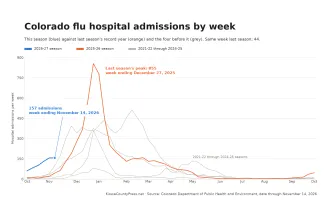
Weekly flu hospital admissions in Colorado this season, last season and the four seasons before. Kiowa County Press chart; data from the Colorado Department of Public Health and Environment
One steady week does not mean flu has peaked. The state's other flu measures kept climbing. Flu accounted for 1.76 percent of emergency department visits, up from 1.36 percent the week before and three times the share in the same week last season. At the clinics that report test results to the state, 10.4 percent of flu tests came back positive, up from 9.1 percent.
Since the state began counting this season on October 4, 689 Coloradans have been hospitalized with flu. At the same point last season, the total was 107, and in none of the four seasons before that did it top 193. Last season was the worst on record, with a peak of 855 admissions in the week ending December 27. The Press reported November 9 that this season was running about three weeks ahead of last year's pace. Federal health officials have cautioned that an early start does not necessarily mean a bigger peak.
Children fill emergency rooms, older adults fill beds
Flu is showing up most often in children's emergency visits. It was diagnosed in about 4.8 percent of emergency visits by children under 5 and 3.4 percent of visits by children ages 5 to 17, compared with a little over 1 percent for adults.
Hospital stays are a different story. Of the 395 flu admissions the state has sorted by age for October, 229 were people 65 or older, a rate of about 22 per 100,000 people. Babies under 6 months and children ages 6 months to 4 years had the next highest rates, about 12 and 11 per 100,000.
Sixteen children were hospitalized with flu in the week ending November 14, down from 21 the week before. One Colorado child has died of flu this season, and the state has not reported another.
Nearly all of the flu is influenza A. Of the hospitalized patients whose virus was subtyped since October 4, 156 had A(H1N1) and one had A(H3N2), the strain that drove last winter's record season.
The state's regional table, updated monthly, counted no flu hospital admissions in its southeast region in October. The highest rates were in the southwest and south-central regions, about 10 per 100,000 people.
COVID-19 admissions jump
Hospitals admitted 87 people with COVID-19 in the week ending November 14, up from 58 the week before. Weekly COVID admissions had stayed between 37 and 58 since early October. That count was higher than the 49 in the same week last season but far below earlier years. In the same week in 2023, Colorado hospitals admitted 344 COVID patients.
COVID accounted for 0.6 percent of emergency visits, up from 0.43 percent the week before. The share of COVID tests coming back positive at reporting clinics dipped to 4.4 percent from 5 percent. The Centers for Disease Control and Prevention rated Colorado's COVID wastewater level moderate for the week ending November 7, up from low the week before.
Older adults account for most COVID hospital stays. Of 210 COVID admissions sorted by age for October, 125 were people 65 or older. Babies under 6 months had the highest rate of any age group, though the number was small, seven infants.
The state counted nine COVID deaths in October and three in September. Last winter, COVID deaths peaked at 43 in January. Since October 4, the state has logged 19 COVID outbreaks at nursing homes and other residential care facilities, compared with 36 over the same weeks last year. Five flu outbreaks have been reported at residential care facilities.
RSV begins to rise
RSV, which can be serious for infants and older adults, appears to be starting its seasonal rise. Hospitals admitted 15 RSV patients in the week ending November 14, up from six the week before. Eleven of them were children. The share of emergency visits by children under 5 diagnosed with RSV rose tenfold, to about 0.3 percent. Last season, RSV admissions did not peak until the week ending February 28.
Across the country
Flu activity nationally is "higher than typically observed at this time of year," the CDC said in its weekly flu report posted November 13. In the week ending November 7, 11.3 percent of flu tests at clinical labs were positive, and about 9,600 people were admitted to hospitals with flu. The agency estimates at least 2.6 million illnesses, 36,000 hospitalizations and 2,100 deaths from flu so far this season.
Five children have died of flu nationally this season. Nearly 99 percent of the influenza A viruses that public health labs subtyped that week were H1N1. The CDC still rates the season's severity as low for all ages but says that may change, and its forecast calls for flu hospital admissions to keep rising through at least the week ending November 28. Colorado's level of flu-like illness at doctors' offices was rated moderate that week.
COVID-19 activity is low nationally, the CDC said, though emergency visits and wastewater levels are increasing. The national wastewater level is moderate, and the West is the region with the highest level.
What health officials recommend
The CDC recommends a flu vaccine every season for everyone 6 months and older. It takes about two weeks after a shot for protection to build. In October, state health officials urged Coloradans who had not been vaccinated to get the shot now.
The CDC's COVID-19 vaccine guidance for this season recommends the 2026-27 vaccine for all adults 18 and older. For children and teens, it is recommended for those with moderately or severely weakened immune systems, and others may get it after talking with a health care provider. In September, the state re-issued a standing order that lets pharmacists give the COVID vaccine without a prescription.
For RSV, the CDC recommends a single dose of vaccine for everyone 75 and older and for adults 50 to 74 at higher risk. It is not a yearly shot. Babies can be protected either by a vaccine given during pregnancy or by an antibody shot for infants under 8 months.
Prescription antiviral drugs can treat flu and COVID-19 and work best when started early, especially for people at higher risk of complications. Officials also recommend staying home when sick, covering coughs and sneezes, and washing hands often.