
Flu arrives early in Colorado as hospital admissions run eight times last year's pace

Flu season has come early to Colorado. Hospitals admitted 122 people with influenza in the week ending October 31, according to the Colorado Department of Public Health and Environment. In the same week last year, the number was 15.
Since the state began counting this season on October 4, 359 Coloradans have been hospitalized with flu. Admissions have climbed every week, from 60 to 79 to 98 to 122. Last season, Colorado did not see a week above 120 admissions until the week ending November 22. This year's season is running about three weeks ahead of that pace.
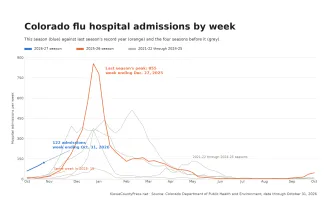
Weekly flu hospital admissions in Colorado, this season against last season's record year and the four seasons before it. Data through October 31, 2026. KiowaCountyPress.net graphic from Colorado Department of Public Health and Environment data.
Last season was the worst on record. The state counted 5,931 flu hospitalizations, the most since it began tracking in 2004, including a record 1,169 children. Eight Colorado children died. The season peaked at 855 admissions in the week ending December 27.
Who is being hospitalized
Older adults are being hit hardest so far. In October, 223 Coloradans age 65 and older were admitted with flu, a rate of about 22 per 100,000 people. Babies under six months had the next highest rate, about 15 per 100,000, followed by children from six months to four years old at about 10 per 100,000.
Nineteen children were hospitalized in the week ending October 31, the most of any week so far. One Colorado child has died of flu this season. The state confirmed the death in October. The child was of elementary school age and lived outside the Denver area, and health officials said they had no record that the child had received this season's flu vaccine.
Other measures are rising with the hospital counts. Flu accounted for 1.23 percent of emergency department visits in the week ending October 31, up from 0.74 percent the week before. At the clinics that report test results to the state, 8.5 percent of flu tests came back positive.
The state's regional table, which is updated monthly, showed one flu hospital admission in southeast Colorado in September and none posted for October as of November 4.
A different virus than last year
Last winter's record season was driven by an influenza A(H3N2) virus. This fall, a different virus is spreading.
Nationally, 97.7 percent of the influenza A viruses that public health labs subtyped in the week ending October 31 were A(H1N1), the Centers for Disease Control and Prevention reported. In Colorado, every hospitalized patient whose flu virus was subtyped that week had H1N1. No H3N2 cases were found among them.
The CDC said the H1N1 viruses circulating this year show more genetic variety than in past seasons, and that it is too early to know what that means for how well the vaccine works. The agency also cautioned that an early start does not necessarily mean a higher peak or a more severe season.
Across the country
Flu activity is higher than usual for this time of year across much of the United States, the CDC said in its report posted November 6. Nationally, 9.1 percent of flu tests at clinical labs were positive in the week ending October 31, and about 8,400 people were admitted to hospitals with flu that week. The agency estimates at least 1.7 million illnesses, 25,000 hospitalizations and 1,400 deaths from flu so far this season.
Two children's deaths were reported to the CDC that week. The agency still rates the season's severity as low for all age groups, but says that could change as activity rises. Its forecast calls for flu hospital admissions to keep increasing nationally through at least the week ending November 21.
The CDC also reported two confirmed cases of H5 bird flu in Washington state dairy workers, one of whom died. No spread from person to person has been found.
What health officials recommend
The flu vaccine is recommended for everyone six months and older, and state health officials are urging people who have not gotten this year's shot to do so now. It takes about two weeks after vaccination for protection to build. Vaccines are available at pharmacies, clinics and local public health agencies.
Prescription antiviral drugs can treat flu, and the CDC says they work best when started as early as possible. They are especially important for people at higher risk of complications, including adults 65 and older, young children, pregnant women and people with chronic health conditions.
Officials also recommend staying home when sick, covering coughs and sneezes, and washing hands often.