Opponents warn about Prop. NN's impact on TABOR

© Baris-Ozer - iStock-1420488382
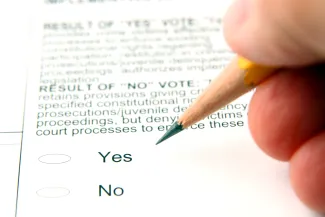
Coloradans will vote November 3 on an initiative to increase K-12 public education funding by up to 50% over the next 10 years.
But opponents argue the measure would do that by overriding the state constitution's Taxpayers' Bill of Rights, which refunds surpluses to taxpayers. Colorado is the only state with what is commonly called TABOR.
© Svanblar iStock-146069215
The initiative known as Proposition NN comes from Senate Bill 26-135, which was adopted in the Legislature this year and signed by Governor Jared Polis. The passage meant the Legislature decided to put the measure on the general election ballot.
Proponents say Prop. NN would not increase state taxes, but rather allow the state to retain the money it already collects for public education funding. An increase of these funds will be used to increase teachers’ pay, reduce class sizes, and allocate more funding to alternative career and technical education paths.
But critics argues the proposition overrides TABOR by allowing the state to keep the revenue it accrues instead of refunding it back to the taxpayers. They note TABOR was created to allow taxpayers to have a direct say on where their taxes go. TABOR was always intended to return excess tax revenue to taxpayers, according to opponents who apply that argument to Prop. NN.
The Secretary of State's Office's Bluebook Ballot Guide states that this proposition would "permanently eliminate or reduce TABOR refunds," as it will eventually hand over the state nearly $5 billion a year for the next 10 years to disperse into educational funding at the government's will.
© flickrcc - Alan Levine
The guide also notes that for households already stretched thin, especially for those who rely on refunds paid out by TABOR, this bill could have significant impacts.
Opponents argue the state, which has increased funding for public schools by nearly 25% over the last five years, should exhaust absolutely every resource before reaching back into taxpayers' pockets.
And some critics argue the “no taxes," promised by Prop. NN supporters, is actually just replaced by fees, and as these fees accumulate, the state – with Prop. NN – will keep the accrued fees as revenue and funnel it into K-12 public education.
The Center Square reached out to A Brighter Colorado and Let's Go Colorado, the two registered agents on the Secretary of State's Office's website opposing the bill, for comment, but they did not respond by publication time.
The initiative, meanwhile, will require an independent audit to take place every year in every school district in the state. It calls for each district to publish a report of how it spent its funds.
Jeremy Meyer, the Colorado Department of Education’s communications director, said some districts already require an independent financial audit, which is submitted to the Office of the State Auditor - Local Governments Unit and the Colorado Department of Education.
Prop. NN will be the fifth attempt to increase K-12 education funding over the last decade, with the most recent three attempts failing as well.
Despite the fact that Colorado was recently ranked No. 1 in the education category by U.S. News Best States ranking, and placed ninth in the nation specifically for K-12 education, the state ranked in the middle of the other 50 states for teachers’ pay.

© iStock / Iskandar Zulkarnaen (2232370432)
Data provided by Moreland University, described as an affordable online alternative university specializing in teacher preparation, found that the average teacher salary in Colorado for all levels is roughly $68,000. The national average teacher salary for all levels is around $72,030.
Moreover, entry level teachers in Colorado make about $42,421, which is nearly $4,000 short of the national entry level average, according to the university.
Some school districts within the state have drastically larger teacher salaries, such as Boulder Valley School District, which has an average teacher salary of nearly $100,000. Many south-metro Denver school districts, like Cherry Creek and Littleton school districts, have salaries between $94,443 and $85,405 respectively.
Randy Barber, the chief communications officer for Boulder Valley School District, told The Center Square that although the district remains one of the highest paying districts in the state, “Colorado school districts are chronically underfunded, so the public education system has many issues to address. We would welcome additional funding to help meet those needs.”
There is also a significant teacher shortage in the state, making classroom sizes bigger and teacher retention rates smaller, according to Moreland University.
Prop. NN is designed to increase the teacher retention rate, make classroom sizes smaller and pay teachers better in hopes that instruction quality will improve, according to proponents.
Barber also said that the district’s understanding of the initiative is that “...the revenue that would be generated by the proposed ballot measure would very much be tied to the state's economic conditions and growth over time.”
However, he noted, “The uncertainty and variability in the economy and state budget that we are experiencing at the moment make predicting quite difficult and introduces a significant degree of variance that limits the value of those projections."
Some Colorado voters remain skeptical over this measure and point to the state's history. In November 2012, state voters elected to legalize marijuana by passing Amendment 64. As part of that amendment, the state agreed to allocate the first $40 million obtained by an excise tax for marijuana sales to public education.
Then, in 2013, voters approved Proposition AA, which allowed the state to levy a 15% excise tax on unprocessed retail marijuana and up to 15% retail tax on retail marijuana. The revenue obtained by the tax also went to public education.
However, the news organization Boardhawk noted that Colorado ranked sixth for fourth grade math standing in 2013 and has fallen nearly 11 places on the list since then. Eighth-grade math standing also went from being ranked eighth in the nation to 14th, as of 2024.
Moreover, in 2024, the state ranked 28th in fourth-grade mathematics for low-income students. For non-economically disadvantaged students, fourth-grade mathematics was ranked ninth in 2024.
And Colorado’s low-income fourth grader test scores ranked significantly below the national average for other low-income fourth grader test scores. Although non-economically disadvantaged students in Colorado tend to outpace the national average for test scores, some have criticized the state for not reaching the students who need educational opportunities and assistance the most.
Meyer said the state does not report on the total marijuana tax revenue directed to K-12 education.
"Some analyses may rank states based on their National Assessment of Education Progress (NAEP) results, but CDE generally focuses on Colorado’s actual performance over time and statistically significant comparisons with the nation and other states rather than a single state ranking," according to Meyer.
“A state’s rank can change because of changes in that state’s performance, changes in other states, or both," Meyer said.
The Colorado Education Association, the state's largest union of educators, noted the state still has more than a $3.5 billion budget shortfall and ranks “dead last” in teachers’ pay. CEA said this statistic could be a determining factor in why Colorado ranks so low for public education.
Jeffrey Gustaveson, the union’s communications director, also told The Center Square that the marijuana tax was an indication that Colorado voters “care deeply about funding our schools and ensuring students and teachers have the resources they need to be successful.”
“With Prop NN, there will be a public audit every year, and local school districts are also required to share publicly how they are using this investment. Transparency is at the heart of this measure because voters deserve to know where their dollars are going and that they are going to benefit kids and schools," Gustaveson said.
In regard to what Prop. NN could actually do for Colorado schools in both urban and rural areas – which appears to be where the disconnect in funding arises – Gustaveson said, “Prop NN will increase funding for every district in the state and has been endorsed by urban and rural schools alike, including the Colorado Rural Schools Alliance and every district in the Denver Metro area.”
He added that because the measure requires that funds go to increasing teacher pay and retention, decreasing class sizes, and for career and technical education, “within those narrow uses, schools will determine what makes the most sense for their district. Annual public reporting will ensure that voters know exactly how their school district is using those investments.”
Gustaveson also provided comment on the “tax increase” counterargument raised by opponents, saying “No one will pay a dollar more than they are currently paying to increase funding for our chronically underfunded schools. Prop NN does not change TABOR. TABOR itself created the process that allows voters to increase the revenue cap to ensure proper funding for critical priorities like education, like they did in 2005.”
“Now it is time to raise it again to keep up with Colorado’s economy and the needs of our state," Gustaveson said.