Rain runoff sends Arkansas River E. coli back to the top of the scale from Pueblo to Las Animas; river below John Martin stays clean

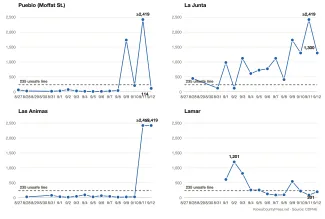
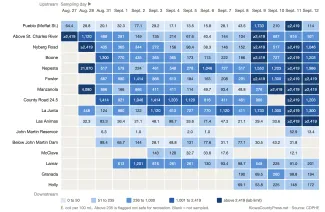
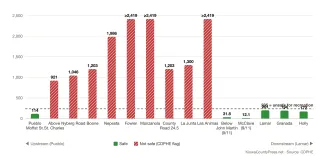
A pulse of rain runoff sent E. coli readings on the Arkansas River back to the top of the scale on September 9 and 11 at every sampling site from Pueblo through Las Animas, including the site upstream of the Pueblo sewage spill, according to new state data posted after this story first ran. The river below John Martin Reservoir, from the dam through Lamar, Granada and Holly, stayed within the safe range. By Saturday, September 12, the readings at Pueblo had already fallen back, and the state's advisory to stay out of the river from Fountain Creek through La Junta remains in place.
©
The newest results, from Saturday, September 12, put the Highway 50 bridge near Lamar at 201 colony-forming units per 100 milliliters, under the 235 mark the Colorado Department of Public Health and Environment uses to call a site unsafe for recreation. Lamar had spiked to 548 on Wednesday, September 9, dropped to 91 on Friday, and rose again on Saturday as the runoff pulse arrived. Below John Martin Dam the river read 32 on September 11, the McClave drainage site read 12 the same day, and the two sites the state added on September 8 read 194 at Granada and 173 at Holly on September 12. The reservoir itself read 13. Lamar's rise on September 12 means the runoff pulse had just reached it, so readings there may briefly cross the line before they clear, as they did on September 9.
Upstream, the picture was far worse. On Friday, September 11, nine of the ten sites from Pueblo through Las Animas came back at or above 2,419, the highest number the lab can measure: the Moffat Street bridge in Pueblo, Nyberg Road, Boone, Nepesta, Fowler, Manzanola, County Road 24.5, La Junta and Las Animas. Only the site above the St. Charles River, at 816, came in under the ceiling, and it too was flagged unsafe. By Saturday, September 12, the pulse was moving through: Pueblo had dropped to 115 and was rated safe again, the sites from St. Charles to La Junta read between 921 and 1,300 with Fowler and Manzanola still at the ceiling, and Las Animas, at the downstream end, was still above 2,419.
The cause this time was rain, not sewage. NOAA records show 0.47 inches of rain at Pueblo's airport on Tuesday, September 8, after a dry stretch. The federal river gauge at Pueblo rose the same day, the gauge near Avondale rose from 159 to 266 cubic feet per second on September 9, and the readings at the Pueblo site above the spill jumped that day from 44 to 1,733. Runoff from streets, fields and storm drains carries bacteria into a river, and the numbers climb and then fall as the pulse passes downstream. Fountain Creek, which drains Colorado Springs and enters the Arkansas at Pueblo, read 579 on September 12, the first time it had been sampled since September 3.
©
The September 12 samples are the newest the state has released as of Tuesday, September 15. The state also added Granada and Holly to its sampling list on September 8, extending coverage to the Kansas line. CDPHE has issued no release since September 4, and the City of Pueblo has posted no new discharge notice. The state's data lists CDPHE as the sampling organization for every sample since August 31 and does not name the laboratory that ran the tests.
What happened
The sewage came from the City of Pueblo's wastewater system near Confluence Park, where Fountain Creek meets the Arkansas. According to the city's Wastewater Department, a sewer pipe that runs inside a stormwater pipe had a hole cut in its top many years ago. The hole was patched with concrete. Over time the concrete slipped out. Pressure in the sewer line, which was being used to keep bypass pumps running, pushed untreated wastewater out through the hole and into the stormwater pipe, which empties into the river.
State and city stormwater officials were notified early Thursday, August 27, and the discharge was stopped by about 11:45 a.m. that day, the city said. The Colorado Department of Agriculture and CDPHE said the spill began August 26. The two agencies put the volume at about 4.25 million gallons. Colorado Parks and Wildlife has used 4.2 million gallons in its notices.
© iStock - FooTToo
"We need to notify the public of the untreated discharge issue in the Arkansas River so that water users, recreation individuals and more can avoid the area," Pueblo Director of Wastewater Andra Ahrens said in the city's August 27 notice. The city at first asked river users downstream to stay out of the water through Monday, August 31, and named Avondale, Boone, Fowler, Manzanola, Rocky Ford, Swink, La Junta and Las Animas as communities that could be affected.
The Pueblo Department of Public Health and Environment collected three river samples the afternoon of August 27. Results came back the evening of Friday, August 28. Upstream of the spill the river read 64 CFU per 100 mL, a normal level. Downstream at Baxter Road the sample was above 2,419, the highest number the lab equipment can measure. A Nyberg Road sample the next day was also above the measuring limit.
That evening CDPHE and Pueblo County told the public to avoid contact with the river from where Fountain Creek enters it all the way through John Martin Reservoir, with no end date. The advisory named Blende, Avondale, Fowler, Manzanola, Rocky Ford, La Junta and Las Animas.
The spill reaches John Martin
Colorado Parks and Wildlife warned visitors August 30 to stay out of the water at John Martin Reservoir State Park near Hasty beginning Monday, August 31, when the sewage was expected to arrive. The park stayed open. The advisory covered swimming, wading, tubing, paddleboarding and fishing, and asked visitors to keep pets out of the water.
"While we cannot fix what is coming downstream, we have an opportunity to prepare and communicate with our visitors before it arrives," park manager Dan Kirmer said at the time.
©
The reservoir was already under a yellow caution for possible toxic algae. Lake Hasty, a separate lake inside the park, was closed to full-body contact under a red algae warning. Kirmer said the sewage would not affect Lake Hasty, but its algae restrictions stayed in place.
Wednesday, September 2, CPW expanded its advisory to 10 state wildlife areas and the Las Animas Fish Hatchery along the river, from Melon Valley near Rocky Ford east to Holly. The list included Fort Lyon, North Gateway Ponds, Granada, Deadman and Midwestern Farms.
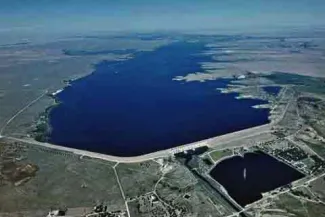
View from the air of the John Martin Reservoir dam in Bent County. Courtesy CPW.
"Raw sewage can carry pathogens such as E. coli, viruses and protozoa," said Ashley Rust, CPW water quality specialist. "Out of an abundance of caution, we provide these advisories to the public."
Prowers County Public Health and Environment issued its own alert September 3. A sample taken September 1 at the Highway 50 bridge in Lamar had come back at 613, and the county told residents to avoid all contact with the river there. The county said North Gateway Ponds were being tested as a precaution, but the risk there was low because the ponds only take river water during major floods. Two samples from the ponds, on September 4 and 5, read 1 and 2.
The reservoir clears
The sewage did not linger in John Martin. Four samples at the east boat ramp between August 31 and September 6 never read higher than 6.3. CDPHE lifted the advisory for the reservoir Friday, September 4, after several days of results within the state standard. Samples on September 11 and 12, during the runoff pulse upstream, read 53 and 13, both well within the standard.
"Multiple safe readings over several days gives us confidence to lift the sewage-related advisory," Kirmer said. "Testing will continue through the weekend and in the days ahead, and we will keep visitors informed."
"Thanks to coordinated sampling efforts with Colorado Parks and Wildlife and local partners, we have verified that E. coli levels at John Martin Reservoir are back within standard thresholds, allowing us to restore full recreational access," said Nicole Rowan, director of CDPHE's Water Quality Control Division.

The same announcement kept the advisory in place for the river from Fountain Creek through La Junta. CDPHE had not issued an update as of Tuesday, September 15. The Otero County Health Department, which serves La Junta, had not posted an update on the river since September 2 as of Thursday, September 10.
E. coli is a family of bacteria that lives in the intestines of people and animals. Most kinds are harmless, and health officials test river water for E. coli because finding it is a sign that sewage or manure has reached the water. Where E. coli is high, the germs that travel with it are likely to be there too. According to the Centers for Disease Control and Prevention, people get sick by swallowing the bacteria, which can happen through contaminated water as well as food or contact with animals. Some strains, called Shiga toxin-producing E. coli, can cause severe illness. In a small share of those cases the infection leads to hemolytic uremic syndrome, a condition that can cause kidney failure and can be fatal. Children under 5, adults 65 and older, and people with weakened immune systems are most at risk. The state's warning list covers the wider set of germs a sewage spill carries: bacteria, viruses and parasites that can cause diarrhea, vomiting, stomach cramps and fever.
Farms and ranches
The Colorado Department of Agriculture notified registered produce growers along the valley soon after the spill was discovered. On September 3 it sent a stronger notice to all agricultural producers in the lower Arkansas basin.
Growers should not sell any produce whose edible portion may have touched contaminated water, the department said. Crops not covered by the federal Produce Safety Rule that were irrigated with river water should not be harvested until growers talk with the department. Other crops irrigated with contaminated water should not go into the animal feed market. Anyone who irrigated from the river or from ditches fed by the river on or after August 25 was asked to contact the department's Produce Safety Program before harvest.

The department said the risk is higher than with runoff from livestock because the contamination came from human waste. It can carry parasites such as Cyclospora that readily infect people.
"Our collective goal is to avoid a mandatory 'stop sale' for ALL agricultural products in the Lower Arkansas Basin," the notice said.
Ranchers were told to give livestock another source of clean water and to call a veterinarian if animals had already drunk from the river.
Drinking water and what comes next
CDPHE said it had no evidence the spill affected any public drinking water system. Systems downstream were notified in time to shut off their river intakes, and treatment plants have other barriers against contamination. Anyone on a private well who believes it may have been affected was asked to contact the Water Quality Control Division.

© mheim3011 - iStock-544332118
U.S. Senator John Hickenlooper met with state and local leaders in Pueblo September 2, to discuss the spill and cleanup plans, and heard concerns about its effect on farmers and ranchers from county officials in La Junta, according to a release from his office. "This is the worst nightmare," the release quoted him as saying at the Pueblo press conference.
What still applies
Until CDPHE lifts the advisory for the river between Fountain Creek and La Junta, the state asks people in that stretch to:
- Stay out of the river. No swimming, wading, tubing, kayaking or fishing.
- Keep children, pets and livestock away from the water.
- Do not drink untreated river water or use it to prepare food.
- Do not put untreated river water on fruits or vegetables that will be eaten raw.
Anyone who does get into the water should wash with soap and clean water, wash wet clothing separately, and see a doctor if diarrhea, vomiting, cramps or fever develop.
The state is now sampling about 15 river sites from Pueblo to Holly. Results are posted on CDPHE's Arkansas River spill dashboard, linked from cdphe.colorado.gov/water-quality under "City of Pueblo: Wastewater Spill." Prowers County residents can call the county health department at 719-336-8721. Producers can reach the Department of Agriculture's Produce Safety Program at cda_produce.safety@state.co.us.