Rain trims extreme and exceptional drought as Colorado closes out the water year

© KiowaCountyPress.net
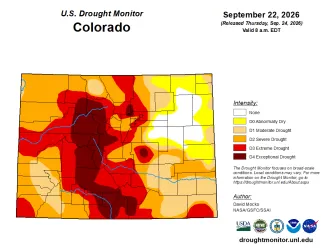
Rain over parts of Colorado last week pulled back the state’s most severe drought categories, according to the National Drought Mitigation Center, though exceptional drought still grips much of the central mountains and the San Luis Valley. The U.S. Drought Monitor map released Thursday, September 24, reflects conditions as of 8 a.m. Tuesday, September 22.
Extreme and exceptional drought combined now cover 38 percent of Colorado, down from 44 percent a week earlier, according to the U.S. Drought Monitor. The National Drought Mitigation Center said most of the High Plains “received beneficial rainfall,” but noted that more precipitation will be needed to ease extreme drought across much of Colorado, where areas of exceptional drought remain in the central part of the state.
©
Colorado drought conditions - September 22, 2026 - National Drought Mitigation Center
Snowpack
Colorado’s 2026 water year ends Wednesday, September 30, closing a year that saw drought steadily tighten its hold on the high country. When the water year began on September 30, 2025, 46 percent of the state was free of drought and no area was classified in exceptional drought. Today just 6 percent of Colorado is drought-free and exceptional drought covers 13 percent of the state, concentrated along the mountain spine that feeds the state’s major rivers.
Mountain snowpack is typically negligible this time of year, and the new accumulation season is only beginning. That leaves reservoirs and streams heading into winter dependent on how quickly fall and early-winter storms can rebuild snowpack across the central and southern mountains, where the deepest drought is centered.
Near-term moisture may help. The National Drought Mitigation Center reported that remnants of a tropical system are expected to bring significant moisture to the Four Corners states and the western Great Plains over the next several days, with heavy rainfall in the forecast. The 6- to 10-day outlook for September 29 through October 3 favors above-normal precipitation over much of the central United States.
Drought Conditions
Exceptional drought, the most severe category, eased from 15 percent to 13 percent of Colorado this week, according to the U.S. Drought Monitor. The largest pullback came along the western edge of the exceptional drought core in the Colorado River corridor west of the Continental Divide, where conditions improved to extreme drought. The core itself, stretching from the central mountains south through the San Luis Valley, remained in place, including Eagle County, Lake County, Summit County, Chaffee County and Alamosa County, each of which was largely or entirely in exceptional drought a week ago.
Extreme drought contracted from 29 percent to 25 percent of the state. Improvement was visible in northwestern Colorado, where extreme drought gave way to severe drought in several areas, and in the southwestern part of the state, where moderate drought expanded.
On the southeastern plains, the two small pockets of extreme drought that sat along the lower Arkansas Valley a week ago were removed, and moderate drought expanded across much of the region, continuing the improvement that began the previous week. Baca County remains the driest area on the southeastern plains, with extreme drought still covering its southern portion. In northeastern Colorado, abnormally dry conditions expanded slightly, while the area free of drought held near 6 percent of the state.
Statistics
Compared to the previous week, drought-free area held at 6 percent of Colorado, while abnormally dry conditions grew from 6 to 8 percent. Moderate drought expanded from 16 to 18 percent and severe drought from 28 to 29 percent. Extreme drought declined from 29 to 25 percent, and exceptional drought fell from 15 to 13 percent, shifting a portion of the state into less severe categories.
One year ago, on September 23, 2025, conditions were far milder. Forty-three percent of the state was free of drought, and no part of Colorado was in exceptional drought. Abnormally dry conditions covered 10 percent of the state, moderate drought 9 percent, severe drought 22 percent and extreme drought 15 percent.
| Week | Date | None | D0 | D1 | D2 | D3 | D4 |
|---|---|---|---|---|---|---|---|
| Current | 2026-09-22 | 6 | 8 | 18 | 29 | 25 | 13 |
| Last Week to Current | 2026-09-15 | 6 | 6 | 16 | 28 | 29 | 15 |
| 3 Months Ago to Current | 2026-06-23 | 0 | 3 | 12 | 47 | 29 | 9 |
| Start of Calendar Year to Current | 2026-01-06 | 26 | 28 | 30 | 11 | 4 | 1 |
| Start of Water Year to Current | 2025-09-30 | 46 | 9 | 9 | 22 | 14 | 0 |
| One Year Ago to Current | 2025-09-23 | 43 | 10 | 9 | 22 | 15 | 0 |
Drought categories include (ranked from least to most severe) abnormally dry (D0), moderate (D1), severe (D2), extreme (D3), and exceptional (D4) drought.