Republican candidates for Sheriff face off at Kiowa County forum

© Baris-Ozer - iStock-1420488382
This article was updated June 6, 2026, at 1:12 p.m. to clarify that Kiowa County Farm Bureau has opted not to endorse candidates, however other Farm Bureau affiliates are free to do so.
Kiowa County Republican voters, and independent voters choosing to cast a Republican ballot in the June 30 primary election, will have a choice between two candidates for sheriff: incumbent Bryan Williams, and challenger Joshua Robertson. The sheriff’s race is the only local office contested for this election cycle.
Both candidates appeared at the Eads Senior Citizen Center Thursday night in a forum presented by Kiowa County Farm Bureau to speak to their backgrounds, philosophies, and intent for law enforcement over the coming four-year term.
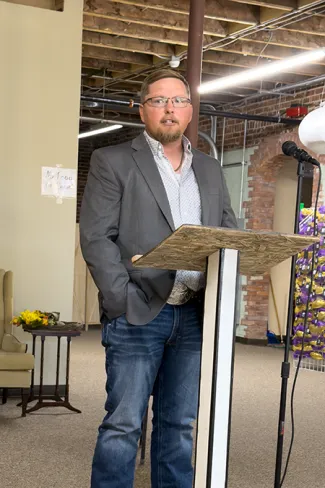
©
During opening remarks, Robertson noted that he had been a Colorado Peace Officer Standards and Training (POST)-certified law enforcement officer since 2020, and had served under Williams as well as two past sheriffs, Forrest Frazee and Casey Sheridan.
Williams highlighted his service as a Marine and 32 years in law enforcement, which included 23 years with the Colorado State Patrol before retiring.
Gary Melcher from Prowers County Farm Bureau moderated the forum, presenting written questions submitted in advance by the audience. The first question asked the candidates to present their views on addressing the younger generation.
Robertson emphasized a need to be present at youth events, and to remember that Kiowa County has two schools. He noted that children need to be able to trust, not fear, law enforcement officers, and appealed to parents to avoid using law enforcement officers as a disciplinary threat to children.
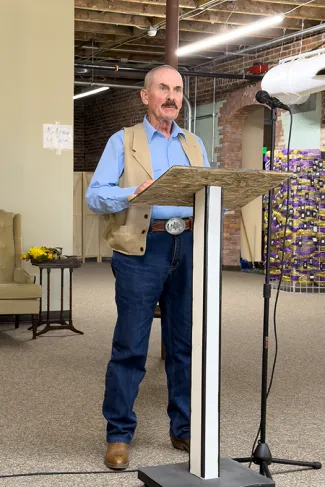
©
Concurring, Williams noted that he spends every morning at the school in Eads. While acknowledging Plainview School, he reminded the audience that school in Eads had intersections which posed a danger to students crossing streets. He further stated that, though challenging with a staff of four deputies, one is sent to each end of the county every day.
Melcher’s next question focused on supporting local business.
Robertson states there is a need to keep money in the county – though that can be difficult with competition from national retailers. Without the effort, towns would continue to shrink. He highlighted insignia patches for officer’s uniforms being produced locally as a positive example.
Williams noted that he shops at local stores, and encourages his deputies to do the same. For his office, while price is a factor, he does ask local businesses for bids on products and services. Tires are purchased locally, and vehicles are serviced locally when possible.
The next question asked candidates to address budgets and the need for deputies.
Williams walked through the budget process, noting the budget changes each year. For this year, about $650,000 has been allocated to the Sheriff’s Office, which is not a lump sum but comprised of line-item expenses to cover payroll, vehicles, fuel, supplies and other expenses. He stated he is careful with tax money – the people’s money. Salaries are the largest expense, though he would still like better pay for deputies since current salaries are not enough to retain deputies long-term. There is also other equipment he would like to obtain, however it is expensive, and Williams intends to maintain a tight rein on expenses. He also stated that the fuel budget would likely be exceeded since costs have double from when the budget was prepared last year.
Robertson said he did not have a lot to say about the budget, and acknowledged that, when he worked for Williams, Williams did a good job managing funds. He agreed with the need to increase deputies’ compensation, which must be balanced against ongoing training, which is significantly more expensive than in the past.
Melcher’s next question focused on employee retention and recruiting.
Williams outlined the current staff, which includes four deputies, undersheriff, administrative deputy, and a court security officer who is paid for via grant funds. While he works to spread coverage around the county, 24/7 coverage is not possible, and shifts are divided between mornings and evenings. Salaries for deputies are largely competitive with neighboring counties, but not larger areas, and he stated that one deputy had been lost to Lincoln County for higher pay. Training is important, though it can also lead to the loss of deputies who are able to use the increased knowledge to seek positions with other agencies.
Retention is almost impossible, Robertson agreed, stating it is difficult to get people to work for under $100,000. He recommended ensuring people were treated well, and that better pay would be key, and likely always a problem.
The candidates were then asked how they would reconcile state legislation that differs from rural values.
Williams stated that he had testified before the state legislature, and that he is a firm supporter of the Second Amendment to the United States Constitution, while the state legislature is not. He testifies when he can, though it can be difficult, yet needs to be done.
“We have to get out and get our voices heard,” said Robertson, telling lawmakers why guns are a necessity in rural areas. He also suggested that the concealed carry permit process is being made “a joke” with requirements to the point many people give up. Robertson stated that Williams has been making the process as easy as possible within the law, a process he would continue.
The next question from the audience asked about developing and maintaining relationships with other law enforcement agencies outside the county.
Drawing upon his 23 years with the Colorado State Patrol, Williams noted that he knew current CSP Chief Matthew Packard when Packard was new to the patrol. He also touted knowing all the surrounding sheriffs, and that they work together. Further, he calls upon the Colorado Bureau of Investigation for assistance when needed.
Robertson stated that rural counties must work together at all times. He proposed bringing agencies together regularly for joint training, and cited an example hosted in Kiowa County which also helped reduce costs. He also referenced the importance of asking for help from other agencies when needed, and agencies working at each other’s large community events to provide support.
The candidates were then asked about their leadership and administrative skills.
Robertson recounted his military career, leaving when he was a sergeant. He has experience commanding up to 45 people at one time. After leaving the army, he returned home to help with the family business and farm while also operating a trucking business with his father, which requires budgeting and scheduling skills. He also stated that people often ask why he wants to be a cop. He stated that, being in law enforcement, there is something new to learn every day – the learning never stops.
Williams started by managing auto repair businesses before joining the Marines, then joining the Colorado State Patrol. He also served as a volunteer law enforcement officer locally for seven years before being elected Sheriff.
Both candidates were asked how they would handle conflicts, especially with people they know.
Williams said he knew nearly everyone in the room and, at some point, it might be necessary to take law enforcement action or provide law enforcement support to anyone. He stated he has arrested law enforcement officers, and doesn’t play to favoritism.
Robertson agreed, stating that it is difficult to have lines, but the job requires it. While he is here to take care of people, there is also a job to do.
Melcher then asked the candidates about how they take advice from the community and from deputies.
Williams reiterated his open door policy, stating citizens do offer their suggestions. When possible, he’ll accept the advice, and will also explain when he cannot.
Robertson was also open to community input, recommending calls, texts, or emails to offer suggestions and ideas. He also noted that he was “not big on” coming to the office, preferring to be out in the community.
With behavioral and mental health issues being prevalent in small communities, the candidates were asked to outline their approach.
Williams acknowledged that mental health issues are significant, though he also noted law enforcement is limited in what it can do without risking lawsuits. He stated he would help any way possible, and has training to meet and talk with people to guide them to assistance.
Robertson referenced his military career, where mental health issues are significant, and he had attended funerals for colleagues. He said there is a need to be willing to help people through processes, and that everyone can experience mental health issues.
Editor’s note: If you or someone you know is in need of emotional support, call the Suicide and Crisis Lifeline at 988 to be connected to one-on-one support for mental health, suicide, and substance use-related problems for anyone 24/7.
Melcher then asked about e-bikes, golf carts and similar vehicles being driven on town streets.
Williams noted that the Town of Eads contracts for law enforcement services and, while he talked with the board of trustees about ordinances, action hasn’t been taken. Further, the state does not regulate e-bikes. Golf carts can be driven to the course, and are not intended to be driven around town. A state law could be applied, however the public would not favor doing so. He does not intend to give up his efforts, and is considering safety activities for children, such as a bicycle rodeo to teach the rules.
Robertson suggested looking to other communities which have faced similar issues for ideas about their approach. He noted he “grew up on a four-wheeler,” but also knew the rules. In his view, if children follow the rules there would not be an issue.
The next question addressed Flock-brand and similar cameras, such as those recently introduced in Cheyenne County.
Williams focused on the cost of the system. A five-year contract at $15,000 per year would be required, though a grant would cover three years. He said they were good tools, but not affordable.
Robertson said he was a proponent of Flock cameras. While some people are concerned about being tracked, Robertson explained that a search warrant and probable cause are necessary to search for vehicles in the system. He stated the cameras’ capabilities can give law enforcement time to react properly and call for assistance when needed.
One of the final questions of the evening asked the candidates about their approach to educating citizens on their right to defend themselves in- and out of their homes.
Williams stated that he has a person who provides that training and, for those who ask him, he explains the law. “You can’t just shoot people who make you angry,” he noted. He reiterated his firm support for the Second Amendment, and that his concealed weapons class covers the topic.
Robertson would like to conduct trainings as often as possible, and teach self-defense in a variety of locations. He also proposed quarterly community get-togethers which could include self-defense instruction as well as show the training law enforcement officers must take.
The forum concluded with appeals for each person to vote, and to encourage younger generations to become involved in the political process.
There are no Democrat candidates for sheriff, so the winner of the Republican primary will go on to be sworn in for a four-year term beginning in January following the November general election.
Other candidates for county offices include Howard (Butch) Robertson for Commissioner District 2, Adrienne Yates for Clerk and Recorder, Diana Flory for Treasurer, Marci Miller for Assessor, and Jimmy Brown for Coroner. All appear on the Republican primary ballot.
Farm Bureau organizations exist at the local, state, and national levels. Policy directives come from local members to pass to the state organization, which develops policy positions. The organization’s lobbyists pass those views to state legislators based solely upon adopted policies. Farm Bureau represents all aspects of agriculture, as well as those who live communities who may not be directly involved in agriculture production.
Kiowa County Farm Bureau is non-partisan and does not endorse candidates, though other Farm Bureau organizations may choose to make endorsements.