
States go their own way as RFK Jr. shifts federal vaccine policy

New federal guidance to reduce the number of vaccines recommended for all children from 17 vaccines down to 11 comes as states already are charting their own courses on vaccine policy.
The new federal guidelines mention a directive issued by President Donald Trump in December calling to align the U.S. vaccination schedule with “peer” countries, including Denmark, that recommend fewer childhood vaccines — even though those countries provide more robust government-funded health systems.
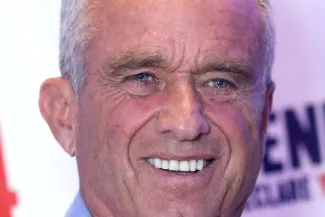
Robert F. Kennedy, Jr. © By Gage Skidmore, CC BY-SA 3.0, Link
At stake are requirements for attending public schools, where most states have seen lower vaccination rates since the pandemic, as well as insurance coverage that makes vaccines affordable. At least 17 states have announced they will disregard the new federal guidance.
Many have created formal alliances to share health information. The Northeast Public Health Collaborative, composed of Connecticut, Maine, Maryland, Massachusetts, New Jersey, New York state, Pennsylvania, Rhode Island, Vermont and New York City, announced Monday it will continue following guidance from the American Academy of Pediatrics.
“The science is clear. Vaccines remain the best protection for keeping children and communities healthy,” the collaborative said in its announcement. “The vast majority of American adults and parents believe routine childhood vaccines are important for public health.”
The American Academy of Pediatrics held a news conference this month to denounce the changed recommendations from the federal Centers for Disease Control and Prevention.
“Literally children’s health and children’s lives are at stake,” Dr. Sean O’Leary, chair of the association’s committee on infectious diseases, said at the Jan. 5 event. “There’s no evidence that skipping or delaying certain vaccines is beneficial for U.S. children. What we do know is that whenever children go without recommended vaccinations, they’re at risk for these diseases that we can prevent.”
And governors of 14 states have formed another alliance to share public health information, including on vaccines. The updated CDC guidance “creates confusion and introduces unnecessary barriers for families who want to protect their children from serious illness,” said the Governors Public Health Alliance in its January 6 news release. The governors are all Democrats, though the group says it is nonpartisan.
New Jersey moves
One of the states rejecting federal guidelines is New Jersey.
Jeffrey Brown, the acting commissioner of the New Jersey Department of Health, issued an executive order in December opting to keep older federal recommendations for a birth dose of the hepatitis B vaccine, despite changes in federal guidelines from the federal Advisory Committee on Immunization Practices.
Brown also urged state lawmakers to pass a bill formally decoupling state recommendations from federal rules on Jan. 5, the same day the new federal guidelines were released. The legislation would allow independent action on vaccines without such orders and would also require insurers to cover the vaccines, Brown said.

© monkeybusinessimages - iStock-684060608
The legislation “makes it very clear that the department of health can rely on expert bodies outside the ACIP when making vaccine recommendations that make sense for public health,” Brown said in his testimony before the Assembly health committee.
Novneet Sahu, the state’s deputy health commissioner, also testified and said federal changes reflect a dangerous “adoption of conspiracies and conjecture” about vaccines.
“When federal leaders fail and misinformation spreads, state policies and practices must empower New Jerseyans to receive accurate, evidence-based information about infection disease prevention tools like vaccines,” Sahu testified.
The bill, which passed in the state Senate in December, was approved by the committee in a 6-3 vote. The bill was passed by the state Assembly Jan. 12 and now heads to Democratic Governor Phil Murphy’s desk.
One of the “no” votes in the health committee was Republican Assemblyman Erik Peterson, who said at the hearing that he distrusts the state health department because of decisions about nursing homes during the pandemic.
“You have a lot of derogatory things to say about the federal government. But some of us have no faith in the health department here in the state of New Jersey,” Peterson said.
Changes elsewhere
Similar changes to vaccination policy are happening this year in the 23 states and the District of Columbia where vaccine recommendations that govern schools are tied to federal guidelines, said Andy Baker-White, senior director of state health policy at the Association of State and Territorial Health Officials. The association is tracking the new and proposed changes in 14 states and the district.
Many are setting up their own advisory committees or task forces to make vaccine recommendations. In many states, the guidelines are tied to school vaccination requirements, insurance coverage of vaccinations and rules allowing pharmacists to give vaccinations.

© iStock - ffikretow
Brown, the New Jersey acting health commissioner, said in his testimony that insurance requirements are an important part of the state’s bill, saying it “would make sure that people can continue to get reimbursed for vaccines even if ACIP [the federal advisory committee] removes vaccines from the schedule or changes those recommendations.”
The Centers for Disease Control and Prevention, in its announcement, said there would be no changes in insurance coverage for any of the vaccines, even though some are no longer recommended for all children.
AHIP, a health insurance trade group, said there had been no coverage changes and that all vaccines recommended as of September would be covered at least until the end of this year.
Florida has held public hearings on Republican Governor Ron DeSantis’ proposal to remove a requirement that children receive the hepatitis B, varicella (chickenpox) and haemophilus influenza B (Hib) vaccines in order to attend public school.
In Louisiana, there was an unannounced policy change in 2024, forbidding health workers from holding vaccination events or promoting COVID-19, flu or mpox vaccinations. That has made it hard for mothers like Crystal Rommen, director of Louisiana Families for Vaccines, an advocacy group that supports timely vaccinations.
Rommen said she had to organize other mothers of small children this year to make sure they got a COVID-19 vaccine.
“We have these policies that create more hesitation or doubt for parents,” said Rommen, a social worker with a 10-year-old son and a 7-year-old daughter. “I rallied my mom friends together, got a list of parents and children that wanted their child to get the COVID vaccine before my pediatrician could justify ordering enough doses. I’m kind of a bulldog. I’m gung-ho.”
The new federal guidelines continue to suggest 11 vaccines for all children, including measles, mumps and chickenpox. In announcing the guidelines, the CDC said reducing vaccinations aligns with “international consensus” while “strengthening transparency and informed consent.”
But experts said Denmark is not the right model for American policy.
Denmark has fewer undetected cases of some diseases, partly because of more access to health care and testing, so vaccinating large numbers of children doesn’t always make sense, a Danish specialist told Science magazine in a Jan. 7 article.
“The United States is not Denmark, and there is no reason to impose the Danish immunization schedule on America’s families,” Dr. Andrew Racine, president of the AAP, said in a statement.
The new guidelines have “more flexibility and choice” for six vaccines, the U.S. Department of Health and Human Services said, recommending them only for high-risk groups or for “shared clinical decision-making” rather than for all children: rotavirus, COVID-19, influenza, hepatitis A and B, and meningococcal disease.
That term means that doctors and parents should decide together, but it has caused confusion and reduced use in the past when applied to COVID-19 vaccines for all ages, according to a University of Pennsylvania survey.
“Expecting parents to engage in shared decision-making with health care providers about routine, thoroughly studied childhood vaccinations suggests that the public health community has doubts about the safety and efficacy of these vaccines when it does not,” said Patrick E. Jamieson, director of the university’s Annenberg Health and Risk Communication Institute in a statement.
Christine Sexton of the Florida Phoenix contributed to this report.