‘States must act’: Utah governor pushes for AI regulations ahead of federal preemption talk

© Khanchit Khirisutchalual - iStock-1515913422
Government should not be telling tech companies how to develop their artificial intelligence, Utah Governor Spencer Cox says, but it must be in the business of protecting children.
“The minute you decide to use those tools to give my kid a sexualized chat bot, then it’s my business and it’s the government’s business, and we are going to get involved,” he told a room full of tech executives at an AI Summit the Utah Department of Commerce hosted on Tuesday.
Cox has had a long complicated relationship with social media and artificial intelligence. And, while he doesn’t believe the government should be telling companies how to develop technology, he said he believes it must dictate some limits.
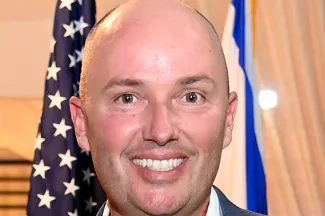
Utah Governor Spencer Cox
And the federal government should not interfere with that effort, he said.
“However much you hate social media, you do not hate it enough. You do not hate these companies enough,” he said.
His remarks came just days after 12 Republican Utah lawmakers signed a letter urging Congress to reject a provision in the National Defense Authorization Act that would allow the federal government to preempt state and local governments on AI regulations.
In the letter, state lawmakers said that in an “increasingly fraught digital environment” there are new risks for youth and seniors online. A federal preemption would leave communities exposed and could “nullify a wide range of laws that states have already adopted to address urgent digital issues.”
“I would much prefer that we had a Congress that could actually pass a bill, that could actually do something that could function the way it was designed to function,” Cox said. “But if it is not going to function, then the states must act, and we must have the ability to do that, and we will fight for that ability to do that.”
However, arguing that these technologies have the potential to solve big problems in society, Cox announced a “pro-AI initiative,” meant to look at the technology’s impacts on workforce, industry, state government, academia, public policy and education.
“The core element asks us to prioritize human leadership in the age of AI, ensuring that AI remains understandable in how it functions, accountable in its impacts and adaptable to human needs, rather than the other way around,” he said. “And the second core element is that AI must be human-enhancing. It should expand our capabilities, not diminish them.”
The state is planning on spending $10 million for a workforce accelerator initiative that will support AI in the state, Cox said. That would include curriculum expansions for AI research, energy, semiconductors, quantum computing and advanced materials both in higher education institutions and K-12.
An AI-loaded 2026 session
After creating a state office to regulate AI and foster innovation in 2024, Republican lawmakers have big plans to boost AI regulations during the 2026 legislative session.

“In this next session, and coming up, you’re going to see much more work with our state Legislature,” Cox said. “We’re going to be looking at harm reduction in AI companions, transparency around deep fakes, and an upcoming study around data ownership and control more broadly, as well as the interaction with AI and health care.”
Let us know what you think...
Also, a big focus will be preventing anti-competitive actions by big tech companies, an issue Utah lawmakers started to work on this year, when they approved the first law in the nation to push tech companies towards interoperability, allowing users to own their own data
“We need to make sure that we don’t end up with five AI companies. We need thousands of AI companies in this country,” Cox said.
Representative Ariel Defay, R-Kaysville said during a panel on Tuesday that she will sponsor legislation aiming to regulate deep fakes and AI companions. She’s also expected to draft a bill titled “the balanced technology in classrooms act,” which stems from her concerns of AI use in the education system, she said.
“I want all the districts, all the (local education agencies), to have the conversation,” Defay said. “Are we correctly balancing the use of technology in our classrooms? And that includes tech and AI.”