Utah Legislature passes bill to expand Utah Supreme Court, add 5 more lower court judges

© legacyimagesphotography - iStock-160735792
A bill to expand the Utah Supreme Court from five justices to seven — and also add two more Court of Appeals justices and three district court judges — has won final legislative approval from the Utah Legislature.
SB134, sponsored by Senate Minority Whip Chris Wilson, R-Logan, now goes to Governor Spencer Cox’s desk.
The governor’s office did not immediately respond to a request for comment about the bill Friday, but Cox has previously expressed support for expanding the Utah Supreme Court. He’s expected to sign it.
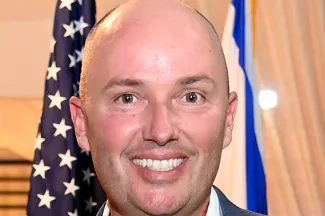
Utah Governor Spencer Cox
The governor and Republican legislative leaders have said the $6.5 million bill isn’t aimed at “court packing” or changing the makeup of the state’s highest court to appoint justices that make decisions more in the Republican-controlled Legislature’s favor. They have argued it’s to better align Utah with other similarly-populated states that have seven justices while also increasing “statewide resources” for the courts.
But critics, including Democrats and some legal professionals, have argued that the timing and optics of the Utah Supreme Court expansion is suspicious. It comes as the Republican-controlled Legislature continues to clash with the courts over several rulings, especially in the state’s redistricting lawsuit which recently led to a court-ordered map that included one Democratic district and three heavily GOP districts.
The bill was supported by most GOP legislators but opposed by Democrats and a handful of Republicans.
The Republican-controlled House approved the bill on Friday on a 57-18 vote, with four Republicans joining Democrats to vote against it: Representatives Clinton Okerlund, R-Sandy; Ray Ward, R-Bountiful; Anthony Loubet, R-Kearns; and Leah Hansen, R-Saratoga Springs.
Last week, the Senate voted 21-8 to approve the bill, with one Republican, Senator Evan Vickers, R-Cedar City, and the state’s only third-party lawmaker, Forward Party of Utah Senator Emily Buss, of Saratoga Springs, joining Democrats in voting against.
‘Meant to be helpful, not hurtful’
The bill’s House sponsor, House Majority Leader Casey Snider, R-Paradise, said Friday the goal of the bill is to “provide additional resources to the courts to allow them to be more efficient, more effective and more responsive.”
“It is meant to be helpful, not hurtful,” he said. “It is meant to be an improvement, not a criticism.”
Snider also argued that “seven sets of eyes reviewing the complex and difficult issues our state has ever faced is better than having only five sets of eyes.”
Because the bill won approval with more than two-thirds of the Legislature, it will take effect immediately after the governor signs it. Cox can then begin the process of choosing two new Utah Supreme Court justices, who would then be subject to confirmation by the Senate.

While its proponents said it’s meant to infuse much-needed money and resources into the state’s court system in order to help with heavy workloads and speed up decision-making, opponents argued legislators should have concentrated more funding on the district court level, where Chief Justice Matthew Durrant has said there is the greatest need.
Representative Grant Miller, D-Salt Lake City, opposed the bill, though he started his arguments by acknowledging it does “some good.”
“A lot of resources are being allocated to clerks and to district court judges, which is sorely needed,” Miller said. “What concerns me here is the great expense that would have to be incurred by the state to expand the Supreme Court.”
Miller said it would require expensive renovations to the court’s chambers and offices, not to mention the money needed to pay the two new justices and their clerks.
“This is an ongoing expense. Supreme Court justices are appointed for life,” he said. “This is not an amount of money we could ever dial back.”
Miller argued to instead use the money to fund additional clerks and district court judges.
“The courts have issued a wish list to us. At the top, they’ve asked for support for their staff and for their judiciary clerks and assistants,” Miller said. “Nowhere in their wish list have they asked for two Supreme Court Justices.”
The bill originally would have only added two justices each to the Utah Supreme Court and Court of Appeals — but Republican lawmakers changed the bill last week to include three additional district court judges after Durrant’s State of the Judiciary speech in front of lawmakers last week.
“We listened to the judiciary, and we did add the three district court (judges),” Wilson said during a media availability Thursday.
The bill does include significantly more money for the district courts — but not as much as the state’s judiciary has requested.
‘The biggest funding we’ve ever done for the judiciary’
In his State of the Judiciary speech, Durrant highlighted key budget requests for the judiciary, including $6 million in ongoing funds to train and retain courthouse staff, and more money to fund eight additional district court judges, one juvenile court judge, four commissioners, and at least one if not two Court of Appeals judges.
Durrant told lawmakers that expanding the Utah Supreme Court is “of course, your prerogative.” But he urged them to also weigh the judiciary’s budget requests. “If you elect to fund two new justices, please do not do it at the expense of the judicial positions we have prioritized,” he said.
When pressed on the bill fulfilling some — but not all — of the judiciary’s requests for the district, Wilson told reporters, “You know what, I don’t know of a state department that’s ever gotten everything they’ve asked for.”
“I think it’s the biggest funding we’ve ever done for the judiciary,” Wilson said. “From what I’ve been told, it is by far the biggest commitment we’ve made.”
Wilson’s SB134 comes with a cost of more than $6.5 million, including more than $4.6 million in ongoing funds to pay for the new judges, their staff, and their benefits.
Nearly half of the bill’s price tag would go toward making room for two more Utah Supreme Court justices, including $1.7 million in one-time money to build new chambers, along with $1.4 million in ongoing money to fund the salary, benefits and staff for the two new justices.
It would also cost the state about $1.3 million in ongoing money for the salary, benefits and staff for the two additional Court of Appeals justices, along with nearly $1.9 million in ongoing money for the salary, benefits and staff for the three new district court judges.
Although the bill has won final legislative approval, lawmakers are still weeks away from finalizing their budget, which usually doesn’t happen until the final days of the Legislature’s 45-day session, scheduled to adjourn on March 6.
If lawmakers don’t fully fund the bill despite its passage, it could die. Asked about that possibility during a media availability on Friday, Senate President Stuart Adams, R-Layton, told Utah News Dispatch it will be a priority during the budgeting process and it has a “high probability” of being funded.
“We have to fund it,” he told reporters. “That’s something we have to do.”