Cancer, aging and keeping doctors in town: what Kiowa County residents told Weisbrod Health

© Chris Sorensen / KiowaCountyPress.net
Cancer worries Kiowa County residents more than any other health problem. Growing old is second. And when people put off seeing a doctor, the reasons are the cost and the wait for an appointment, not the distance. Those are among the findings from Weisbrod Health's 2026 community survey, presented at the hospital's second Community Health Needs Assessment meeting in September.
Hospitals repeat a community health needs assessment every three years. The survey, and a live discussion with 17 local leaders, will help set Weisbrod Health's priorities for the next three.
Who answered
The survey opened September 1 and ran online through SurveyMonkey. Forty-four people answered 34 questions about health, access to care, housing, food and transportation.
The hospital was careful to say what those 44 answers are and are not. They are a volunteer sample, not a random one. Nearly nine in ten respondents were women, 93 percent were white, and 98 percent live in the 81036 ZIP code, which is Eads. Seven in ten work 40 hours a week or more. Men, younger residents and anyone outside Eads are underrepresented. The hospital said it will treat the results as a guide to what matters, paired with clinical and claims data in the full assessment, rather than as precise percentages for the whole county.
What worries people
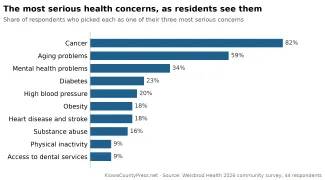
Asked to pick the three most serious health concerns in the community from a list of 20, 82 percent of respondents chose cancer. Aging problems came second at 59 percent and mental health problems third at 34 percent. Diabetes, high blood pressure, obesity, heart disease and stroke, and substance abuse each drew between 16 and 23 percent.
©
Most respondents called the community healthy, but not strongly. Sixty-three percent rated community health as "somewhat healthy," 28 percent as "healthy" and 2 percent as "very healthy." Seven percent said "unhealthy." On safety, the verdict was firmer: 73 percent said the community is safe, 9 percent very safe and 18 percent somewhat safe. Nobody called it unsafe.
Asked what matters most for a healthy community, half of respondents put access to health care in their top three. A good place to raise children came next at 45 percent, followed by affordable housing and low crime at 34 percent each.
Putting off care
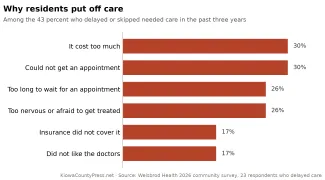
Forty-three percent of respondents said they or someone in their household had needed care in the past three years and delayed it or went without. Of those 23 people, 30 percent said it cost too much and 30 percent said they could not get an appointment. A quarter said the wait for an appointment was too long, and a quarter said they were too nervous or afraid to be treated. Seventeen percent said insurance did not cover the care, and 17 percent said they did not like the doctors.
©
Prescriptions are a smaller problem, but not for everyone. Seventy percent said they can afford their medications through insurance without hardship. Sixteen percent said they can afford them, but it is a financial hardship. The hospital flagged that group, because they already have insurance. Coverage alone is not closing the gap for them.
In the past two years, 65 percent of households used the hospital's emergency department and 65 percent used primary care. Thirty-five percent had surgery, 30 percent saw a specialist and 23 percent had a hospital stay. Among specialists, chiropractors led at 43 percent, then dentists at 40 percent and physical therapists at 36 percent. The hospital noted that all three are services usually found outside a hospital's own specialty mix.
Two-thirds of respondents are satisfied with the health care system overall, counting the very satisfied, satisfied and somewhat satisfied together. Eighteen percent were neutral, and 11 percent were dissatisfied.
Everyday needs
For most respondents, the basics are covered. Ninety-eight percent have a steady place to live, 81 percent never worried about food running out, and 93 percent said transportation has not kept them from appointments or work.
The gaps are small in number but real. Nineteen percent said they sometimes or often worried about running out of food. Sixteen percent reported pests at home, such as bugs, ants or mice, and 26 percent reported some housing problem such as pests, mold or leaks. Seven percent said a lack of transportation had kept them from care, work or daily needs. One respondent had faced a utility shut-off threat in the past year. The hospital said each of those needs often amounts to one to three households in this sample, but they are worth tracking.
Three-quarters of respondents said poor physical health had not kept them from their activities on any day in the past month, and three-quarters said the same of poor mental health. About one in four said they feel lonely or isolated at least sometimes. No one said usually or always.
What people want
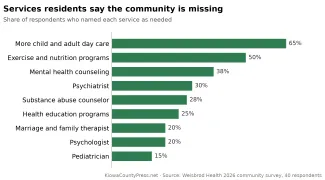
Asked what services the community lacks, 65 percent named more child and adult day care. Half named exercise and nutrition programs. Behavioral health showed up in four separate answers: mental health counseling at 38 percent, a psychiatrist at 30 percent, a substance abuse counselor at 28 percent, and a psychologist and a marriage and family therapist at 20 percent each. Health education programs drew 25 percent and a pediatrician 15 percent.
©
Weisbrod already calls emergency department patients afterward to offer a primary care follow-up. Asked how they would like that call to come, two-thirds of respondents wanted a text first, or a text instead. The most popular choice, at 33 percent, was a text with the option to ask for a call. Twenty-one percent wanted a text saying a call is coming, and 12 percent wanted a text only. Twenty-four percent were fine with a call out of the blue. One respondent did not want a follow-up at all.
In their own words
Thirteen of the 44 respondents wrote an answer to the question "What else would you like us to know?" The theme that came up again and again, unprompted, was keeping providers in town.
"Please work on trying to keep our providers here," one wrote. "I find a good one I really like and they leave... why are they willing to drive to surrounding communities to practice?"
Others thanked the hospital for its leadership and staff. One wrote that racial issues in the community make it hard for people of other races and cultures to come to the hospital for care. Another asked for a program that teaches people to grow, cook and preserve their own food, and for the hospital to sponsor fitness clubs and events.
What local leaders added
At the September meeting, 17 people from hospital leadership and nursing, the county Department of Social Services, public health and the Eads school district reviewed the results and added their own view through a live poll.
They counted small-town connectedness, safety and neighbors looking out for each other as strengths, along with the hospital's existing follow-up calls to emergency patients, which drew broad support for expansion.
The gaps they named matched the survey. Distance, provider availability and cost limit specialty care, with dental, dermatology, orthopedics and endocrinology mentioned. Waitlists and gaps in Medicaid and out-of-network coverage make the delays worse. Stigma and privacy concerns keep people from seeking help for mental health and substance use. Housing, grocery costs and child care strain household health.
The priority areas they raised were housing affordability, expanded specialty care and management of chronic disease such as high blood pressure, cancer prevention and screening, and recreation and wellness spaces, such as a community pool, tied to mental health. Leaders also said on their own that patients respond better to a text than to a cold call.
The hospital's summary boiled the survey down to six points: cancer, aging and mental health top the list of concerns; cost and scheduling are the biggest barriers to care; provider retention came up repeatedly without being asked; demand for behavioral health spans several kinds of service; basic needs are mostly met, but not for everyone; and text-first communication is the clear preference.