Colorado ballot measure would let state keep more tax money for education

Colorado public schools could get a funding boost under a ballot measure lawmakers will consider referring this year.
The measure would raise the cap on how much revenue the state can keep and spend under the Taxpayer’s Bill of Rights. The increase would be tied to how much the state spends on education through its general fund, which is now about $4.5 billion. The measure is backed by the Colorado Education Association, a teachers union.
© flickrcc - Alan Levine
“For more than 30 years, an outdated and arbitrary revenue cap has kept our state funding tied up so tightly that we can’t invest in public education and keep up with student needs,” CEA President Kevin Vick said during a press conference Thursday on the steps of the Colorado Capitol. “Even when Colorado’s economy is strong, this cap blocks the state from using money it already collects for K-12 education.”
The state is required to refund money it collects over the TABOR cap to taxpayers through a variety of mechanisms. In recent years, it has sent direct checks to people and issued various tax credits, but under the proposed measure that money would go to education instead of back to taxpayers.
Two studies found that Colorado lags in school funding by between $3.5 billion and $4 billion. Even if the cap is raised for education costs, that doesn’t mean the funding gap will actually close, because the state does not collect money over the cap — known as a TABOR surplus — every year. A forecast from the non-partisan Legislative Council Staff in December predicted a $297 million surplus in the 2025 fiscal year, but a $465 million deficit below the cap in the 2026 fiscal year.
“This will give us $90 million to $100 million. That is far from ultimate sufficiency, but we need to provide some relief now,” Vick said.
But education advocates still see the ballot measure as a strategy to address low teacher pay, growing classroom sizes and shrinking support in schools, particularly in rural parts of the state.
© Svanblar iStock-146069215
“Schools keep losing teachers, paraprofessionals and support staff, because wages don’t come close to a livable income,” said Sam Islaub, a library teacher and paraprofessional in Summit County. “Turnover increases, stability disappears and students lose the trusted adults who support them every day.”
The state’s teacher turnover rate is about 17 percent, while the rate in Summit County is nearly 26 percent, according to data from the Colorado Department of Education. The average teacher salary is about $73,000.
“We’re standing here today because we believe that our work matters and that our students matter. Voters should have the chance to show that they agree,” she said.
The measure would also have an annual audit provision, Vick said.
The bill to refer the measure will be sponsored by Senator Jeff Bridges, a Greenwood Village Democrat, and Representative Jennifer Bacon, a Denver Democrat and the assistant majority leader in the House. Vick said the legislation is expected to be introduced in early February.
The ballot measure would come on the heels of other moves to increase education funding. A new funding formula passed by the Legislature last year will direct an additional $500 million to schools over seven years. The Legislature also got rid of the so-called budget stabilization factor in 2024, a mechanism that let the state fund schools below a constitutional level to make the budget work.
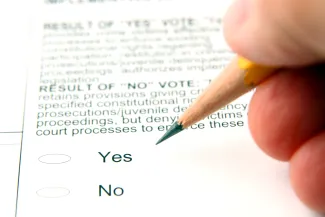
Legislation to refer the measure to voters will need a simple majority in both the state House and Senate to land on this year’s ballot. Democrats have large majorities in both chambers.
The last time the Legislature referred a measure to raise the TABOR cap was in 2023 with Proposition HH, which was aimed at reducing the impact of property taxes. It failed by 19 percentage points.