Colorado State Land Board approves stewardship plan to protect declining lesser prairie-chicken

The Colorado State Board of Land Commissioners on Thursday unanimously approved the 2026 Lesser Prairie-Chicken Stewardship Action Plan, a five-year strategy to protect and manage habitat for one of the state’s most at-risk bird species on roughly 84,300 acres of state trust land in southeastern Colorado.
The plan targets habitat areas where lesser prairie-chicken range overlaps with active agricultural operations and reinforces the agency’s dual responsibility to safeguard ecological health while generating revenue for Colorado’s public schools.
Fewer than 100 breeding males of the plains-dwelling grouse are estimated to remain in Colorado, following decades of steep population declines. State trust lands make up just 3 percent of lesser prairie-chicken habitat statewide, but contain a significant share of high-quality sandsage and native grasslands considered critical to the species’ survival.
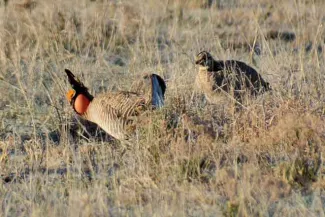
Male lesser prairie chickens can be heard stomping their feet in a mating dance, and they boom by inflating a red sac on their neck and quickly releasing the air. They also make a cackling noise that can be heard as they engage in mock battles, flying into the air and confronting rivals on the breeding grounds. Courtesy CPW / Bill Vogrin.
“This plan reflects exactly what our mission calls us to do — care for these lands in a way that sustains both their ecological integrity and their long-term value for future generations,” said Dr. Nicole Rosmarino, Director of the State Land Board. “By investing in habitat stewardship for the lesser prairie-chicken, we are supporting resilient landscapes, strengthening financial stability for our agriculture partners, and ensuring these trust assets continue to serve Colorado’s public school beneficiaries for decades to come.”
The Stewardship Action Plan focuses on three goals: resource conservation, responsible resource development, and outreach and engagement with agricultural lessees. Key strategies include protecting priority areas from energy development, using adaptive grazing practices, exploring incentive-based conservation programs, and strengthening protections around high-priority habitat such as the Sand Sage Generational Grassland.
Other Colorado producers, such as a Leopold Conservation Award-winning ranch, have demonstrated how working lands can support at-risk species recovery.
The plan was developed in close collaboration with Colorado Parks and Wildlife, whose research and habitat assessments informed many of its priorities.
“The lesser prairie-chicken is an iconic species of Colorado’s southeastern grasslands and an important indicator of ecosystem health,” said Laura Clellan, Director of Colorado Parks and Wildlife. “This plan represents a meaningful step forward — bringing science, stewardship, and partnership together to improve habitat conditions and give this species a better chance at long-term recovery.”
Agricultural lessees manage the majority of lesser prairie-chicken habitat on state trust lands and will be central to the plan’s implementation.
“Our lessees are essential partners in this work,” said Deb Froeb, President of the Colorado State Board of Land Commissioners. “This plan is designed to meet producers where they are — offering tools, incentives, and collaborative opportunities to support grazing practices that benefit both their operations and the health of lesser prairie-chicken habitat. I hope this can serve as a useful example, and perhaps as a source of inspiration, for similar approaches across the state.”
Recent polling has shown broad public support for voluntary private land conservation, suggesting the producer-partnership approach has a receptive audience. Management of the species has been contentious, with legal challenges in neighboring Kansas shaping the regulatory landscape.
Implementation begins immediately, with annual monitoring and reporting on habitat improvements, lessee engagement, and overall effectiveness. The Board will review progress annually and reconsider the plan at the end of the five-year period. The plan maintains flexibility for compatible land uses, including agricultural production and renewable energy and transmission development where appropriate.