Commentary - Bear attacks in Colorado are climate attacks

Last week, a black bear broke into a house in Estes Park and attacked a woman who is in her 80s, scratching her stomach and knocking her to the floor.
Colorado Parks and Wildlife has long urged residents to take precautions in bear country, as outlined in this bear awareness guide published nine years ago.
The week before that, a bear attacked an angler in his 60s in Jefferson County. The bear knocked the man to the ground and bit his legs until his friends managed to scare the animal away.
The number of bear attacks in Colorado this year is more than double the figure last year, and they come amid an extraordinary number of bear encounters as environmental pressures drive bears to food-finding extremes. Colorado Parks and Wildlife, the state’s wildlife manager, has broadcast bear safety awareness, and news outlets in the state have widely covered the unusual bear activity. But what has failed to come through official and media channels is the obvious, if uncomfortable, fundamental cause of this phenomenon: global warming.
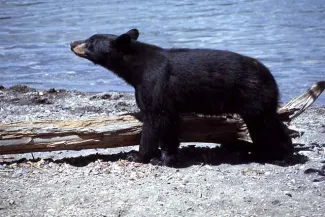
Black bear. Courtesy National Park Service
These bear attacks are climate attacks.
According to CPW, 6,129 bear “incidents” — including “sightings and conflicts” — occurred this year through mid-August. Just 3,115 were reported during the same period last year, and the state is on pace to record the most incidents since officials started keeping track.
These include unprecedented encounters, such as bears appearing in the middle of Denver. Last week a bear showed up in the city’s Platt Park neighborhood, near Washington Park. This is not too far from the heart of the urban core. Never happened before.
Climate horrors in Colorado are no longer just a threat. They’ve arrived.
We’re in the time of year when black bears go on an eating spree to store up fat for the winter. But natural sources of food are especially scarce this year. Why? “Low mountain snowpack, wildfires and drought have reduced the availability of natural foods such as berries, fruits, nuts, plants and grasses in parts of Colorado,” according to CPW.
What the agency omits is that human-caused climate change, from the burning of fossil fuels, is a key contributor to low mountain snowpack, wildfires and drought.
“What we’re seeing are the unprecedented impacts of climate change right now on the environment, and bear behaviors reflecting that,” said Samantha Miller, senior carnivore campaigner with the Center for Biological Diversity and a Grand Lake resident. She noted in an interview with Newsline that increasing wildfires and hotter and drier conditions degrade bears’ ability to survive. “All of these factors are really contributing to decreasing habitat, less available food for bears, and bears becoming more desperate right now because of the climate impacts that they are navigating.”

Colorado saw a record-low snowpack this year, and a study from Colorado School of Mines researchers showed that global warming is almost certainly to blame. Wildfires in Colorado are becoming bigger and more intense, and researchers have established that climate change plays a role. A drought that’s gripping the Southwest is so severe and so prolonged that researchers call it a megadrought. What’s causing it? Yes, climate change. Now we can add to these expressions of catastrophic global warming the desperation of Colorado’s hungry bear families.
“With climate change, it causes a cascade of impacts on our ecosystems,” Miller said. “So it causes drought. It causes wildfire. All of that then causes less habitat, less food availability. Harsher winters can cause, you know, more like a weaker condition in animals, too, as they emerge. The longer summers are hard. Warmer springs are hard. All of these things impact not only wildlife like bears, but also food for wildlife like bears … It’s all from climate change, and it’s all interconnected.”
It’s important to be forthright about these things. When state officials can’t bring themselves to honestly acknowledge why bears are behaving in a way they’ve never seen before, they rob residents of understanding, which otherwise might spur them to demand new leaders. Saying the extraordinary bear behavior is due to drought without mentioning climate change is like saying the Pan Am Flight 103 passengers died in a plane crash without mentioning the plane was bombed.
Elected leaders in the United States, including in Colorado, have consistently failed to approach the climate crisis with the urgency it requires. CPW’s reluctance even to mention global warming in connection with this year’s bear attacks is part of an all too familiar pattern of half-measures and foot-dragging in state climate policy. If the depletion of water resources, loss of whole forests, and vanishing snow doesn’t get the attention of state leaders, maybe bear bites will.