Drought eases in western Colorado, but extreme drought lingers in the mountains

© KiowaCountyPress.net
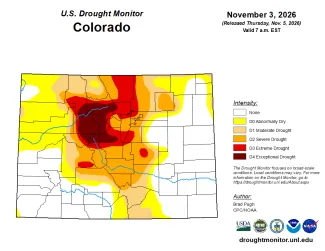
Drought eased across Colorado this week after heavy precipitation fell on the western third of the state, according to the U.S. Drought Monitor, a partnership including the National Drought Mitigation Center. The map released Thursday, November 5, shows conditions as of 7 a.m. EST (5 a.m. MST) Tuesday, November 3. About 39 percent of the state is in drought, down from about 50 percent a week earlier.
Snowpack
Mountain snowpack is off to an uneven start. The U.S. Department of Agriculture’s Natural Resources Conservation Service reports start-of-day SNOTEL readings that are still unchecked this early in the day, so they are best read as a rough guide. The deepest snow is in the southwest. Beartown, in San Juan County, held 11.5 inches of snow water equivalent, and sites in Mineral County, including Rat Creek, Middle Creek and Wolf Creek Summit, held 7 to 8 inches.
The northern and central mountains lag far behind. Readings at Eagle County sites ran between 0.2 and 0.6 inches, and Summit County sites ranged from none to 1.3 inches. Grand County sites mostly read under 1 inch, with a high of 1.6 inches at Arapaho Ridge. Among the sites we checked, Pitkin County was stronger, with Castle Peak at 3.5 inches. Snow water equivalent is the amount of water in the snow if it were melted.
Drought Conditions
The worst drought remains in the mountains. According to the U.S. Drought Monitor, Summit County is 88 percent in exceptional drought (D4) and 12 percent in extreme drought (D3). Eagle County is 78 percent exceptional and 12 percent extreme. In Grand County, 65 percent is exceptional drought and 23 percent is extreme drought.
©
Farther north and east, the picture is milder. Routt County is 12 percent exceptional, 26 percent extreme and 15 percent severe drought (D2). Pitkin County is 23 percent exceptional, 19 percent extreme and 35 percent severe drought. Jackson County has no extreme or exceptional drought, with 57 percent in moderate drought (D1) and 32 percent in severe drought, and Moffat County has no drought worse than severe, which covers about 4 percent of the county. The Drought Monitor narrative says widespread precipitation of a half inch to 2 inches, locally more, led to one-category improvements across the western third of Colorado, along with parts of the northern and central Great Plains.
Our corner of the state stayed clear. According to the Drought Monitor, Kiowa County, Cheyenne County, Prowers County, Bent County and Baca County are each 100 percent free of any dryness.
Statistics
Compared with last week, 42 percent of Colorado is free of any dryness, up from 35 percent. Abnormally dry (D0) conditions, which are not drought, covered 19 percent, down from 15 percent. Moderate drought (D1) slipped to 12 percent from 21 percent, severe drought (D2) held at 15 percent from 16 percent, extreme drought (D3) edged down to 7 percent from 8 percent, and exceptional drought (D4) was steady at 4 percent. Altogether, 61 percent of the state was free of drought, meaning none plus D0, up from 50 percent.
A year ago, on November 4, 2025, 45 percent of the state was free of any dryness and 71 percent was free of drought. Drought covered 29 percent of Colorado then, with 1 percent in extreme drought and none in exceptional drought. The water year began October 1, and at the start of the water year 91 percent of the state was in D0 or worse, with 82 percent in drought.
| Week | Date | None | D0 | D1 | D2 | D3 | D4 |
|---|---|---|---|---|---|---|---|
| Current | 11/3/26 | 42 | 19 | 12 | 15 | 7 | 4 |
| Last Week to Current | 10/27/26 | 35 | 15 | 21 | 16 | 8 | 4 |
| 3 Months Ago to Current | 8/4/26 | 3 | 6 | 13 | 31 | 34 | 13 |
| Start of Calendar Year to Current | 12/30/25 | 29 | 33 | 22 | 13 | 2 | 1 |
| Start of Water Year to Current | 9/29/26 | 9 | 9 | 24 | 23 | 25 | 10 |
| One Year Ago to Current | 11/4/25 | 45 | 26 | 16 | 12 | 1 | 0 |
About 74 percent of Coloradans live in areas in drought, according to the U.S. Drought Monitor.
The U.S. Drought Monitor ranks conditions from least to most severe: abnormally dry (D0), which is not yet drought, then moderate (D1), severe (D2), extreme (D3), and exceptional (D4) drought.