Drought expands across eastern Colorado as exceptional conditions tighten in the mountains

© KiowaCountyPress.net
Chris Sorensen / (Kiowa County Press)
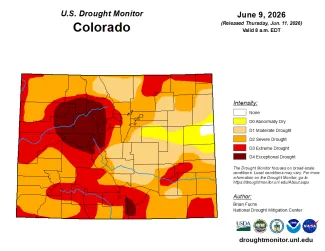
Drought intensified across Colorado again this week, with moderate drought spreading over the eastern plains and exceptional drought holding its grip on the western mountains, according to data released Thursday by the National Drought Mitigation Center. The U.S. Drought Monitor map, which reflects conditions through Tuesday, June 9, shows that more than 99 percent of the state is now experiencing at least abnormally dry conditions, with roughly a third of Colorado mired in extreme or exceptional drought — the two most severe categories on the scale.
©
Colorado drought conditions as of June 9, 2026. Source: National Drought Mitigation Center.
Snowpack
Colorado’s mountain snowpack has all but vanished for the season, and what little remains is melting out far ahead of schedule. As of June 7, statewide snowpack stood at just 9 percent of median, according to the Natural Resources Conservation Service, capping one of the leanest snow years on record. Median melt-out timing across the state’s SNOTEL network is running about 36 days ahead of normal.
The early collapse traces back to a record-warm March, when statewide snow water equivalent plunged from about 60 percent of median on March 1 to roughly 20 percent by April 1. Sustained record temperatures during a concentrated stretch in mid-to-late March drove the rapid depletion, leaving high-country streams to peak early and reservoirs short of their usual spring boost.
The consequences are now showing up in runoff. June-through-July streamflow forecasts statewide sit near 24 percent of median, and at Lake Powell — where June and July normally supply about half the season’s inflow — only about 21 percent of the projected seasonal volume remains. A year ago, conditions were markedly better: the U.S. Drought Monitor recorded no exceptional drought anywhere in Colorado in mid-June 2025, and just 5 percent of the state was in extreme drought, compared with 36 percent in those two categories today.
Drought Conditions
The most severe conditions remain concentrated in the western and central mountains, where exceptional drought (D4) now blankets entire counties. According to the U.S. Drought Monitor, Eagle and Pitkin counties are entirely in exceptional drought, while Summit County sits at 88 percent exceptional and 12 percent extreme. Grand County is 54 percent exceptional and 41 percent extreme, and Garfield County is split between 48 percent exceptional and 51 percent extreme drought.
Exceptional drought also reaches into Routt County (33 percent), Rio Blanco County (23 percent) and Gunnison County (15 percent), while Mesa County, though only 3 percent exceptional, is 94 percent in extreme drought, according to the U.S. Drought Monitor. The continuing warmth across western Colorado — where temperatures ran 6 to 9 degrees above normal this past week — has done little to relieve the parched landscape.
On the eastern plains, drought continued to deepen. Extreme drought (D3) expanded across the northern tier, where Sedgwick County is now 92 percent in extreme drought and Logan County 30 percent, according to the U.S. Drought Monitor. Neighboring Weld County reached 39 percent extreme drought as moderate drought spread across much of east-central Colorado. The lone bright spot came in southern Colorado, where recent rainfall trimmed extreme drought slightly.
Statistics
Compared with the previous week, the share of Colorado free of drought held steady near 1 percent, but conditions shifted toward the worse. Abnormally dry coverage (D0) eased from 7 to 4 percent as that ground was absorbed into moderate drought (D1), which grew from 17 to 19 percent. Severe drought (D2) held at 40 percent, extreme drought (D3) remained at 27 percent, and exceptional drought (D4) was unchanged at 9 percent — a slight expansion in the north offset by modest relief in the south.
The year-over-year picture underscores how sharply conditions have deteriorated. One year ago, on June 10, 2025, about 40 percent of Colorado was free of drought, just 5 percent sat in extreme drought, and no part of the state had reached exceptional drought. Today only about 1 percent of Colorado is drought-free, 27 percent is in extreme drought and 9 percent has fallen into exceptional drought — the worst June reading the state has seen in years.
| Week | Date | None | D0 | D1 | D2 | D3 | D4 |
|---|---|---|---|---|---|---|---|
| Current | 6/9/26 | 1 | 4 | 19 | 40 | 27 | 9 |
| Last Week to Current | 6/2/26 | 1 | 7 | 17 | 40 | 27 | 9 |
| 3 Months Ago to Current | 3/10/26 | 21 | 15 | 27 | 24 | 12 | 1 |
| Start of Calendar Year to Current | 12/30/25 | 29 | 33 | 22 | 13 | 2 | 1 |
| Start of Water Year to Current | 9/30/25 | 46 | 9 | 9 | 22 | 14 | 0 |
| One Year Ago to Current | 6/10/25 | 40 | 13 | 26 | 15 | 5 | 0 |
Just over 4,957,000 Colorado residents live in a drought-impacted area. Colorado’s 2023 population was estimated at 5,877,610.
Drought categories include (ranked from least to most severe) abnormally dry (D0), moderate (D1), severe (D2), extreme (D3), and exceptional (D4) drought.