EarthTalk - What is space debris, and can we reduce or eliminate it?

©
Dear EarthTalk:
What is space debris, and can we reduce or eliminate it?
H.B., Troy, NY
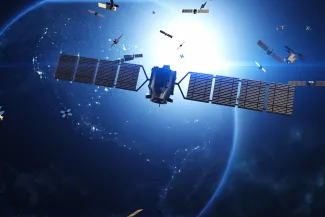
Space debris, also known as space junk, consists of defunct man-made objects that orbit Earth, including satellites, spent rocket stages and other various fragments from collisions. According to the European Space Agency, space surveillance networks are currently tracking approximately 40,000 objects orbiting Earth, only 11,000 of which are active “payloads” (still functioning satellites and other equipment), with the rest classified as space debris.
© yucelyilmaz - iStock-2101393672
However, the actual amount of space debris could be over 1.2 million objects more than one centimeter in length and capable of causing catastrophic damage on impact. Lack of proper regulation and surveillance of space debris has exacerbated conversation around the threat posed to life on Earth. In 2021, one of the International Space Station’s (ISS) robotic arms was punctured by a piece of space debris. As space debris is projected to exponentially increase in the next decade, future collisions may cause irreparable damage to satellites, technological systems that support GPS, and weather forecasting.
One major consideration in space debris is the “Kessler Syndrome” risk that describes the cascading effects of the debris as one collision creates multiple fragments that further collide and create more debris. Consider the 2009 collision between the Iridium satellite and Cosmos satellite: some 2,000 fragments created still orbit Earth today and pose significant risks to outer space systems. While most of the 200-400 large pieces of debris that reenter Earth’s atmosphere annually burn up, five to 10 percent survive.
Recently, numerous policies have been established to mitigate the effects of space debris, including the United Nations’ 25-year de-orbit rule, which recommends that spacecraft orbital stages in Low Earth Orbit (LEO) be removed from orbit within 25 years after the end of their operational life. However, the global de-escalation effort is infinitely more convoluted than simply ridding of space debris. Professor of Astronautics and Head of the Astronautics Research Group at the University of Southampton Hugh Lewis stated in an interview that “[Space debris] is not just a technical problem we have to solve, but a social one as well,” in regards to the race between countries, governments and corporations to use space.
Though national competition for space may be inevitable, it is imperative that countries and governments work together for the best interest of our planet and strategize the use of space among one another. Space is a common resource, yet its pollution and befouling risks astronaut safety, climate security, and more. To reduce space debris, we must support stricter regulations and advocate for cleanup technologies from corporations and the private sector.
CONTACTS
- Space Debris by the Numbers, esa.int/Space_Safety/Space_Debris/Space_debris_by_the_numbers.
EarthTalk® is produced by Roddy Scheer & Doug Moss for the 501(c)3 nonprofit EarthTalk. See more athttps://emagazine.com. To donate, visit https://earthtalk.org. Send questions to: question@earthtalk.org.