Exceptional drought expands across Colorado's high country as heat and wildfires deepen dry conditions

© KiowaCountyPress.net
Chris Sorensen / (Kiowa County Press)
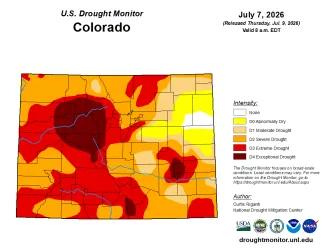
Exceptional drought — the most severe category tracked by the U.S. Drought Monitor — tightened its grip on Colorado’s central mountains this week, as persistent heat, growing precipitation deficits and multiple large wildfires pushed conditions from bad to worse across the western half of the state. According to data released Thursday by the National Drought Mitigation Center and valid through Tuesday, July 7, exceptional (D4) drought now covers about 10 percent of Colorado, while extreme (D3) drought or worse blankets roughly 44 percent of the state.
The U.S. Drought Monitor noted that conditions worsened in parts of central and southwest Colorado, where several large wildfires were burning in areas of low soil moisture and large precipitation shortfalls. Central Colorado near and east of Denver and Colorado Springs also degraded as rainfall failed to keep pace with the summer heat. A small pocket of the state slipped back into drought-free status, but that improvement was more than offset by expanding extreme and exceptional drought elsewhere.
Snowpack
With the calendar deep into July, Colorado’s mountain snowpack has long since melted out, and the state is now living on whatever runoff the past winter delivered. That inheritance was meager. The Drought Monitor’s water-year comparison shows how far conditions have deteriorated: at the start of the water year on Sept. 30, roughly 46 percent of Colorado was free of drought, but by this week that figure had collapsed to just 2 percent.
A below-average snowpack across the central and western mountains left reservoirs, streams and soils short heading into the warm season, and the dry spring and early summer have only compounded the deficit. Runoff from the high country peaked early and thin, leaving the headwaters counties of the upper Colorado, Roaring Fork and Gunnison river basins among the hardest hit in the state.
Conditions are dramatically worse than they were a year ago. On July 8, 2025, no part of Colorado was in exceptional drought and only about 7 percent sat in extreme drought, while nearly 45 percent of the state was drought-free. This year, by contrast, exceptional drought alone covers a tenth of Colorado and virtually none of the state is without at least abnormally dry conditions.
Drought Conditions
The most severe conditions are concentrated in the central and northwest mountains, where several counties are now entirely in exceptional drought. According to the U.S. Drought Monitor, Eagle, Pitkin and Lake counties are each rated 100 percent D4. Summit County is close behind at about 88 percent exceptional drought with the remainder in extreme (D3) drought, while Grand County sits at roughly 54 percent exceptional and 41 percent extreme.
The pattern extends west and south along the mountains. Garfield County is split almost evenly, near 48 percent exceptional and 49 percent extreme drought, and Routt County in the northwest carries about 33 percent exceptional and 13 percent extreme coverage. Rio Blanco County reports roughly 23 percent exceptional and 51 percent extreme drought, according to the U.S. Drought Monitor.
Extreme drought dominates a broad swath of the western and southern high country even where exceptional drought has not yet taken hold. Gunnison County stands at about 63 percent extreme and 17 percent exceptional drought, and Mesa County is roughly 87 percent extreme. In the San Luis Valley and southern mountains, Saguache and San Juan counties are each fully in extreme drought, underscoring how widely the dry conditions have spread across the state.
Statistics
Compared with the previous week, Colorado’s most severe drought categories continued to expand. Extreme drought (D3) grew from about 30 percent of the state to 34 percent, and exceptional drought (D4) edged up from 9 percent to 10 percent. Moderate (D1) and severe (D2) drought each eased slightly, to 10 and 38 percent respectively, and a small share of the state — about 2 percent — returned to drought-free status after registering none the week before. Abnormally dry conditions (D0) held steady near 7 percent.
The year-over-year contrast is stark. One year ago, on July 8, 2025, no part of Colorado was in exceptional drought and just 7 percent was in extreme drought, while 45 percent of the state carried no drought designation at all and severe drought covered only about 15 percent. Since then, drought-free land has all but vanished and the extreme and exceptional categories have surged, reflecting a dry winter, a thin snowpack and a hot, parched start to summer.
| Week | Date | None | D0 | D1 | D2 | D3 | D4 |
|---|---|---|---|---|---|---|---|
| Current | 2026-07-07 | 2 | 7 | 10 | 38 | 34 | 10 |
| Last Week to Current | 2026-06-30 | 0 | 7 | 13 | 40 | 30 | 9 |
| 3 Months Ago to Current | 2026-04-07 | 0 | 5 | 29 | 20 | 25 | 22 |
| Start of Calendar Year to Current | 2025-12-30 | 29 | 33 | 22 | 13 | 2 | 1 |
| Start of Water Year to Current | 2025-09-30 | 46 | 9 | 9 | 22 | 14 | 0 |
| One Year Ago to Current | 2025-07-08 | 45 | 13 | 20 | 15 | 7 | 0 |
Just over 4,744,000 Colorado residents live in a drought-impacted area. Colorado’s 2023 population was estimated at 5,877,610.
Drought categories include (ranked from least to most severe) abnormally dry (D0), moderate (D1), severe (D2), extreme (D3), and exceptional (D4) drought.
©
Colorado Drought Conditions — July 7, 2026. Source: National Drought Mitigation Center.