Exceptional drought expands as record heat continues across Colorado

© KiowaCountyPress.net
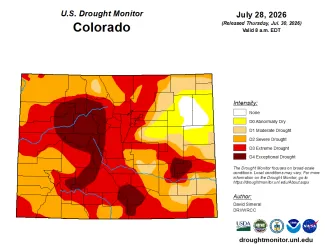
Drought continued to expand and intensify across Colorado over the past week as anomalously warm temperatures, shrinking soil moisture, and elevated evaporative demand took a toll on the state, according to data released Thursday by the National Drought Mitigation Center. The latest map, valid Tuesday, July 28, shows exceptional drought - the worst category - covering nearly 14 percent of the state, with much of the deterioration concentrated on the eastern plains.
©
Snowpack
With the snowmelt season long since over, Colorado’s water outlook now rests on reservoir storage and the summer monsoon, and neither offers much comfort. The U.S. Bureau of Reclamation reported Lake Powell at just 23 percent full - 33 percent of average for the date and the lowest on record for late July in the past 30 years. Lake Mead stood at 27 percent full, while the total Colorado River system was at 33 percent of capacity, down from 39 percent at the same time last year.
Monsoon moisture that has delivered welcome relief to Arizona and New Mexico has largely bypassed Colorado. While beneficial rain fell across the Four Corners states over the past week, improvements stopped at areas of northwestern New Mexico and southeastern Utah, leaving Colorado’s mountains and plains hot and dry.
The contrast with one year ago is stark. In late July 2025, nearly half of Colorado was free of drought, and extreme drought touched just 12 percent of the state, with no exceptional drought anywhere. This week, less than three percent of the state remains drought-free.
Drought Conditions
Conditions are most dire in the central and northern mountains. Eagle and Pitkin counties are entirely covered by exceptional drought, according to the U.S. Drought Monitor. Summit County is close behind at 88 percent exceptional drought, with the remaining 12 percent in extreme drought. In Grand County, 54 percent of the area is in exceptional drought and 41 percent is in extreme drought, while Routt County reports 33 percent exceptional and 13 percent extreme drought.
The eastern plains saw notable deterioration this week. In Kiowa County, exceptional drought now covers 36 percent of the county and extreme drought another 54 percent - leaving 90 percent of the county in the two worst categories. Neighboring Cheyenne County has 11 percent of its area in extreme drought, with another 40 percent in severe drought, while Prowers County is now more than one-third covered by severe drought.
The deterioration follows a stretch of record warmth. Montrose and Dinosaur recorded their warmest 30-day period on record, while Grand Junction, Trinidad, and Denver each experienced their second-warmest, with departures of three to four degrees above normal, according to the U.S. Drought Monitor.
Statistics
Compared with the prior week, the area of Colorado free of drought held nearly steady at three percent, while abnormally dry conditions decreased from seven to six percent. Moderate drought increased from nine to 10 percent, severe drought eased slightly from 32 to 31 percent, and extreme drought was unchanged at 37 percent. Exceptional drought grew from 12 to 14 percent of the state.
One year ago, 46 percent of Colorado was drought-free, with 10 percent abnormally dry, 13 percent in moderate drought, 20 percent in severe drought, and 12 percent in extreme drought. Exceptional drought was absent from the state.
| Week | Date | None | D0 | D1 | D2 | D3 | D4 |
|---|---|---|---|---|---|---|---|
| Current | 7/28/26 | 3 | 6 | 10 | 31 | 37 | 14 |
| Last Week | 7/21/26 | 3 | 7 | 9 | 32 | 37 | 12 |
| 3 Months Ago | 4/28/26 | 0 | 0 | 10 | 31 | 41 | 18 |
| Start of Calendar Year | 12/30/25 | 29 | 33 | 22 | 13 | 2 | 1 |
| Start of Water Year | 9/30/25 | 46 | 9 | 9 | 22 | 14 | 0 |
| One Year Ago | 7/29/25 | 46 | 10 | 13 | 20 | 12 | 0 |
Just over 4,656,000 Colorado residents live in a drought-impacted area. Colorado’s 2023 population was estimated at 5,877,610.
Drought categories include (ranked from least to most severe) abnormally dry (D0), moderate (D1), severe (D2), extreme (D3), and exceptional (D4) drought.
Colorado drought conditions as of July 28, 2026. Map courtesy of the National Drought Mitigation Center.