
‘I have no reason to quit’: South Dakota EMTs still lending a hand in their 80s

Listen to an audio version of this story produced by reporter Meghan O’Brien. For broadcasters: See below for downloadable version with host scripts.
When he first earned his emergency medical technician certification almost three decades ago, Gerald Frame didn’t expect to still be a volunteer EMT at age 83.
He’s also still running an auto mechanic shop.
“Who knew?” he said. “That’s my life. My world is pretty small — it’s the ambulance and it’s the customers that I do repairs for.”
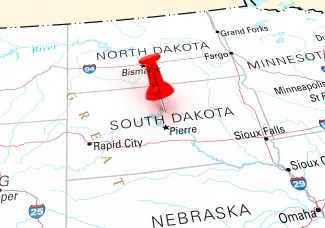
South Dakota’s emergency medical services workforce is aging, according to data gathered by the state Department of Health. The average age of an EMS provider in the state is 51 years old. More than 30 providers are in their 70s, and two of the oldest are 83: Frame and Jim Wallace, who both volunteer in western South Dakota.
Frame volunteers in the small town of Whitewood, where his mechanic shop is located and where the ambulance service is affiliated with the one in Spearfish.
Frame’s journey in emergency medical services started in the 1990s when he heard about an EMT class in Whitewood.
“And I thought, ‘what the heck?’” he said.
More than a decade ago, Frame had a heart attack. It was the executive director of the Spearfish Ambulance Service, Brian Hambek, who recognized the symptoms.
“So, for this last 11 years or so, I’m paying it back,” Frame said. “I got some help when I needed it, I like to help people, so in a way, it’s kind of paying back for my heart, him catching my heart attack.”

© iStock - nevarpp
Hambek is glad to have him.
“Gerald is 83, but he’s spry as a billy goat, and I love him to death,” Hambek said. “He’ll do anything for his community in Whitewood. He just will.”
These days, Frame mostly drives the ambulance, stocks it with supplies and does what he can to make patients feel safe and heard in an emergency, said Andy Binder, operations director for the Spearfish Ambulance Service.
“He’s found ways to continue doing what he can do,” Binder said. “Maybe he doesn’t get to go carry the patient out of the ditch, but that doesn’t mean that he can’t drive the truck perfectly safe. It doesn’t mean he can’t do a good assessment and do vitals.”
Frame has no plans to stop.
“I have no reason to quit,” he said. “If I can continue to do it, I’ll continue to do this.”
Staying involved as a trainer
An hour southeast of Spearfish, 83-year-old Jim Wallace teaches scuba diving classes at his shop in Rapid City. He also teaches EMT courses in Spearfish and volunteers for the Spearfish Ambulance Service when he can.
“I’m in it just to keep my certifications up and better my knowledge, because everything changes constantly,” Wallace said. “I’m constantly learning, and that’s what I love.”
Wallace first earned an EMT certification in the 1970s as a member of the U.S. Coast Guard. He served as a volunteer EMT in Clark, near Watertown in northeast South Dakota, after he retired. He and his wife moved to Rapid City 12 years ago.
After taking a refresher course with Hambek, Wallace started volunteering with Spearfish while he and his wife worked on moving west. He’d travel across the state — nearly 350 miles — to Spearfish on a Monday and stay all week before returning home to Clark, with a few weeks off in between.
“That’s how much I like being a paramedic,” Wallace said. “I’ll keep on doing it until I’m pushing daisies up.”
While running a dive shop, Wallace sometimes struggles to find time for volunteering in the field. But he makes sure his presence is there in the classroom, teaching new EMTs and seasoned veterans.
“He does all of my EMT education through here. That’s a way of him being a paramedic,” Hambek said. “He can help out and help train new people in this profession.”
Navigating challenges in rural areas
Black Hills State University is in Spearfish, and some college students take Wallace’s classes, whether it’s because they’re merely interested in getting their certification or because they need it for ski patrol or Forest Service jobs in the Black Hills, Hambek said.
“They’ll stick around for two, three years, until they graduate college, and then they’re gone,” Hambek said. “But at least I have them for a couple years.”
The flight of younger residents from rural areas is part of the reason for South Dakota’s aging emergency medical services workforce. The remaining people in rural areas might not have enough time to commit to coursework.
Some services pay their staff, but for some people, the pay is not worth the demanding aspects of the job.
If rural services don’t recruit more young providers, Hambek said, they’re at risk of closing their doors once providers retire or physically cannot provide care any longer. That means longer wait times for people to get help in an emergency situation.
“So it’s a never-ending circle downward, which is sad,” Hambek said.
Hambek’s Spearfish ambulance crew listens in to Whitewood’s radio, and sends backup if the crew needs it. The Spearfish service responds to calls in a 600-square-mile area, sometimes lending a hand to neighboring communities like St. Onge and Belle Fouche, along with Whitewood.
“If you’re a small town with only a handful of patients, you can’t pay a bunch of staff, but if you have enough calls that people can’t volunteer, then how do you cover that?” Binder said. “You end up with the guys that have been around forever, that stay around and keep going because they want to help their neighbors out.”
Paramedics usually leave that position after less than a decade, Hambek said, usually to move on to different healthcare professions.
Less than 25% of the state’s ambulance services rely solely on volunteers, according to the state Department of Health. Others pay for part-time help. In Whitewood, for example, part-time EMTs get paid about $20 per hour, just for the time that it takes to respond to a call. In Spearfish, where call volumes are much higher, EMTs get paid for the entire time they’re on call, at about $15 per hour.
Wages vary across the state, Hambek said, depending on call volumes and staffing levels.
To get the money for wages and salaries, services say they need higher reimbursement rates from insurance companies and Medicaid. In smaller communities, providers might only respond to about 100 calls a year — less than half of what Spearfish does in a month, Hambek said.
“That means there’s income coming into the service, that I can afford to pay people to do the job,” he said of the Spearfish service. “But these smaller communities, they just don’t have the resources, both manpower and financial. And they’re tied. They’re linked together.”
Lawmakers seeking solutions
An 11-member legislative task force is spending time this summer learning more about how to support and fund local emergency medical services.
At its first meeting in June, healthcare leaders in the state told lawmakers they’re looking at regionalization as a possible solution to the shrinking EMS workforce, creating “workforce pools” so EMS leaders can rely on other services from neighboring areas when needed.
Bridget Hathaway, of the Jones County Ambulance, compared the approach to travel nursing. It could help services like Jones County “who are on the smaller side and might just need somebody for a couple days once in a while,” like during the summertime, she said, when communities often have more outdoor activities and celebrations.
In smaller communities with older providers, state EMS Director Marty Link said, a solution might require “having the tough conversation to say, is it sustainable?”
“That might mean that ambulance service does dissolve,” Link said. “And that might mean they can still provide service to their community, but maybe more as a first response unit.”
That would involve coordination with bigger communities to step in if a patient needs transportation to a hospital.
Lawmakers on the task force have until November to provide proposals that could be introduced as bills in next year’s legislative session, which begins in January. The task force’s second meeting is scheduled for August 24.