Montana Fish and Wildlife Commission takes middle ground on wolf hunting quotas

The Montana Fish and Wildlife Commission this week adopted new wolf hunting and trapping regulations, with a 300-wolf limit for the upcoming season, reflecting the state’s lower population estimate for the species.
The decision on Wednesday took a middle-of-the-road stance between a Montana Fish, Wildlife and Parks department recommendation of 250, and last year’s quota of 452 wolves.
“Why not split the difference?” said Commissioner Ian Wargo. “We’re bound by the law on one side, we’re bound by relisting on the other. I don’t know why we’re not trying to thread that needle a little bit more.”
The Fish and Wildlife Commission, which sets department regulations, established a 452-wolf quota for last year following legislative directives to bring down the population, despite wolf advocates saying it was too risky to kill that many animals.
Earlier this year, Montana FWP released a new version of its integrated Patch Occupancy Model, or iPOM, for estimating the statewide wolf population that showed a drastically smaller wolf population than previously thought — 725 instead of 1,094.
Molly Parks, carnivore coordinator for FWP, gave the commission a presentation on how the new model incorporated different amounts of data about wolf observations, pack sizes and pack ranges, which includes a lot of modeling as wolves are a hard species to accurately count individually.
The new estimate by the department doesn’t mean the population has suddenly experienced a decline during the last year, but rather that wolf populations have likely been overestimated for years.
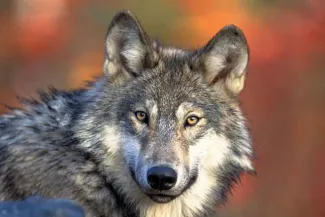
Gray Wolf. Courtesy U.S. Fish and Wildlife Service.
Gray wolves were removed from the endangered species list in 2009 with the states of Montana, Idaho and Wyoming taking over wolf management in each state.
Montana FWP has set a 450-wolf management baseline to ensure the population remains high enough to avoid a federal government takeover.
In response to the new data showing a lower population in the state, FWP recommended dropping the hunting and trapping quota from 452 to 250.
During the 2025-26 wolf season, which ended on March 15, harvest totaled 247 wolves, including 145 by hunters and 102 by trappers. The number was the lowest since 2016. The new season with new quota starts September 15.
Wargo asked for an amendment to bring it up to a 300-wolf quota statewide, with regional sub-quotas, pointing out that the department’s forecasting models show killing 300 wolves won’t reduce the population to risky levels.
“iPOM 2.0 is overly conservative,” Wargo said of the new model. “We have layers upon layers, safety factors on safety factors.”
The great wolf debate
Dozens of members of the public showed up in person and online to comment on the new hunting and trapping regulations, many criticizing the department’s population models — either for vindicating wolf advocates who have long argued the state’s method overestimates wolves, or from detractors who say the new model is overly cautious and hasn’t been thoroughly vetted.
Mark Cooke, with Wolves of the Rockies, said while the new population model is being scrutinized, the department should manage wolves with a higher level of caution.
“We aren’t asking Montana to not manage wolves. We’re asking Montana to manage them carefully, transparently, and with the best available science,” he said. “And I’ll close with one comment: Uncertainty should lead to caution, not greater killing.”
Montana Representative Jedidiah Hinkle, a Belgrade Republican who leads the House Fish and Game Committee and has pushed for drastically reducing wolf populations, called the whole plan “a mess.”
During the Legislature when lawmakers debated several bills authorizing killing a much higher number of wolves, Hinkle said the department “vigorously defended” its original iPOM model.
“By just changing the pack size and the distribution of the territory, we’re able to knock off 400 wolves,” he said. “The only thing that happened between that time is a lawsuit over the management of wolves. Looks pretty fishy to me.”
Several commenters pointed out that wolves are an economic driver in the areas near Yellowstone National Park, and reducing the population in Montana could affect that area.
But ranchers from around the state offered a different view: The economy they participate in takes a bigger hit from having more wolves around.
“No one’s coming to Ovando, Montana, to watch wolves,” said rancher Bob Rowland. “They’re all going to the park, and so our economy is based on livestock, hunting, big game.”
According to Montana FWP’s annual wolf report, the state Livestock Loss Board paid out more than $90,000 to reimburse livestock producers for wolf kills in 2025 — half the amount paid out for grizzly bear kills.
Lance Fourstar, a member of the Fort Peck Assiniboine Tribe, asked for the commission to consider a 200-wolf quota, drawing on his perspective as an Indigenous person “whose ancestors shared this land with the wolf for thousands of generations.”
“To our people, the wolf is not a trophy, a pest, or a number on a spreadsheet to be manipulated for political motives,” Fourstar said. “The wolf is a sacred relative, a teacher of family unity, and a crucial balance keeper of the natural world.”
Diane Boyd, a retired wolf and carnivore specialist with FWP, said the department’s revised modeling was a good start, but killing more than 200 wolves next year would likely lead to a declining population.
“If Montana continues along the ‘kill more wolves’ paradigm instead of science, Montana’s wolf population will continue to decline and will likely fail to maintain its stated population goal of 450. Montana will then lose control of wolf management as the federal government takes over,” Boyd said. “You can change its trajectory with significantly lowering quotas and more conservative management objectives.”
Unlike most species, the wolf hunting and trapping regulations are reviewed annually.
At the end of the meeting, the commission unanimously approved a 300-wolf limit for the upcoming season, along with sub-quotas that include just one wolf in each of the two management areas outside Yellowstone National Park.