Oklahoma governor’s veto could discontinue Native American education council

A statewide council on Native American education could be discontinued unless the state Legislature reverses a governor’s veto.
Governor Kevin Stitt on Monday vetoed House Bill 3006, legislation that would extend the existence of the Oklahoma Advisory Council on Indian Education by another five years. State lawmakers overrode a similar veto from Stitt in 2023 and continued the Native education council until July 1 of this year.
The 18-seat council, founded in 2010, gives recommendations to the Oklahoma State Department of Education about issues and goals affecting Native American students’ schooling and about the teaching of tribal history.
In his veto message, Stitt said the council “does not appear to have functioned as an active or effective body” and hasn’t operated with proper transparency.
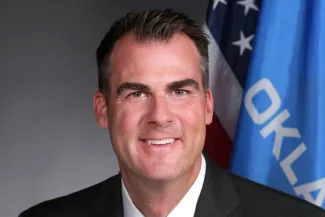
Oklahoma Governor Kevin Stitt - public domain
The governor noted publicly available records indicate it met only six times in the past five years and twice in the past three, though it’s meant to meet quarterly.
The state Education Department, which facilitates the council’s meetings, said the body has met seven times since late 2023. The agency provided agendas for each of the meetings.
None of the agendas given to Oklahoma Voice were otherwise publicly viewable online, though the Oklahoma Open Meeting Act requires agendas to be posted on the public body’s website.
Few of the council’s meeting notices have been posted, either, with the Oklahoma Secretary of State’s Office, another task state law requires.
The Education Department’s executive director of American Indian Education, Jackie White, organizes the council’s meetings as the state superintendent’s designee to the board.
Under former state Superintendent Ryan Walters’ administration, White and her staff had limited access to the Education Department’s website to post updates on council meetings, she said in a message through the agency’s communications staff. That access was restored after state Superintendent Lindel Fields succeeded Walters in October, she said.
The council last met on Jan. 21 and is scheduled to meet again on June 17. A public notice is listed with the Secretary of State for the January meeting, but the January agenda is not visible on the council’s webpage.
The council at times struggled to have the necessary majority of members present to hold a public board meeting, White said, especially when it had multiple vacant seats that state leaders had not yet filled with appointees.
Its 18 seats include representatives from seven tribal nations, four tribal education departments, school districts, colleges, and other education- and Indigenous-focused groups.
The council’s chair, Cherokee Nation Chief of Staff Corey Bunch, said the governor’s veto is “disappointing,” given Oklahoma is among the states with the highest percentage of Native American students.
More than 150,000 Oklahoma students are Native American, making up 15% of the state’s total student population, according to Education Department data from the 2024-25 school year.
The advisory council “truly gave a voice” to Native students while meeting regularly with the state superintendent at no cost of operation, Bunch said.
“Cooperation and collaboration, in my mind, are always the best path forward and we hope other measures keep the advisory council in place,” he said in a statement.
The council advocates that Native American students receive an effective and high-quality public education, said Mary Wildcat, who represents the Osage Nation on the board.
“OACIE’s members include representatives from various tribal nations and education experts across Oklahoma,” said Wildcat, also the director of the Osage Nation Department of Education. “Their collective knowledge and experience offer valuable insights that enhance public education, ultimately strengthening the entire state of Oklahoma.”
Stitt called the board’s purpose “largely redundant.” He said it overlaps with work being done at the Education Department’s Office of American Indian Education.
“If the goal is smaller, more accountable government, there is no reason to keep extending a dormant, redundant advisory council that lacks transparency,” his veto message states. “It should instead be eliminated.”
Stitt, who has feuded with tribal leaders throughout his two terms in office, used to appoint half of the council. The Legislature stripped him of all but one appointee in 2023, citing tribal leaders’ complaints that Stitt left seats vacant on the council for years. Lawmakers gave control of Stitt’s other eight appointments to the House speaker and Senate president pro tem.
Even after the change, a lack of appointments by legislative leaders hindered the board from meeting for several more months. It was able to begin meeting more regularly in November 2023.
Osage Nation Principal Chief Geoffrey Standing Bear described the board as “a bridge between tribal and state organizations on education matters.” He said both sides, including the governor, would agree that state-tribal communication “needs to continue and be more active.”
“In my view, Oklahoma should be proud of its diversity, and everyone needs to work more closely together, especially when it comes to educating children,” Standing Bear said in a statement.
Members of the House and Senate voted with overwhelming bipartisan support to extend the council for another five years.
House Speaker Kyle Hilbert, R-Bristow, and Senate President Pro Tem Lonnie Paxton, R-Tuttle, said Thursday it hasn’t been decided yet whether their chambers will pursue a veto override.
House Bill 3320 presents another option to continue the council. The legislation would remove the sunset date for several state boards, including the Native American education council, which would allow them to exist indefinitely.
State law gives public boards and councils a year after their termination date to cease their affairs.