Opposing Colorado tax laws to face off on November 3 ballot

© iStock - Ligorko
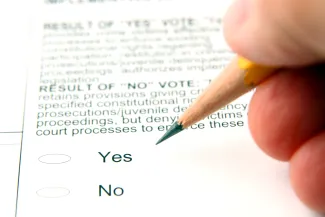
Voters in Colorado will choose between one of two opposing income tax measures on the November 3 ballot – or potentially an unintended combination.
The two income tax proposals recently gained signatures from Colorado voters across the state, as is required to be included on the November ballot. One is an effort to solidify the state’s current flat tax rate, while the other would introduce a graduated tax rate.
Colorado is one of 15 states with a flat tax rate, meaning all earners – individuals and corporations – pay the same 4.4% state tax on their income, according to the Tax Foundation.
© Svanblar iStock-146069215
Supporters of Initiative 232, the Income Tax Rate Cap, argued the current 4.4% income tax rate is high enough for all Coloradans.
“Colorado's the second or third most expensive state in the nation, depending on which study you look at,” Kristi Brown, executive vice president for Advance Colorado, the group behind Initiative 232, told The Center Square. “The last thing we need right now is to increase people's taxes.”
Initiative 232 will ask Colorado voters if they would like to strengthen the existence of the current 4.4% flat income tax rate. The proposal would see the current income tax described as the “Maximum Tax Rate.”
The initiative was approved for the November 3 ballot by the Secretary of State’s Office Thursday with 184,454 signatures on the measure's petition. Initiatives require 124,238 signatures to become a ballot measure.
Colorado’s Taxpayer Bill of Rights, or TABOR, already requires a ballot measure to raise taxes. Brown said Initiative 232 would add another hurdle to any future effort to raise the state income tax.

© Jerome Maurice - iStock-1426962165
“It basically elevates the requirement and says, ‘OK, in addition to asking people, you also have to remind them that they voted for this 4.4% cap, and not only do they have to agree to raise taxes, they have to agree to repeal the cap,' ” Brown told The Center Square.
Some opponents of Initiative 232 argued the bill was looking more to confuse voters than to change current law.
In direct conflict with Initiative 232’s proposal is Initiative 195, the Graduated Income Tax, which asks voters to change to a graduated income tax. Under this system, Coloradans would pay anywhere from 3.7% to 8.4% in income taxes.
Earners of $25,000 and below would pay 3.7%, while those making $100,000 and below would pay a 4.2% tax. Anybody below $500,000 would pay the current 4.4% rate, while earners up to $750,000 would see a 7.4% rate. Up to $1 million would mean a 7.9% income tax, and anything above $1 million would see an 8.4% rate.
“There are so many people, not just in Colorado, across the country – but specifically in Colorado – struggling with the cost of living and affordability,” said Joshua Mantell, director of government relations for the Bell Policy Center, the group behind Initiative 195.
“We see this as a real antidote to a lot of those issues," Mantell told The Center Square.

Proponents for Initiative 195 said the income tax change would generate an additional $2 billion for the state while only increasing taxes on the state’s top earning 3% of individuals and 5% of corporations.
The additional funds would not be subject to the state’s TABOR laws, meaning taxpayers wouldn't get a refund if there's a surplus. And the additional tax funds could only be spent on K-12 education, healthcare, Medicaid, childcare and early education programs.
“This is just kind of a lockbox set of dollars that can only be used for those three purposes,” said Mantell.
Supporters of Initiative 195 said they submitted over 163,000 signatures on their petition for the ballot measure. But unlike Initiative 232, Initiative 195 is an amendment to the Colorado Constitution. To get on the ballot, a proposed constitutional amendment requires signatures from 2% of the registered voters from each of the state's 35 Senate districts.

© Baris-Ozer - iStock-1420488382
Mantell said organizers were confident they met both signature requirements to be included on the November ballot, but said they did not anticipate a decision from the Secretary of State’s Office until September 2.
But opponents to Initiative 195 said the change would negatively impact businesses in the state and could risk capital flight.
“It's not something that just affects people who make over the amount where you start getting a higher tax rate, because those people take jobs and economic development with them when they leave the state,” said Brown.
But proponents of the graduated income tax rate argued the change would help Colorado businesses. They said the move would provide additional funding for childcare that would reduce the cost on businesses, and they said the money would increase the state’s standard of education.
“Businesses want an educated workforce,” added Mantell.
Voters on November 3 could see a variety of outcomes.
A yes on only Initiative 195 and no on Initiative 232 will introduce the state’s graduated income tax system as described. A reverse outcome or no-no vote will keep the state’s flat 4.4% income tax rate, while a yes on both proposals would see the 4.4% income tax cap come into effect, while earners below $100,000 would receive the lower income tax rates introduced under Initiative 195.