Texas is again where the buffalo roam

Click play to listen to an abbreviated version of this article.
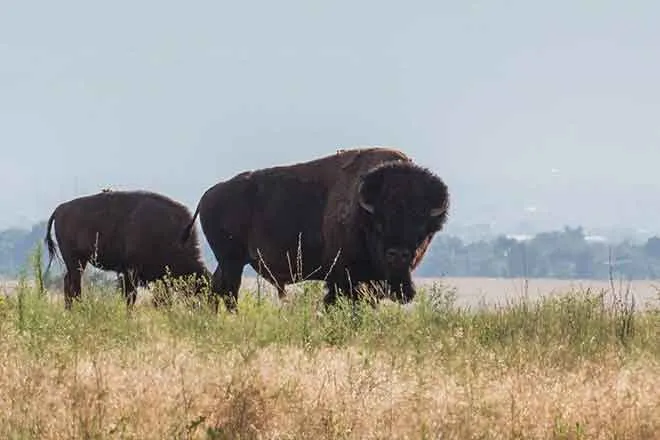
In the 1700s, 80 million bison roamed much of North America. They were everything to the people who lived among them: shelter, food, clothing, and medicine. Their grazing and moving fostered a whole host of biodiversity. But by the 1800s they had been pulled to the brink of extermination, and the Native Americans dependent on them suffered the loss of food, land, culture, spirituality, and connection.
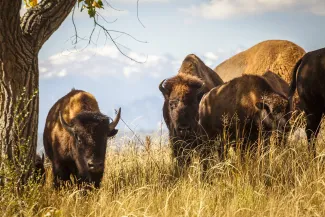
Today, bison (commonly called “buffalo”) are once again thriving and providing for Indigenous people. The nonprofit Texas Tribal Buffalo Project is one of the groups helping to bring them back. Its members are reclaiming indigenous stewardship on two parcels of land.
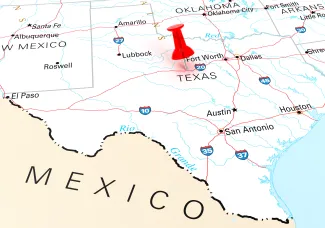
The vision of Lucille Contreras (Lipan Apache), CEO & founder of the Texas Tribal Buffalo Project, is to revive and reconnect all the tribes of Texas through a regenerative herd of American bison, or Iyane’e. Contreras learned to care for bison on the Pine Ridge reservation, then purchased 77 acres in rural Gonzalez County, Texas, in 2020 with a new farmer-rancher loan from the USDA. The herd of 34 bison has grown from the initial eight acquired in 2021.
“All of Texas is traditionally buffalo territory,” Contreras said in an interview with the Daily Yonder. “We invite people to attend the buffalo harvest and have had 400 guests. Lineal descendants are hungry for reconnection to our own traditional homelands.”
As word spread about the project’s herd, nonnative families with land titles dating to the 1700s and 1800s reached out to Contreras. While they originally benefitted from the removal of people and bison, now they want to return the land to its historic inhabitants.
“These (descendants of) colonizers of Texas have a sensitivity that is helpful to native people and the buffalo,” she said. “The younger generations aren’t interested in agriculture, and the older generations want to preserve the land for the legacy of their families as well.”
The nonprofit The Conservation Fund purchased a 150-acre parcel southeast of San Antonio on behalf of the Texas Tribal Buffalo Project and is gradually selling it to them through a lease-to-own agreement. For the first time in over a century, that pastureland in the traditional homeland of the Lipan Apache is under Indigenous care.
“Conservation organizations realize traditional ecological knowledge is the root of sustainable regenerative agriculture,” Contreras said. “We have more family lands waiting for us once we have more capacity.”
Understanding ‘Land Back’
The “Land Back” movement seeks to restore a people to sacred stewardship of their ancestral lands, and successes like the one in Texas are happening across the country. The work of the NDN Collective, a South Dakota-based international Indigenous organization, is just another example.
NDN is one of the largest groups working to correct historic wrongs and invest in Indigenous self-determination, including Land Back initiatives. Thanks to impact investments through its NDN Fund, the Chugach Regional Resources Commission in Seward, Alaska, received a loan to purchase and expand the 1.52-acre home of the Alutiiq Pride Marine Institute. The intertribal entity furthers ocean restoration through its shellfish hatchery and kelp nursery. The institute also conducts sea life research and development.
USFWS - public domain
“This is what LANDBACK looks like in practice: Native-led organizations reclaiming space, strengthening sovereignty, and building for generations to come,” Willow Hetrick, executive director of CRRC, said in a press release.
Nick Tilsen (Oglala Lakota), the founder of NDN Collective, explains that a Land Back ethic doesn’t mean going back in time, but moving forward with all people to create a just and equitable world.
“Sometimes indigenous ‘Land Back’ invokes fear that we are coming for individual people’s property rights and land, but that’s not what we are doing,” Tilsen said in an interview with the Daily Yonder. “While it’s important that people in rural communities understand and acknowledge how they came to get the land in the first place, a lot of our focus is on what it means for federal and other public lands that are largely being mismanaged to go back into Indigenous stewardship. I invite people to come not from a place of fear, but from a place where we all care about the land and how it is stewarded.”
While private ownership initiatives like the marine institute and bison lands are successfully returning land to Indigenous stewardship, recent federal efforts are decreasing other land rights. At the end of 2025, the President vetoed a bill to add a Miccosukee village in the territory of Everglades National Park to their reservation because of the tribe’s outspoken concerns about the Alligator Alcatraz detention center on their traditional lands.
A Braided Narrative of Justice
Contreras and Tilsen have found common cause as members of the Black Liberation-Indigenous Sovereignty Collective, co-founded by Trevor Smith (a Black man) and Savannah Romero (an Indigenous woman and citizen of the Eastern Shoshone Tribe). According to Romero, most Land Back successes in their member organizations are in rural areas of Indian Country or near reservation communities.
The BLIS Collective serves as a hub to connect leaders in the Land Back movement with those seeking reparations, or healing and restoration, for African American people injured because of their group identity. By promoting a braided narrative of justice for both Black and Indigenous people, BLIS includes dozens of member organizations who work to articulate the intrinsic tie between Land Back and reparations.
“There is not just one original sin of our country,” Tilsen said. “It is built on land stolen from indigenous people with an economic engine driven by slavery. Our struggle is interconnected with the struggles of all oppressed peoples, and our liberation is bound up with each other.”
When asked how that collective liberation plays out, Tilsen discussed actions NDN members took during protests after the 2020 murder of George Floyd by Minneapolis police. Leaders watched as statues of Robert E. Lee and other Confederate leaders toppled, contemplating how to show up in solidarity with Black Lives Matter while maintaining their own Indigenous identity. They chose to protest at a site that symbolizes their own struggles: Mount Rushmore. The monument, built on land that was taken in the 1870s from the Sioux Nation, is the epicenter of the longest legal battle over land in U.S. history, according to Tilsen (the Supreme Court ruled in 1980 that the tribe deserves millions in compensation, but the tribe refused the money and demands return of the sacred mountain). By standing in solidarity with the Black liberation movement, they showed that Land Back and reparations are bound up together, Tilsen explained.
A Complex History
The BLIS Collective is deepening relationships and building trust among leaders to create more success stories. Its members are taking the reparation and Land Back narratives and doing the hard and slow work of braiding them together, in real time. There is much to gain by collectively organizing, leaders recognize, but the past can make this a challenge.
Smith, who is also the BLIS executive director, said that colonialism necessitated racial hierarchy. The system, with its divide-and-conquer tactics, pitted Black and Indigenous people against each other and forced them to compete for land and resources.
“Black people were promised 40 acres and a mule on land already stolen, and some tribes enslaved other people,” said Smith. “We are moving through those tensions, putting aside tribalistic ways of thinking and learning how to steward land together.”
In their bimonthly “Solidarity Gym” workshops, BLIS members challenge the cultural narrative and strategize how to align their efforts, transform policy, and resource joint initiatives.
“We are singing from the same songbook and building a louder choir,” Smith said. “We need a new politics of togetherness.”
Kim Kobersmith wrote this article for The Daily Yonder.