
Think balancing Colorado’s budget is easy? Try it.

Colorado voters face some big decisions about taxes and spending this election. A new digital tool lets them see how three big ballot measures would affect the state budget — and whether they can close the state’s $1.6 billion budget gap.
The online tool, called Colorado Tradeoffs, focuses on two ballot measures that would potentially increase the state budget and one that wouldn’t:
- Amendment 87 would replace Colorado’s 4.4% income tax with graduated rates, raising taxes on incomes above $500,000 and lowering them below that level. The change would be enshrined in the state Constitution.
- Proposition 136 would lock in the 4.4% flat income tax rate.
- Proposition NN would eliminate tax refunds in order to provide billions more dollars for K-12 public schools over 10 years.
The tool also asks users to consider how to balance the budget when it comes to K-12, higher education, early childhood education, health care, prisons, affordable housing and rainy day reserves.
Colorado Newsline is among the Colorado news outlets hosting the simulation developed by the Colorado News Collaborative, University of Colorado Denver’s School of Public Affairs and Weigh In, a Colorado-based public benefit corporation focused on community engagement.
More than 6,000 people have used Colorado Tradeoffs already, with about 6% reaching a balanced budget. Completion typically takes about 7 minutes.
About 14% of those who completed the exercise have changed their minds on the ballot measures, said Chris Adams, founder and CEO of Weigh In and a senior fellow at the CU School of Public Affairs, who designed Colorado Tradeoffs. Most of those said they’d vote for Proposition NN and Amendment 87, after previously being opposed.
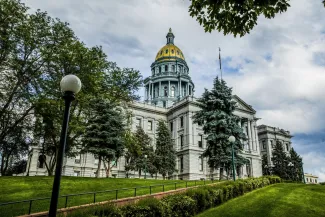
© fotoguy22 - iStock - 1468912821
Adams acknowledged the completion rate looks low, but said it’s comparable to websites that ask people for their email addresses or other simple tasks. Adams said he was pleased with the number of people who get to a balanced budget because “It’s a really hard exercise.”
Adams noted that Colorado’s Taxpayers Bill of Rights, approved by voters in 1992, gives those voters the responsibility to approve any tax increases at the state or local levels. That’s even though the state’s 100 lawmakers must make decisions on how that tax revenue is spent, and what is cut when there isn’t enough money to go around.
“It kind of gives Colorado residents sort of an awesome power,” he said. “The ultimate deciders of tax rates are not the ones under the dome. It’s the rest of us.”
Joint Budget Committee member Senator Barbara Kirkmeyer, a Republican from Brighton, tried the simulation and noted that it doesn’t take into consideration all of the complexities of balancing the state budget. The six-member JBC works full-time for nearly seven months to create the annual budget, which must pass both the House and the Senate before it goes to the governor, who has the power to veto specific line items.
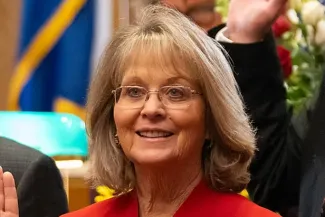
“I don’t think it necessarily captures the nuances of what goes on in our budget or how things actually work within the budget,” Kirkmeyer said. “It doesn’t really give the full picture.”
Kirkmeyer opposes Amendment 87 and Proposition NN. The only JBC member who has endorsed 87 is outgoing Senator Jeff Bridges, a Democrat running for state treasurer. All four Democratic JBC members voted to place Proposition NN on the ballot.
Adams noted that JBC members “have a full range of resources but also responsibility for making decisions. The part (they) can’t make decisions on is the tax rate.”
He said the goal of the simulation is to help Coloradans decide a basic question: “Do I want less government, do I want more taxes? … We want people to really wrestle with the tradeoffs, because that’s what policy makers do.”
About one-third of those who completed the Tradeoff thus far said they’d cut the state’s reserve fund, while 44% said they’d increase funding for early childhood education.