Yellowstone’s oldest wolf pack, Mollie’s Pack, leaves the park, raising fears for its future

This story was first published by WyoFile on July 14, 2026.
Leslie Patten hiked into a remote reach of northwest Wyoming’s Sunlight Basin in December to post a trail camera where she’d earlier seen wolf tracks.
At the time, a winter closure was fast approaching, and the Park County resident wouldn’t be able to retrieve the camera and review the footage for months. When she hiked back to fetch her equipment on May 1, the citizen scientist and author was greeted by one of nature’s most primal noises: the howls of wolves.
The sonorous canines’ calls not far away foretold the footage she’d soon review.
“I looked at the camera, and I had the Mollie’s Pack,” Patten told WyoFile.
Patten posted a one-minute clip on her YouTube page. Six wolves, strung out, casually loped over patches of snow in the timber.
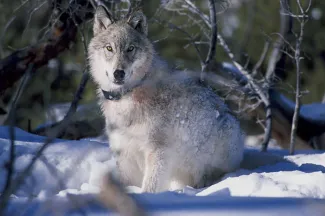
USFWS - public domain
“I didn’t identify them,” Patten said.
But a biologist she knew confirmed the hunch she kept concealed: The wolves belonged to Mollie’s Pack. That’s the last remaining pack from Yellowstone National Park’s historic reintroduction of wolves 31 years ago. Originally called the Crystal Creek Pack, in 2000 they were renamed in memory of Mollie Beattie, the first woman to direct the U.S. Fish and Wildlife Service, who died of cancer during the reintroduction.
“There’s a movie out about them right now at IMAX theaters nationwide — the original name of the movie was the Mollie’s Pack,” said retired Yellowstone Wolf Project leader Doug Smith, who’s finishing up a book on the wolves. “Mollie’s claim to fame is it’s the longest-known intact genetic lineage for any pack in North America.”
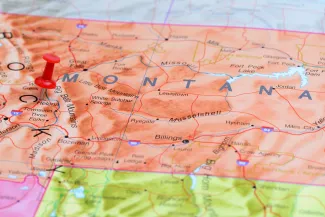
The pack’s new whereabouts, dozens of miles to the east of their typical backcountry territory in Yellowstone’s Pelican Valley, is “deeply concerning,” he said.
“My worry is that there’s a group of people who just don’t like wolves,” Smith said. “And they’ll hunt them more avidly just to get them.”
Wyoming’s wolf hunting season starts September 15, and state wildlife officials voted Tuesday to allow the killing of up to four wolves in the area, sparking concern about the pack’s future. Although wolf hunting is quite difficult, Yellowstone wolves are accustomed to vehicles and crowds. They’re often naive to the dangers posed by humans, and as a result, they are especially vulnerable to hunters.
“That’s the big issue, really,” Smith said. “It takes them a bit to figure it out, because they’re just so used to people.”
It’s a “unique circumstance” that Wyoming Game and Fish Department wolf biologist Ken Mills does not relish and is handling carefully. State wildlife managers even attempted to relocate the Mollie’s Pack den site away from cattle to reduce the chance of conflict that could lead to their demise.
“It is not an ideal situation,” Mills told WyoFile. “It’s exactly the pack you’d never want to move out [of the park]. But that’s what happened.”
The movement and the den
Yellowstone Wolf Project leader Dan Stahler, who succeeded Smith, says that the historically mild winter and sparse snowpack are the likeliest explanation for why Mollie’s Pack wolves left the park for the most prolonged period in three decades.
“The prey that remained in the park were in better shape — they were harder to kill,” Stahler said. “Wolves need vulnerable prey to be successful.”
Right before Halloween, he said, the Mollie’s wolves took off, presumably in search of easier meals. They’d moved around before, especially in the winter, but historically more than 95% of their travels were within the park, he said.
Mollie’s Pack wolves weren’t the only ones in Yellowstone making extraterritorial forays last winter, Stahler said. The 8 Mile Pack “largely vacated” the park last winter, he said, and the Rescue Creek and Junction Butte packs also made big trips.
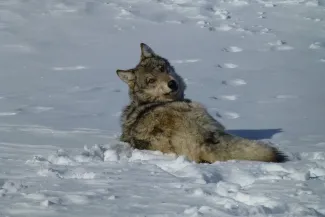
USFWS - public domain
There are three tracking-collar-equipped wolves in the Mollie’s Pack, animals that keep wildlife managers apprised of their daily movements. They’ve only returned to the park “a handful of occasions” since last fall, Stahler said.
Around the time the Mollies headed for Sunlight Basin, about an hour’s drive northwest of Cody, seven adults ran in the family group, according to the Wyoming Game and Fish Department’s annual wolf report. Although the Greater Yellowstone Ecosystem’s wolf population slumped significantly this year due to a distemper outbreak, the Mollie’s Pack only lost one member from natural causes in 2025.
Another member, a 6-year-old male known as Wolf 1339M, peeled off the pack and has mostly been traveling solo after “seemingly” losing his alpha male status, Stahler said.
And another member died accidentally during Game and Fish’s routine capture operations last winter, Mills said. That wolf had “pre-existing injuries” — bruising and hemorrhaging from its head to its hip — and did not survive being tranquilized.
“It’s one of those things that happens,” Mills said. “About one in 100 wolves that we catch from the air die.”
Currently, the Mollie’s Pack includes five adults and five pups, Stahler said. One of its remaining members, Wolf 1090F, is a 12-year-old female and among the oldest wolves on record for both Yellowstone and Wyoming.
The location of the Mollie’s Pack den site, where they’re raising the five pups, isn’t great, Mills said.
“There’s going to be a lot of cattle going into where they’re denned,” he said.
Using a method that’s as simple as walking near a wolf den — a technique Mills has studied — state wildlife officials attempted to get the pack to relocate their den to a safer site. The adult wolves naturally move their puppies after being disturbed, and the idea was to get them away from tempting domestic cattle, which can doom depredating wolves that can’t shake the habit.
“We tried to be proactive,” Mills said. “They’ve moved, but not as far as we would prefer.”
If the Mollie’s Pack does stay out of trouble during the summer grazing season, they’ll face another threat to their persistence come fall.
Where Wyoming manages wolves as trophy game, hunting is tightly restricted. And the seasons are especially conservative this year: The state agency proposed a 50% reduction in hunt limits following a canine distemper outbreak that dropped the state’s population to the lowest level in two decades.
The coming hunt
Even so, Wyoming plans to allow the killing of up to four wolves between September 15 and December 31 in hunt area 1, where the Mollie’s Pack has been dwelling. On Tuesday, the Wyoming Game and Fish Commission approved those regulations, although not before hearing from folks concerned about what the fall hunt means for the Mollie’s Pack.
“They are one of the most studied, scientifically important wolf families in the world,” Marc Cooke told commissioners. “Once they are gone, decades of irreplaceable knowledge are gone with them.”
Cooke, who’s the vice president of Wolves of the Rockies, the day before had emailed Game and Fish commissioners a letter asking them to temporarily close hunt area 1.
“Wyoming has been getting pretty beat up lately with some wildlife issues, and I think there’s an opportunity here for you folks to do the right thing,” Cooke said.
Cooke’s request didn’t stand alone. Representative Liz Storer, a Jackson Democrat, emailed commissioners asking for a one‑season closure in response to an “exceptional biological and public‑interest circumstance.” And Jackson Hole resident Lisa Robertson, who founded Wyoming Untrapped, urged commissioners to do the same in both emails and in public comment on Tuesday before the seven-person board approved the wolf hunting regulations.
“The commission’s decision in this matter extends beyond a single hunting season,” Robertson testified. “It presents an opportunity to demonstrate that Wyoming’s wolf management framework can recognize exceptional circumstances and respond with targeted science-based management action.”
(Editor’s note: Representative Liz Storer also serves as president and CEO of the George B. Storer Foundation, which is a financial supporter of WyoFile. The foundation has no role in WyoFile’s editorial content.)
Game and Fish Commissioner John Masterson engaged Mills after the requests. Could the state agency “logistically, mechanically” protect an individual wolf pack like the Mollie’s, he inquired. And from a “purely scientific management standpoint,” he asked, “is there anything substantially unique about that pack?”
Game and Fish’s wolf biologist responded: “When we look at packs across the landscape, a breeding pair is a breeding pair. A pack is a pack,” Mills said. “That’s how we implement our management plan: based on the broader population assessment.”
Mills told WyoFile in an interview that Game and Fish has taken the same approach when other Yellowstone wolf packs have moved out of the park in the past, not treating them differently than others.
The last two hunting seasons, seven wolves were hunted from the Willow Creek Pack, a former park pack last assessed with six remaining members. And two wolves remain in Shrimp Lake Pack after one of its wolves was killed by a hunter and three more died due to conflict-related issues, Mills said.
Only time will tell if the Mollie’s Pack also loses some of its members when hunting begins this fall. At least as of Monday, the pack was in a place where hunters wouldn’t have the chance.
“Ironically, just yesterday one of my staff members did a monitoring flight, and they were in Pelican Valley,” Stahler said Tuesday morning. “I’m looking at some data, and it does look like they were still in Pelican Valley, as of about 12 hours ago.”
They were over 30 miles from the den site, he said. Although Yellowstone-area packs have been observed moving pups long distances, the pilot did not spot any pups in tow during the overflight.
“I don’t have any reason to think that their visit to Pelican Valley means they abandoned the den or lost pups,” he said. “Wolves can cruise that distance in a day and a half or less.”
Should the wolves remain long term in Wyoming’s hunt area 1, Stahler doesn’t anticipate Yellowstone seeking any special relief for the Mollie’s Pack. Park leadership has taken that step before, when Montana hunting seasons took an especially heavy toll on park packs.
“Packs adjust their range in response to prey availability,” Stahler said. “This is evidence of a wolf pack behaving naturally.”
Stahler remarked that he’d “hate to see” an old alpha female, like Wolf 1090F, lose her life to hunting.
“But you know,” he added, “that’s part of the world of a wolf now, when they leave the protection of a national park.”