EarthTalk – Can we safely drink treated rainwater now?

©
Roddy Scheer & Doug Moss
Dear EarthTalk:
Is it true we can't drink rainwater anywhere on earth now due to pollution? Are there ways to treat it at home so we can drink it safely?
Fatima U., via e-mail
In its purest form, rainwater is considered a natural and safe source of water. However, it can become contaminated by environmental pollutants and chemical toxins as it falls through the atmosphere, rendering it “non-potable” (unsuitable for human consumption) rather than “potable” (safe for drinking and food preparation). In 2022, a study by Stockholm University and ETH Zurich scientists found that all rainwater on Earth is unsafe to drink because of poly- and perfluoroalkyl substances (PFAS), also known as “forever chemicals.”
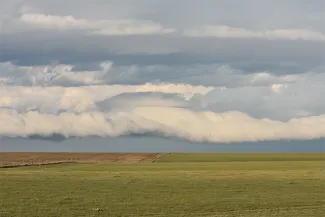
Storm clouds over Cheyenne County, Colorado. © Chris Sorensen / KiowaCountyPress.net
Due to their carbon-fluoride bonds, PFAS do not break down easily in the environment. They are found in consumer goods like food packaging and non-stick cookware and have contaminated global rainwater systems by entering the atmosphere via sea spray aerosols. Wind and atmospheric currents carry pollution across continents, resulting in PFAS being detected in regions as remote as Antarctica. Research into the health effects of this pollution is still emerging: some studies have found no proven cause and effect between these chemicals and poor health, while others have linked PFAS to increased risks of cancer, developmental delays in children, and fertility problems. Graham Peaslee, a nuclear physicist at the University of Notre Dame who specializes in the study of PFAS, states, “It’s not an acute toxin. It’s chronic, so it affects you by long-term exposure.”
One common household method of treating rainwater is boiling. However, this is an emergency response rather than a sustainable system, as it kills bacteria and parasites but does not remove chemicals or heavy metals. To treat rainwater for general pollutants such as microorganisms, one recommended method is ultraviolet (UV) light radiation. Using a UV light bulb, this system inactivates pathogens by exposing them to high-intensity light waves. Another strategy is chemical treatment, which utilizes bleach or liquid sodium hypochlorite.
To cleanse rainwater of PFAS, households can implement reverse osmosis filtration, which uses pressure to force water through a semipermeable membrane and filter out contaminants. It includes multiple stages of filtration: a sediment filter and carbon filters. Available as countertop or under-sink models, most systems come with a dedicated faucet. Research by NC State and Duke University researchers has found that under-sink reverse osmosis and two-stage filters removed PFAS to the reporting limit of analytical methods.
CONTACTS
- Preparing Rainwater for Potable Use, nwaltoolkit.com/wp-content/uploads/2021/06/az1863-2021.pdf.
EarthTalk® is produced by Roddy Scheer & Doug Moss for the 501(c)3 nonprofit EarthTalk. See more at https://emagazine.com. To donate, visit https://earthtalk.org. Send questions to: question@earthtalk.org.