EarthTalk – What is a Miyawaki forest?

©
Roddy Scheer & Doug Moss
Dear EarthTalk:
What is a Miyawaki forest?
Paul Perl, Cheyenne, WY
A Miyawaki forest is a tiny, densely planted forest designed to establish itself much faster than a conventionally planted one. The technique was pioneered in the 1970s by Japanese botanist Akira Miyawaki, who sought to recreate a site’s “potential natural vegetation”—the plant community that would naturally occupy an area with minimal human disturbance.
Instead of planting a few evenly spaced trees, practitioners prepare the soil and pack many locally native trees and shrubs close together, representing different layers of a mature forest. Competition for sunlight encourages rapid growth, while mulch, watering and weeding help seedlings through their first few years. The method is chiefly attractive in cities because forests can be squeezed into small, degraded parcels.
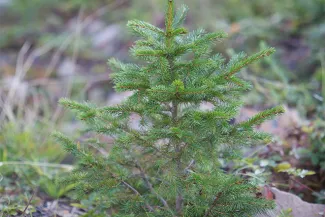
Red spruce tree.
The concept has already taken root across the U.S. Cambridge, Massachusetts, planted a 4,000-square-foot Miyawaki forest at Danehy Park in 2021, containing some 1,400 trees representing 32 native species. Western Washington University in Bellingham, Washington, is using the method to transform land dominated by non-native plants into forest characteristic of the region’s Coastal Western Hemlock zone.
But can you plant one anywhere in America? Not exactly. The underlying idea is to reconstruct native forest vegetation, so species selection must reflect local soils, rainfall and ecology. Miyawaki planting makes the most ecological sense on degraded land in regions that naturally support forests. Converting native prairie, shrubland or desert into dense woodland could instead destroy valuable existing habitat.
There’s another caveat: Some spectacular claims surrounding Miyawaki forests have outrun the science. A 2026 Journal of Applied Ecology review examined 51 publications and found only 21 containing quantitative assessments; just seven included a control and three included replications. Overall, the researchers found weak or no evidence supporting many claims about accelerated growth, biodiversity, carbon sequestration and cost efficiency. “We are not against the Miyawaki method,” study co-author and ecologist Ignacio Fernández told environmental news outlet Mongabay. “But we are worried that a method that was designed for specific conditions is being applied everywhere.”
Miyawaki forests are better viewed not as a universal reforestation hack but as one tool in the restoration toolbox. In the right setting, with carefully selected native species, they can create valuable pockets of greenery and habitat. But the fundamental rule remains: Restore the ecosystem that actually belongs there.
CONTACTS
- Journal of Applied Ecology, “Tiny forests, huge claims”, besjournals.onlinelibrary.wiley.com/doi/10.1111/1365-2664.70242.
EarthTalk® is produced by Roddy Scheer & Doug Moss for the 501(c)3 nonprofit EarthTalk. See more at https://emagazine.com. To donate, visit https://earthtalk.org. Send questions to: question@earthtalk.org.