Feds demand compromise on Colorado River while states flounder despite water shortage

Western states that rely on the Colorado River have less than two months to agree on how to manage the troubled river – and pressure is mounting as the federal government pushes for a compromise and a troubling forecast for the river’s two biggest reservoirs looms.
Top water officials for the seven Colorado River Basin states — Arizona, California, Nevada, Colorado, New Mexico, Utah, and Wyoming — gathered for the three-day Colorado River Water Users Association conference at Caesars Palace in Las Vegas last week.
Colorado River states have until Feb. 14 to reach a new water sharing agreement before current operating rules expire at the end of 2026 —or the federal government will step in with their own plan.
Despite the fast-approaching deadline, states reiterated many of the same issues they did during previous years at the conference, namely, which water users will need to sacrifice more water to keep the Colorado River stable as overallocation, climate change, and rising demand sucks the river dry.
Nevada’s chief river negotiator and general manager of the Southern Nevada Water Authority John Entsminger offered a succinct but sharp assessment of the negotiations during a panel discussion Thursday.
“If you distill down what my six partners just said, I believe there’s three common things: Here’s all the great things my state has done. Here’s how hard/impossible it is to do any more. And here are all the reasons why other people should have to do more,” Entsminger said.
“As long as we keep polishing those arguments and repeating them to each other, we are going nowhere,” he continued.
The seven states that share the river’s flows have been deadlocked for nearly two years over how to govern the waterway through the coming decades — even as water levels at Lake Mead and Lake Powell are forecasted to reach record lows after two straight years of disappointing snowpack across the West.
The Colorado River’s headwaters saw a weak snowpack last winter, contributing to one of the worst spring runoff seasons on record. Water flow into the river this year was only 56 percent of average, leading to significant reductions in Lake Powell, according to the Interior Department’s Bureau of Reclamation.
Federal officials also released a troubling forecast of expected flows for the river in 2026, which were significantly lower than previous predictions. Projections from the Bureau of Reclamation found the Colorado River’s inflow next year would likely be 27 percent lower than normal, with worst-case scenarios predicting even lower flows.
Without a strong winter snow season, it’s possible Lake Powell’s levels could drop low enough to cease hydropower production by next October — a scenario that would also limit the department’s ability to send water downstream to Arizona, California and Nevada.
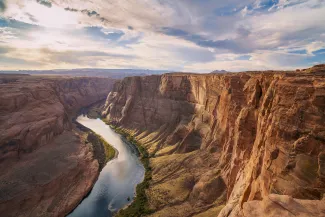
© mheim3011 - iStock-544332118
The federal government has refrained from imposing its own plan for the river, preferring the seven basin states reach consensus themselves. But the Interior Department has ramped up pressure on states to reach a deal.
The Bureau of Reclamation’s Acting Commissioner Scott Cameron said he and other federal officials have intensified efforts to bring states to a consensus, flying out West every other week since early April to meet with the seven states’ river negotiators.
“The expiration of the current agreements is not a distant horizon. It’s less than a year away. The time to act is now,” said Cameron.
Within the next few weeks, the Bureau of Reclamation will release a range of proposals to replace the river’s current operating rules, but said they would not identify which set of operating guidelines the federal government would prefer
During the conference, negotiators for the seven states repeated that they are still committed to finding a consensus despite missing previous deadlines. California’s biggest water districts said they were willing to “set aside many of their legal positions” in order to reach a seven-state agreement.
However, a long-term multidecade strategy for managing low river flows is likely out of reach.
“I went into this process…advocating strenuously for a 20- to 30-year deal,” said Entsminger. “I no longer believe that’s possible with the time we have left and with the hydrology that we’re facing.”
Entsminger said the “best possible outcome at this juncture” is a short-term five-year deal that sets new rules around water releases and storage at Lakes Powell and Mead.
During a panel of state negotiators, states highlighted water conservation efforts they have undertaken to reduce water use and protect the river, but all explained why their state can’t take on more cuts.
“Our savings accounts are totally depleted,” said Utah’s river negotiator, Gene Shawcroft. “Reservoirs were full when we started this process. They’re empty now.”
One of the biggest disagreements between the Upper and Lower Basin states is over which faction should have to cut back on their water use during dry years.
The Lower Basin – Nevada, Arizona, and California – have agreed to take the first 1.5 million acre-feet in water cuts needed to address deficits and evaporation that are reducing flows in the river, but say any additional cuts during dry years must be shared with upstream states. Under the current agreement, Lower Basin states must take mandetory cuts when water levels in Lakes Powell and Mead are low.
The Upper Basin, which is not subject to mandatory cuts under the current guidelines, say they already use much less water than downstream states and should not face additional cuts during shortages.
Any more cuts to water users in downstream states during dry years will be politically perilous, explained Arizona’s top negotiator, Tom Buschatzke. Arizona requires the state legislature to approve any changes to Colorado River management rules impacting the state.
Buschatzke called for the Upper Basin – Colorado, Wyoming, New Mexico, and Utah – to split any additional water cuts with the Lower Basin states 50-50.
“We need conservation in the Upper Basin that is verifiable and mandatory,” Buschatzke said, during the panel.
“I have to go to my legislature and get that approval,” he continued. “And I will say right now, I do not think there is anything on the table from the Upper Basin that would compel me to do that today.”
New Mexico’s river negotiator, Estevan López, responded, “I think we’ve been pretty clear. We are unwilling to require additional mandatory reductions on our water users.”