The Impact of Frame Spacing in Honey Production

©
How do you arrange frames in your beehives? Do you space them out evenly? Place them all together in the center?
While there's no singular "correct" way to position frames in your hives, your arrangement can impact how much, and how fast, your bees produce honey. Which means some methods work better than others for those who want to maximize the quality and quantity of each extraction. How does frame spacing affect honey production, exactly, and what should do to get the most golden reward? Let's explore.
Dense Clusters Warm Wax Faster
A box with fewer frames concentrates the population on the available surface area. Wax production requires heat, and a dense cluster of bees generates that warmth naturally. When the workers crowd together on nine frames instead of spreading out over ten, they warm the wax scales more effectively.
Malleable wax allows for rapid comb construction. This focused effort leads to faster draw-out rates. The colony builds the storage infrastructure quickly and starts filling it with nectar as soon as it’s done. Spreading them too thin slows down the entire operation and delays your honey flow.
Deeper Cells Increase Nectar Storage
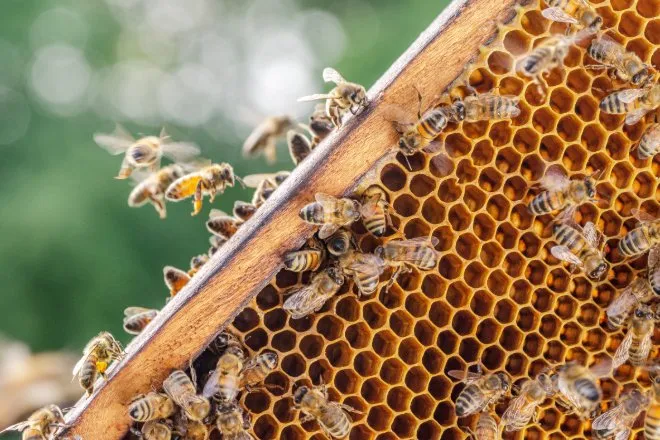
Bees instinctively maintain a specific gap between comb faces to allow workers to pass back and forth. Beekeepers call this "bee space." When you space frames further apart in a honey super—say, using nine frames in a ten-frame box—the bees extend the cell walls outward to close that gap.
This results in "fat" combs that look like bloated pillows. These deepened cells hold considerably more nectar than standard cells. A thicker comb maximizes the volume of honey stored on each individual frame, so you get a heavy-weight haul without adding more boxes to your stack.
Protruding Cappings Speed Up Extraction
Uncapping beehive frames is the most labor-intensive part of the harvest. Those thicker combs mentioned earlier provide a massive advantage here. Because the wax protrudes well past the wooden edges of the frame, your knife slices through the cappings cleanly and easily in one pass.
Standard spacing often leaves cappings flush with the wood, which forces you to use a scratcher tool. Scratching open individual cells takes time and creates a sticky mess. Extended cappings allow for a single, smooth cut that exposes the honey instantly. You save minutes per frame, which adds up to hours during a large extraction day.
Wider Channels Improve Hive Ventilation
To turn nectar into honey, bees need to evaporate the moisture in it. They do this by fanning their wings, which creates airflow to drive off the excess liquid.
But in the heat of summer, a super packed densely with ten frames can suffer from poor circulation. Spacing the frames slightly wider creates larger channels for air to move through the box. These expanded airways allow humidity to escape the hive more rapidly. Drier air helps the bees cure the honey faster. You get a finished, capped product sooner because the ventilation system works in your favor.
Finding the Right Fit for Your Frames
The spacing of frames in your hives can have effects, both negative and positive, on your bee's honey production. If you want the healthiest, heartiest, and heftiest harvest every time, use the information above to optimize your frame spacing for the best possible honey yield.