
Lake Powell is up 14 feet from its record low, and it is still climbing

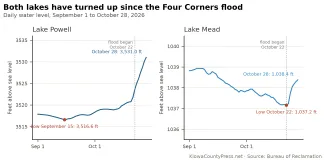
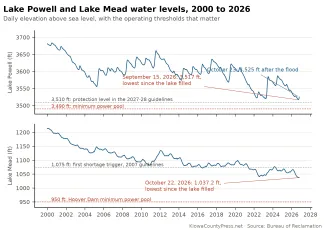
Four days after the Press reported that Lake Powell had risen five feet in a week, the lake has added six more. Reclamation's daily record put it at 3,531.0 feet on Wednesday, October 28, 14.4 feet above the low it set September 15, which was its lowest since the reservoir first filled in the 1960s. The lake has gained 55,000 to 85,000 acre-feet every day since the Four Corners flood began October 22, with no sign yet of tapering, and holds 5.9 million acre-feet, 25 percent of capacity.
Reclamation's weekly update for October 25 recorded a rise of 6.96 feet in seven days. The agency's October study, written two weeks ago, had the lake at 3,518.3 feet at the end of December. It is already 13 feet above that.
©
Lake Mead has turned too, for a different reason. The lake set its record low of 1,037.16 feet on October 22 and stood at 1,038.38 on October 28, up more than a foot. Glen Canyon Dam has held a steady release of about 6,600 cubic feet per second all month, but Hoover Dam has released only 5,300 to 6,300 since October 23, down from 8,000 to 10,000 earlier in the month, so for the first time this fall more water is entering Mead than leaving it. The agency's daily report does not say why the Hoover release was cut.
Upstream, Navajo Reservoir on the San Juan has gained 330,000 acre-feet since September 1 and is 67 percent full, with the dam still releasing only about 300 cubic feet per second. Vallecito is 88 percent full and McPhee 53. Blue Mesa gained 6,600 acre-feet this week, its first rise since summer, though it remains at 18 percent. Flaming Gorge keeps falling under the drought releases that prop up Powell, and Green Mountain, Granby and Dillon are flat. Reclamation puts the Upper Basin's precipitation since October 1 at 236 percent of normal and the Lower Basin's at 465 percent.
©
More is coming. The National Weather Service expects an atmospheric river to put 1 to 2 inches of rain on southwest Colorado and southeast Utah Sunday and Monday, nearly all of it in country that drains to Lake Powell, before a cold front turns it to snow on the passes. Those gains should continue into next week.
The numbers that matter for the river's operations will not move until Reclamation's November 24-Month Study, due about November 13. It will be the first to count the flood, and the first that could change Lake Powell's release range for the water year, which the October study set at 6.0 to 7.0 million acre-feet under the new guidelines' infrastructure protection rules. The Press will have a fuller report after that study is released.