New Mexico begins building back its burned forests

Since 2000, more than 7 million acres of forests and wildlands have burned in New Mexico, underscoring the need for a new center designed to grow tree seedlings for reforestation.
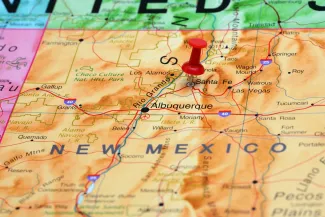
The New Mexico Reforestation Center is expected to improve revegetation efforts by expanding seed collection, storage capacity, nursery production and planting. The center will be built in Mora County, northeast of Santa Fe, as a four-phase, multimillion-dollar facility.
Jenn Auchter, director of the center, said Colorado and Idaho have provided some additional seedlings but New Mexico needs its own facilities to keep up with demand. The state’s current capacity is about 300,000 seedlings a year, while the need for manual reforestation is estimated at 390 million trees.
Auchter noted she has kept an ancient Chinese proverb in mind while planning the center.
“The best time to plant a tree was 20 years ago. The second-best time is now,” Auchter emphasized.
The state’s most recent forest fire has burned at least 9,000 acres after being sparked by a fatal plane crash near Ruidoso. New Mexico’s largest wildfire, the Hermits Peak-Calf Canyon Fire in 2022, burned more than 340,000 acres and will require about 18 million seedlings.
The center is a collaboration among New Mexico State University, New Mexico Highlands University, the University of New Mexico and the Forestry Division of the state Energy, Minerals and Natural Resources Department.
At a groundbreaking ceremony last week, Auchter pointed out if trees are not replanted after fires, grasses and lowland desert shrubs can take over, creating long-term challenges for forest recovery.
“That vegetation is nice but it doesn’t hold the snowpack in the same way that the big trees do,” Auchter explained. “Once those establish, it’s very difficult for the important trees to establish themselves because they’re being outcompeted.”
Auchter is working to engage students in forestry. One project has children plant a seedling in kindergarten and monitor its growth through 12th grade.
She hopes by graduation, students will be proud to know they helped protect New Mexico for future generations by planting trees which will eventually become forests and act as natural water managers by intercepting and storing snow and rainfall.