New nuclear power may come to Nebraska with promise and problems

© Vital Hil - iStock-1461437060
This story is made possible through a partnership between Flatwater Free Press and Grist, a nonprofit environmental media organization.
Applause echoed through the Gage County courthouse. The county board had just approved new, more stringent wind energy regulations, and residents in the overflow crowd couldn’t contain themselves.
Few in the crowded courthouse in September 2020 beamed brighter than Larry Allder. The Cortland-area resident helped lead the yearslong charge against wind energy’s looming expansion into the county.
“It’s been a long road,” he told The Voice News of Southeast Nebraska after the vote.
But six years later, another historically controversial energy source — nuclear power — could be coming to Gage County. This time, Allder has no plans to mount opposition.
“I think that’s a great idea. I like nuclear energy,” Allder said. “I think it’s the way of the future.”
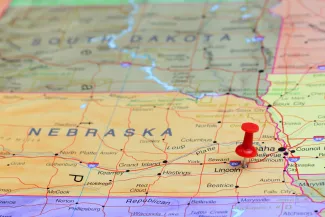
Last week, the Nebraska Public Power District included a Gage County city on a list of four sites for a potential new nuclear power plant. NPPD and several other utilities have been studying the possibility of bringing new nuclear power to Nebraska.
Local support is key in deciding where a new plant could go, according to NPPD leadership. Despite a legacy that often invoked fear, there are signs nuclear might not face the backlash that other energy sources, especially renewables, have generated in recent years.
The Flatwater Free Press spoke with leaders in the four communities identified by NPPD: Beatrice, Sutherland, Norfolk and Brownville. Most said their communities are open to a new nuclear project.
“What I find pleasing and reinforcing is that there is a lot of support out there,” NPPD CEO Tom Kent told Flatwater. “Those communities are really interested in hosting and being a location for this kind of development, and Nebraska has always been a state that’s been very supportive of nuclear power.”

© iStock
Nationally, lawmakers on both sides have begun embracing nuclear power, as have everyday people like Allder. It also is being eyed by utilities, lured — amid growing demand for electricity — by its ability to generate large amounts of power without spewing climate-warming greenhouse gases.
Industry advancements offer another selling point. The next generation of nuclear power plants aims to solve problems the industry has historically grappled with, including high cost, long build times and safety concerns.
That’s what NPPD is considering. The utility was recently awarded over $27 million in cost-shared funding by the U.S. Department of Energy to apply for a federal permit needed to site a new nuclear plant.
But it remains to be seen whether this next generation of nuclear reactors can deliver what proponents promise. The new reactors are still being designed and tested — only one has been commercially connected to the U.S. grid.
If they don’t fulfill these promises, it could pose financial risk for utilities and their customers, especially those pioneering the technology, according to industry experts.
Kent said NPPD isn’t looking to be among the first. The recent steps are just initial ones.
And while the discussion has been framed around smaller reactors, Kent told Flatwater that the Nebraska utilities could look at a larger nuclear reactor — a move that could cost it public support. Kent repeated the community would need to support such a move.
“If that community is a good location for (a smaller facility), which would like be multiple units, it’s going to be a good location for a large scale … (reactor) as well.”
‘We’re supportive’
The latest nuclear innovation wave has generated a massive amount of support from private tech companies and investors who are betting on nuclear as a solution for data centers. Across the country, demand for power is skyrocketing. NPPD anticipates its power demand could increase anywhere from 600 to 3,000 megawatts “over the next several years,” Kent said. For context, the city of Lincoln and surrounding area uses 800 megawatts of power at its peak in the summer.
While projects involving new nuclear designs have started in Tennessee, Wyoming and Washington, Nebraska is probably a decade away from seeing a new nuclear plant, which is why it’s important to start research now, Kent said.
“When nuclear takes off, it’s going to take off quick. So we want to be ready to be in that first set of fast follower orders, right? Or we’ll miss the middle of the next decade,” Kent said.
© zhaojiankang - iStock-802436842
In December, NPPD formed a new nuclear technology consortium with the Omaha Public Power District, Lincoln Electric System and the Grand River Dam Authority. The group is looking at potentially bringing about 1,000 to 2,000 megawatts of new nuclear power to Nebraska, where only one plant exists today. The consortium is intended to reduce the costs of exploring new nuclear technology.
NPPD previously identified 16 communities across the state as potential sites. It hosted meetings in each to gather feedback. It then narrowed the list to four earlier this month.
“I think the general consensus is still that we’re supportive of nuclear energy,” Madison County Commissioner Troy Uhlir said. “There’s definitely more people speaking up and saying, ‘No, not here,’ (but) it’s not overwhelming.”
In Sutherland, a few residents have voiced questions on safety, said Scott Meyer, chairman of the village board. Both Uhlir and Meyer said the few concerns could be calmed by education.
According to the Nuclear Energy Institute, nuclear power plants in the United States are some of the safest industrial facilities in the world. Brownville village board member Paul Fish has firsthand knowledge after living near NPPD’s Cooper Nuclear Station.
“We’ve had, what, 25 years of nuclear power down the road from us, a mile, and have had absolutely no negative problems whatsoever as far as I know,” Fish said. “They put all kinds of notices out, mailers, calendars, all kinds of information, so that we’re on top of what’s going on every step of the way.”
The industry is still developing new safety features in new designs like the ones being studied by NPPD, known as small modular reactors, a type of advanced reactor often referred to as SMRs.
Supporters say advanced reactor plants like SMRs could solve problems that have long beset the nuclear industry: the plants taking a lot of time and money to build. They are also expected to be flexible, generating more or less power as needed, which can work well with renewables, said Joseph Giitter, a former senior executive at the Nuclear Regulatory Commission.
Beatrice Mayor Bob Morgan said the community is excited to be in the top four site options.
Designs Kent says NPPD is eyeing
- Bill Gates-founded company TerraPowers’ Natrium Reactor — This 345 megawatt reactor is being tested in Wyoming.
- General Electric Veranova Hitachi’s BWRX-300 SMR — This reactor could be first installed in the U.S. by the Tennessee Valley Authority
- Westinghouse’s AP1000 reactor — This modular but large-scale design was installed in Georgia at Plant Vogtle. The two reactors each produce about 1,100 megawatts.
However, support could hinge on the type of reactor the utilities choose to build and local impacts on water supplies. Kent said new reactor designs can limit the impact on water.
The next steps: identifying a suitable site, applying for an early site permit from the Nuclear Regulatory Commission and picking a reactor design. The $27 million from the federal government will cover less than half of the application costs, Kent said. The NRC has an 18-month goal for technical reviews of all new reactor-related licensing applications.
“We need something that we can understand the risk for construction, risk for cost, the operating risk, and does it fit our (energy) resource mix well? … And that’ll drive what we select,” Kent said.
Giitter said it makes sense that NPPD is taking a cautious approach, because it can be a significant risk to deploy a design that hasn’t been really tested.
“The promise of the technology is there, but it hasn’t been proven yet,” Giitter said.
The gamble
If Nebraska does move forward with a new nuclear plant, it has a cautionary tale in Georgia.
Georgia’s two new nuclear reactors started producing power in 2023 and 2024, 15 years after the utility applied for a license, according to the Associated Press. These reactors are more advanced than most operating in the U.S., but they are not small like an SMR. The project wrapped up years behind schedule and was over budget, totaling over $30 billion and led to rate hikes for power customers, which fueled public backlash.
The utility’s CEO noted it faced unique obstacles, including a nearly nonexistent workforce and supply chain, complications posed by the Fukushima nuclear accident in Japan in 2011 and the COVID-19 pandemic in 2020, and the design contractor went bankrupt during the project.
However, nuclear projects have historically seen significant delays and gone way over budget, said Edward Kee, CEO of Nuclear Economics Consulting Group. Large or small, these projects in the U.S. can be a gamble for utilities and their ratepayers.
Sometimes, that gamble pays off, as happened in South Texas where, 20 years later, customers are experiencing lower power rates, Kee said. In other cases, the projects never made it to completion.
Since 2010, there have been at least 11 canceled commercial nuclear power reactor plans, according to the NRC.
How much Nebraska’s 1970s nuclear plants cost to construct
- NPPD’s Cooper Nuclear Station, which opened in 1974, cost about $313 million to build. Adjusted for inflation, that price tag today translates to roughly $2.1 billion.
- OPPD’s now-retired Fort Calhoun Nuclear Station, which started operating in 1973, cost about $165 million to build. That’s roughly $1.2 billion today.
While new advanced reactors could potentially minimize issues seen in Georgia, they, too, carry financial risk because they haven’t been tested, Giitter said.
NPPD and its partners are keeping their options open. They could go with a small modular reactor or a newer large-scale reactor like the ones built in Georgia.
Giitter was dubious of a Georgia-style reactor in Nebraska, saying that type of reactor wouldn’t work well with the modern grid and would be a bigger financial risk.
Picking the right design company will be critical.
“The enthusiasm in the market for those (design) companies and the stock market, and the venture capital world is interesting, but there are going to be some disappointments there, because a lot of these companies won’t exist in 10 years, much less have an operating power plant,” Kee said.
As part of the new nuclear consortium, NPPD said in an email that “any substantial investment would require each utility’s board approval.” Kent said the consortium will look at how to finance these projects. Municipal bonds and public-private partnerships with data center companies are potential options, he said.
“Those are all ways that you can de-risk things and accomplish more and spread risk more effectively across all the users.”
The Flatwater Free Press is Nebraska’s first independent, nonprofit newsroom focused on investigations and feature stories that matter.