Rain eases drought on eastern plains as exceptional conditions tighten across the mountains

© KiowaCountyPress.net
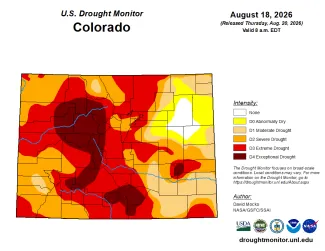
A week of welcome rainfall across eastern Colorado trimmed the worst drought from parts of the plains, while exceptional drought held its grip on the central mountains and western valleys, according to the U.S. Drought Monitor released Thursday by the National Drought Mitigation Center. The map reflects conditions as of 8 a.m. EDT Tuesday, August 18.
Statewide, severe drought or worse covered 77 percent of Colorado, down from 80 percent a week earlier. Exceptional drought - the most intense category - eased slightly to 13.68 percent from 14.10 percent, and the share of the state free of drought or dryness climbed to 2.80 percent from less than 1 percent.
©
Colorado drought conditions as of August 18, 2026. (National Drought Mitigation Center)
Snowpack
Colorado's high-country snowpack completed its seasonal melt-out weeks ago, as is typical for late August, leaving reservoir storage and summer monsoon rainfall to carry the state through the balance of the 2026 water year, which closes September 30.
The water year that is now winding down began in far better shape than it will end. When it opened September 30, 2025, nearly 46 percent of Colorado was free of drought and no part of the state was in exceptional drought, according to the U.S. Drought Monitor. Extreme drought covered about 14 percent of the state. Today, exceptional drought alone covers nearly 14 percent, and extreme drought has expanded to roughly 36 percent - a reversal driven largely by a poor mountain snow season and a hot, dry spring across the Western Slope.
The 2027 water year begins October 1, and the coming winter's snow accumulation will determine how much relief the high country's long-term drought receives. The Climate Prediction Center's six- to 10-day outlook favors well-above-normal temperatures across most of the continental United States through August 29, offering no near-term help to mountain soil moisture heading into the snow season.
Drought Conditions
Exceptional drought - the U.S. Drought Monitor's most severe designation - now blankets all of Eagle County, Pitkin County and Lake County, each showing 100 percent D4 coverage. Summit County was close behind at 88 percent exceptional drought with the remaining 12 percent in extreme drought, while Chaffee County stood at 78 percent exceptional and 22 percent extreme.
Elsewhere along the Continental Divide and on the Western Slope, Grand County reported 54 percent exceptional drought, 41 percent extreme and 6 percent severe. Garfield County was split nearly evenly between exceptional at 48 percent and extreme at 49 percent. Routt County showed 33 percent exceptional and 60 percent extreme, while Gunnison County registered 22 percent exceptional, 59 percent extreme and 20 percent severe. Park County carried 15 percent exceptional drought with 81 percent of the county in extreme drought, and Teller County showed 43 percent extreme and 57 percent severe drought.
Not all of western Colorado fared as poorly. Moffat County in the state's northwest corner reported just a trace of exceptional drought at 0.2 percent, with 20 percent of the county in extreme drought and the balance in severe drought. Jackson County showed 11 percent extreme drought, 66 percent severe and 23 percent moderate - the lightest footprint among the northern mountain counties.
On the eastern plains, rainfall of 1 to 3 inches over wide areas produced the week's clearest improvement, according to the National Drought Mitigation Center. Kiowa County saw extreme drought retreat sharply, falling to 37 percent of the county from 51 percent a week earlier, with severe drought expanding to 45 percent from 31 percent as conditions eased one category across a broad swath. Exceptional drought held steady at 17 percent in the county's southeast corner.
Cheyenne County trimmed extreme drought to 2 percent from 4 percent, with 51 percent of the county in severe drought and 45 percent in moderate drought. Prowers County remained the least-affected of the area counties, with 97 percent in moderate drought and just 3 percent in severe drought - no extreme or exceptional drought was present. Bent County was unchanged from the prior week at 3 percent exceptional, 7 percent extreme, 15 percent severe and 75 percent moderate drought.
Statistics
Compared to the previous week, drought-free area across Colorado grew to 3 percent from 1 percent, while abnormally dry conditions were unchanged at 6 percent. Moderate drought edged up to 14 percent from 13 percent and severe drought fell to 28 percent from 31 percent. Extreme drought was essentially flat at 36 percent compared to 35 percent, and exceptional drought held near 14 percent. The state's Drought Severity and Coverage Index eased to 328 from 336.
Conditions remain markedly worse than a year ago. On August 19, 2025, 30 percent of Colorado was free of drought and dryness, with 15 percent abnormally dry, 12 percent in moderate drought, 13 percent in severe drought, 22 percent in extreme drought and 7 percent in exceptional drought. Over the past 12 months, the drought-free share of the state has fallen 27 points while exceptional drought has roughly doubled.
| Week | Date | None | D0 | D1 | D2 | D3 | D4 |
|---|---|---|---|---|---|---|---|
| Current | 2026-08-18 | 3 | 6 | 14 | 28 | 36 | 14 |
| Last Week to Current | 2026-08-11 | 1 | 6 | 13 | 31 | 35 | 14 |
| 3 Months Ago to Current | 2026-05-19 | 0 | 4 | 17 | 36 | 33 | 10 |
| Start of Calendar Year to Current | 2025-12-30 | 29 | 33 | 22 | 13 | 2 | 1 |
| Start of Water Year to Current | 2025-09-30 | 46 | 9 | 9 | 22 | 14 | 0 |
| One Year Ago to Current | 2025-08-19 | 30 | 15 | 12 | 13 | 22 | 7 |
Just over 4,594,000 Colorado residents live in a drought-impacted area. Colorado's 2023 population was estimated at 5,877,610.
Drought categories include (ranked from least to most severe) abnormally dry (D0), moderate (D1), severe (D2), extreme (D3), and exceptional (D4) drought.